 Lynden Siding
 Siding Installation for Everson Homes
Everson sits in the lower Nooksack River valley, a few miles east of Lynden, in a part of Whatcom County where tree cover, river-bottom humidity, and a steady run of Pacific weather systems combine to put real stress on exterior siding. Homes here don't just get rained on — they sit damp for long stretches, and that dampness is what actually damages siding over time, not any single storm.
We're a Lynden-based crew, and Everson is inside our regular service area, not a special trip. That matters more than it sounds like it should, and we'll explain why later in this page. First, let's talk about what actually needs to happen for a siding installation to hold up on an Everson home.
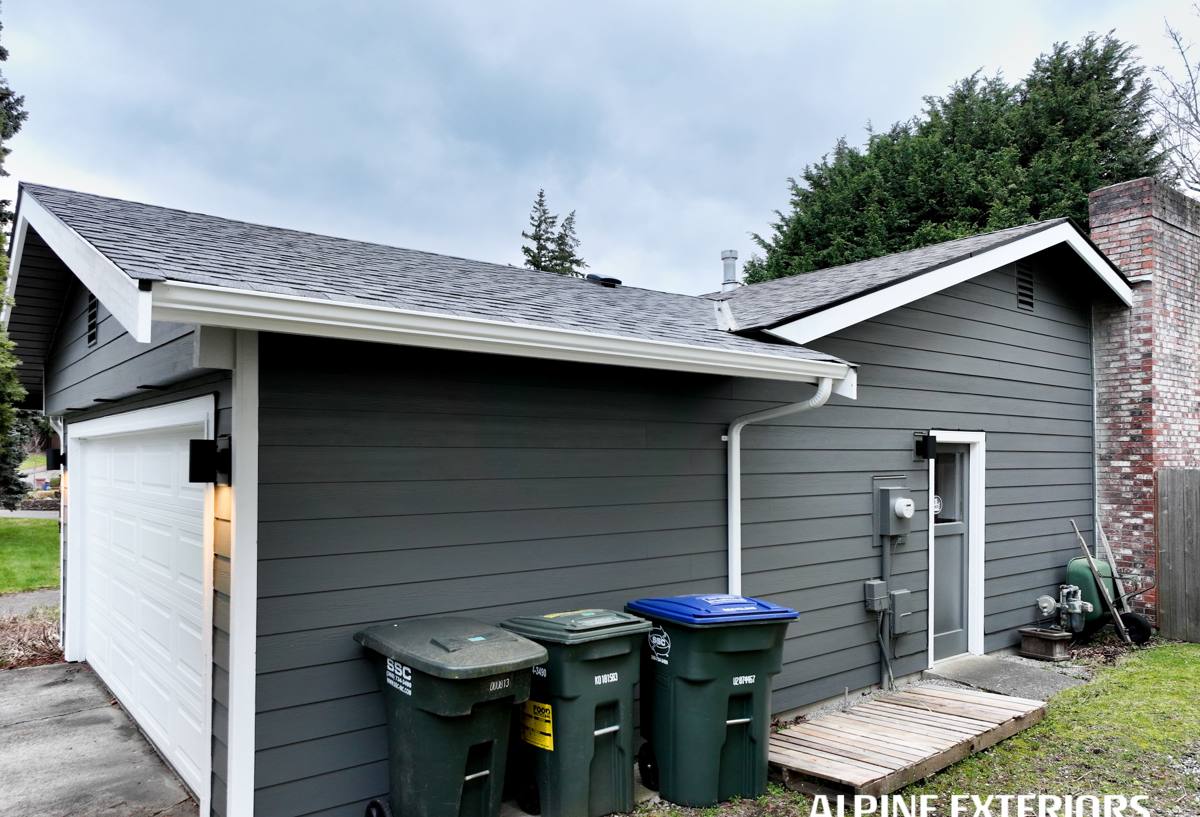
What This Climate Does to Siding
Three things drive most of the siding problems we see on homes in and around Everson:
- Driving rain — wind-driven rain off Pacific storm systems doesn't just wet a wall's surface, it pushes moisture behind poorly lapped siding and undersized flashing.
- Persistent humidity — the Nooksack valley holds moisture longer than more exposed, wind-swept sites. Walls stay damp longer between rain events, which matters for any material that swells, wicks, or feeds mold when wet.
- A long moss and algae season — shaded, tree-lined lots (common in and around Everson) keep north- and east-facing walls cool and moist for much of the year, which is exactly what moss and algae need to take hold.
None of that is unique to Everson — it's Whatcom County weather generally, plus the local effect of river-valley terrain and heavier tree canopy on many lots. The upshot is the same one we'd give any homeowner in this corner of the state: whatever goes on the wall has to handle sustained moisture exposure, not just occasional rain.
Why Salt Air Still Matters Inland
Even away from the immediate shoreline, marine air moving in off the Strait of Georgia and Puget Sound carries fine moisture and airborne salts across much of Whatcom County. It's a slower, lower-grade exposure than a beachfront home would see, but combined with the valley's humidity, it accelerates the same failure modes — swelling, delamination, coating breakdown — on materials that aren't built to handle it.
Why Material Choice Is the First Decision, Not the Last
A lot of siding problems get blamed on installation quality, and installation quality does matter — we'll get to that. But the material itself sets the ceiling on how well any installation performs over 20+ years in this climate. That's the reason we standardized on James Hardie fiber cement and stopped installing vinyl, LP SmartSide, cedar, or primed spruce, regardless of what a homeowner's budget or preference might otherwise lean toward.
This isn't a knock on those products in the abstract — each has legitimate uses and each has defenders. It's a statement about what we're willing to warranty our labor against, given what we see happen to siding in Whatcom County over time.
| Material | Behavior in Sustained Moisture | Moss/Algae Resistance | Typical Maintenance |
|---|---|---|---|
| Vinyl | Doesn't absorb water, but seams and J-channels can trap moisture behind the panel; warps/cracks in temperature swings | Grows on surface film in shaded, damp areas | Periodic cleaning; panels can't be spot-repainted |
| LP SmartSide (engineered wood) | Wood-based core is vulnerable at cut edges and fastener penetrations if caulking/paint isn't maintained | Moderate; surface treatment helps but edges are the weak point | Regular caulk and paint upkeep, especially at edges |
| Cedar / primed spruce | Natural wood swells, checks, and can rot if finish fails or ventilation is poor | Susceptible without diligent upkeep | Frequent refinishing; highest ongoing labor |
| James Hardie fiber cement | Non-combustible cement-based board; dimensionally stable, doesn't swell or rot from moisture | Factory ColorPlus finish resists moss/algae better than field-applied paint | Occasional rinse; no repainting needed for the life of the finish warranty |
What a Correct Installation Actually Involves
Siding is a system, not a product. On an Everson home, we treat every one of these steps as non-negotiable, because skipping any one of them is how a good material still ends up with a moisture problem five or ten years down the road:
- A continuous, properly lapped weather-resistive barrier (WRB) behind the siding — no gaps, no shortcuts at penetrations
- Correct flashing at every window, door, and roofline intersection, integrated with the WRB in the right shingle-lap order
- Proper fastening — right nail type, spacing, and depth per Hardie's installation specifications, not "close enough"
- Correct board gaps and clearances, including ground clearance and deck/patio clearance, so water has somewhere to go
- Factory-cut and factory-primed edges wherever possible, with any field cuts back-primed before installation
- Ventilation behind the cladding where the wall assembly calls for it, so trapped moisture has a way out
Any one of these done wrong can undermine an otherwise good product. This is where a lot of "the material failed" complaints actually trace back to installation, not the board itself.
Our Process on an Everson Job
1. Inspection and Moisture Check
Before we quote anything, we look at the existing wall assembly — not just the siding surface. On older homes especially, we're checking for hidden moisture damage at trim, windows, and the bottom courses, since that changes the scope of the job.
2. Tear-Off and Sheathing Assessment
Once the old siding is off, we inspect the sheathing and framing underneath. Any rot or soft spots get repaired before a single new board goes up — new siding over damaged sheathing just hides a problem instead of fixing it.
3. WRB, Flashing, and Trim
This is the step that determines whether the wall stays dry for the next few decades. We install the barrier and flashing to spec, then trim, before the field siding goes on.
4. Hardie Installation
Boards are installed to manufacturer fastening and clearance specs, with attention to lap direction relative to prevailing wind and rain in this part of the county.
5. Final Walkthrough
We walk the finished job with the homeowner, check caulking and touch-up at any field cuts, and go over basic care.
The James Hardie Lines We Install
James Hardie makes climate-engineered product lines, and for Whatcom County we default to HZ5, the version formulated for wetter, freeze-cycle climates like this one, rather than the HZ10 line built for hot, dry regions. The core product options homeowners typically choose between are:
- HardiePlank lap siding — the standard horizontal lap look, available in several profiles and factory ColorPlus finishes
- HardiePanel vertical siding — often used for accents, gables, or a board-and-batten look
- HardieTrim — matching trim boards for a consistent, factory-finished look at corners, windows, and fascia
ColorPlus factory finish matters more here than in drier climates — it's baked on under controlled conditions and holds up against the moss, algae, and fading pressure of a shaded, humid site far better than field-applied paint typically does.
Cost Factors for an Everson Siding Job
| Factor | Why It Affects Price |
|---|---|
| Home size and wall complexity | More square footage and more corners, gables, and cutouts mean more material and labor |
| Condition of existing sheathing | Rot or moisture damage found during tear-off adds repair scope before new siding can go on |
| Existing siding removal | Multiple layers or difficult-to-remove material (like old cedar) adds labor time |
| Trim and accent work | Vertical panel accents, extensive trim, or custom detailing add material and install time |
| Access and site conditions | Tree cover, tight lot lines, or difficult equipment access common on wooded Everson lots |
We don't publish flat prices because these variables genuinely change the number — but we'll give a straightforward, itemized quote after we've actually looked at the house.
Why a Local Lynden Crew Matters Here
We work Everson regularly as part of our normal Lynden-area route — it's not a special trip or an add-on territory. That means we already know the kind of moisture and moss issues that show up on shaded, river-valley lots in this part of Whatcom County, and we're not guessing at local permitting or working from a template built for a different climate. If something needs a callback or a follow-up during curing weather, we're not driving in from out of the area to handle it.
After Installation: What Homeowners Should Do
- Rinse siding annually, more often on shaded north- and east-facing walls prone to moss
- Keep gutters clear so overflow doesn't run down the wall face
- Trim back vegetation and tree limbs that keep siding shaded and damp longer than necessary
- Check caulking at trim joints and penetrations every year or two and touch up as needed
- Address any impact damage promptly — small chips are a quick fix; ignored ones can let moisture in
If you're weighing a siding replacement on an Everson home, we're happy to take a look and walk you through what we'd actually recommend for your specific walls and exposure — no pressure, no generic sales pitch. Use the form below to request a free estimate.