 Lynden Siding
 Nooksack's Climate Is Harder on Siding Than It Looks
Nooksack sits in the Nooksack River valley just east of Lynden, close enough to the foothills that weather patterns can feel different from one property to the next. What doesn't change much across the area is the moisture load. Whatcom County sees a long wet season, humid marine air that pushes inland through the valley, and stretches of overcast, low-drying weather that can run from October well into spring. Add tree cover, low morning sun on north- and east-facing walls, and older siding that's been painted over one too many times, and you get the two things we see most on service calls out here: moss and trapped moisture.
Moss isn't just cosmetic. It holds water against the siding surface, keeps that surface from drying out between rain events, and over years that constant dampness is what breaks down paint film, swells wood-based products, and works its way into seams and butt joints. Driving rain — wind-driven rather than straight-down — is the other factor. It finds horizontal laps, unsealed cuts, and old caulk lines that have shrunk or cracked, and it doesn't take a hurricane to do it. A normal Whatcom County winter is enough if the siding material and the installation details aren't built for it.
What We Look for on a Nooksack Home
- Moss or algae streaking on north and shaded walls, especially under eaves and tree canopy
- Soft or swollen spots at the bottom courses, corners, and around window trim
- Caulk that's cracked, pulled away, or missing at butt joints and penetrations
- Paint that's chalking, peeling, or has been recoated multiple times without addressing the substrate underneath
- Gaps where siding meets trim, decks, or roof lines — common entry points for wind-driven rain
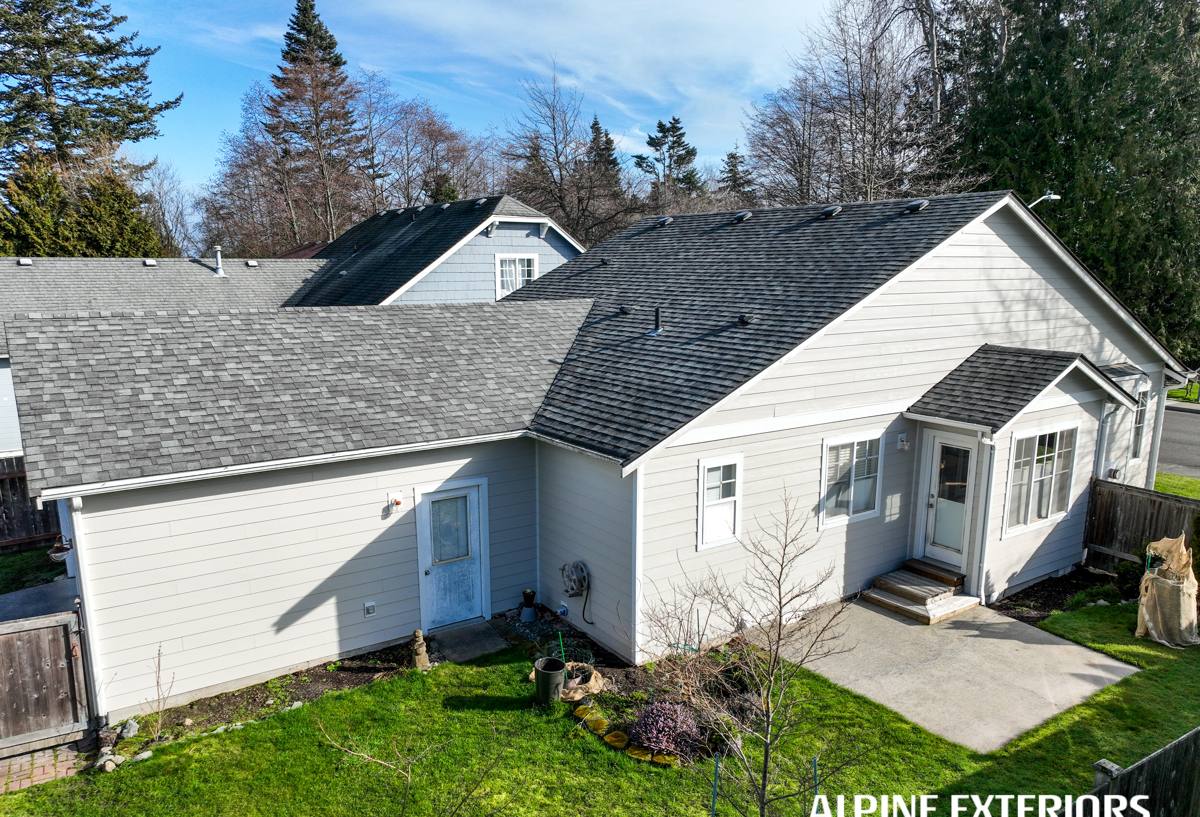
Why We Install Only James Hardie Fiber Cement
We made a decision a long time ago to standardize on one siding system rather than carry several options and let price shop the decision. That system is James Hardie fiber cement. It's non-combustible, it's engineered specifically for wet climates like ours, it holds paint — or rather, a factory-applied finish — far longer than field-painted materials, and it comes with a strong, transferable manufacturer warranty. For a house that's going to sit in this valley's moisture cycle for the next 30-plus years, those are the properties that actually matter.
That doesn't mean every other product is a bad product. It means we looked at the trade-offs honestly and decided we'd rather install one thing extremely well than install several things at a discount.
Where the Alternatives Fall Short for This Climate
| Product | What it does well | Why it's not what we install here |
|---|---|---|
| Vinyl siding | Low upfront cost, no repainting | Panels expand and contract with temperature swings, seams and laps can let moisture behind the cladding, and it doesn't hold up to the same fastening tolerances as fiber cement in wind-driven rain |
| LP SmartSide (engineered wood) | Lighter weight, easier to install, warmer look | It's still a wood-based product — edges and cut ends are the vulnerable point, and in a climate with our moss and rain exposure, moisture management at seams has to be nearly perfect for the life of the warranty to hold |
| Cedar / primed spruce | Natural look, long tradition in the Northwest | Requires ongoing refinishing, is a combustible material, and is the most maintenance-intensive option in a climate that keeps wood damp for months at a time |
| James Hardie fiber cement | Non-combustible, factory-cured ColorPlus finish, climate-engineered HZ product line, long transferable warranty | Higher material cost than vinyl; installation is more labor-intensive and detail-sensitive, which is why correct fastening and flashing matters |
The honest trade-off with Hardie is upfront cost and installation labor — it's heavier than vinyl and less forgiving of shortcuts than either vinyl or engineered wood. That's exactly why installation quality matters as much as the product itself, which is the next section.
The Hardie Product Line We Use
James Hardie builds its siding in regional formulations — HZ5 for the Pacific Northwest's wetter, more humid climate zone — engineered to resist moisture absorption and hold dimensional stability better than a generic national product. On top of that, ColorPlus Technology bakes the finish on at the factory in a controlled environment, rather than relying on a field-applied coat that has to cure correctly on-site in whatever weather happens to show up that week. That's a meaningful difference in a valley where a dry, low-humidity painting window isn't guaranteed for long stretches of the year.
We install lap siding, panel siding, and trim in the profiles and colors that fit the house, and we back it with James Hardie's manufacturer warranty, which is transferable if the home sells — something buyers and their inspectors do ask about.
More Than Siding: Full Exterior Work for Nooksack Homes
Siding rarely fails in isolation. A roof that's shedding water onto a wall, a window that's not flashed correctly, or a deck ledger that's trapping moisture against the house band board will undermine even a well-installed siding job. Because of that, we handle the full exterior envelope — siding, roofing, windows, and decks — so the pieces that touch each other actually get evaluated together instead of by four different companies pointing fingers at each other.
Where these systems intersect
- Roof-to-wall transitions: improper step flashing or kick-out flashing at roof lines is one of the most common causes of hidden water damage behind siding
- Window flashing: siding installed around a poorly flashed window will show staining and rot at the corners within a few seasons
- Deck ledgers and attachments: where a deck ties into the house, that connection point needs proper flashing or it becomes a direct path for water into the wall assembly
What a Siding Project Looks Like in Nooksack
Every job starts with a walk-around, not a sales pitch. We look at the current siding, note where moisture has already gotten in, check the condition of the sheathing once old siding comes off, and flag anything at the roof, window, or deck connections that needs attention before new siding goes on. Covering up a moisture problem with new siding just delays the repair and makes it more expensive later.
From there: removal of old material, repair of any damaged sheathing, correct installation of weather-resistive barrier and flashing at every penetration, then Hardie siding installed to manufacturer fastening and clearance specs — including the ground clearance and gutter clearance details that matter most in a climate where splash-back and moss are constant issues.
Cost Factors for a Nooksack Siding Project
| Factor | Why it moves the price |
|---|---|
| Extent of existing damage | Rotten sheathing found under old siding has to be replaced before new siding goes on |
| House size and complexity | More corners, gables, and trim detail mean more labor and cut waste |
| Siding profile and accessories | Lap width, panel vs. lap, and trim choices all affect material cost |
| Access and site conditions | Tree cover, tight lot lines, and multi-story walls affect staging and labor time |
| Tie-in work | Flashing repairs at rooflines, windows, or deck connections found during removal |
Why a Local Crew Matters Here
A crew that works Whatcom County knows what this climate actually does to a house over time, not just what a spec sheet says on paper. We know which walls in a shaded Nooksack lot are going to hold moss longest, why ground clearance and gutter placement matter more here than in a drier climate, and what a normal wet-season timeline looks like for scheduling a project so it's not rushed into a bad-weather window. That local knowledge shows up in the small decisions — flashing details, clearance heights, fastener spacing — that separate siding that lasts three decades from siding that starts failing in eight years.
Simple Things Homeowners Can Do Between Now and a Full Replacement
- Keep gutters clean so water isn't overflowing directly onto siding below
- Trim back branches and shrubs that keep walls shaded and damp
- Rinse moss and algae off siding gently rather than letting it build up season over season
- Check caulk at trim joints and window edges once a year, especially before winter
- Have any soft, discolored, or bubbling siding inspected before it spreads
If you're noticing moss buildup, soft spots, or aging siding on a Nooksack-area home, we're glad to take a look. We offer free, no-pressure estimates — walk the house with us, get a straight answer on what's actually going on, and decide from there.