 Lynden Siding
 Aldergrove Sits Right in the Path of Fraser Valley Weather
Aldergrove is close enough to Lynden that a lot of the same weather patterns move through both communities in the same afternoon. Marine air off the Salish Sea pushes inland across the Fraser Valley, bringing salt-laden moisture with it, and that air doesn't stop at the border. Add in the long, low-angle rain that Whatcom County and the surrounding BC lowlands see from October through May, and exterior building materials here are under near-constant pressure — not from any single dramatic storm, but from months of steady dampness that never fully dries out between weather systems.
That combination — salt air, driving rain, and a moss season that can run half the year in shaded, north-facing spots — is exactly the kind of climate that separates siding products that look good on a spec sheet from siding products that actually hold up. We've built our business around installing the one product we trust to do that consistently, and this page walks through why, along with how our siding, roofing, window, and deck work fits together for homes in the Aldergrove area.
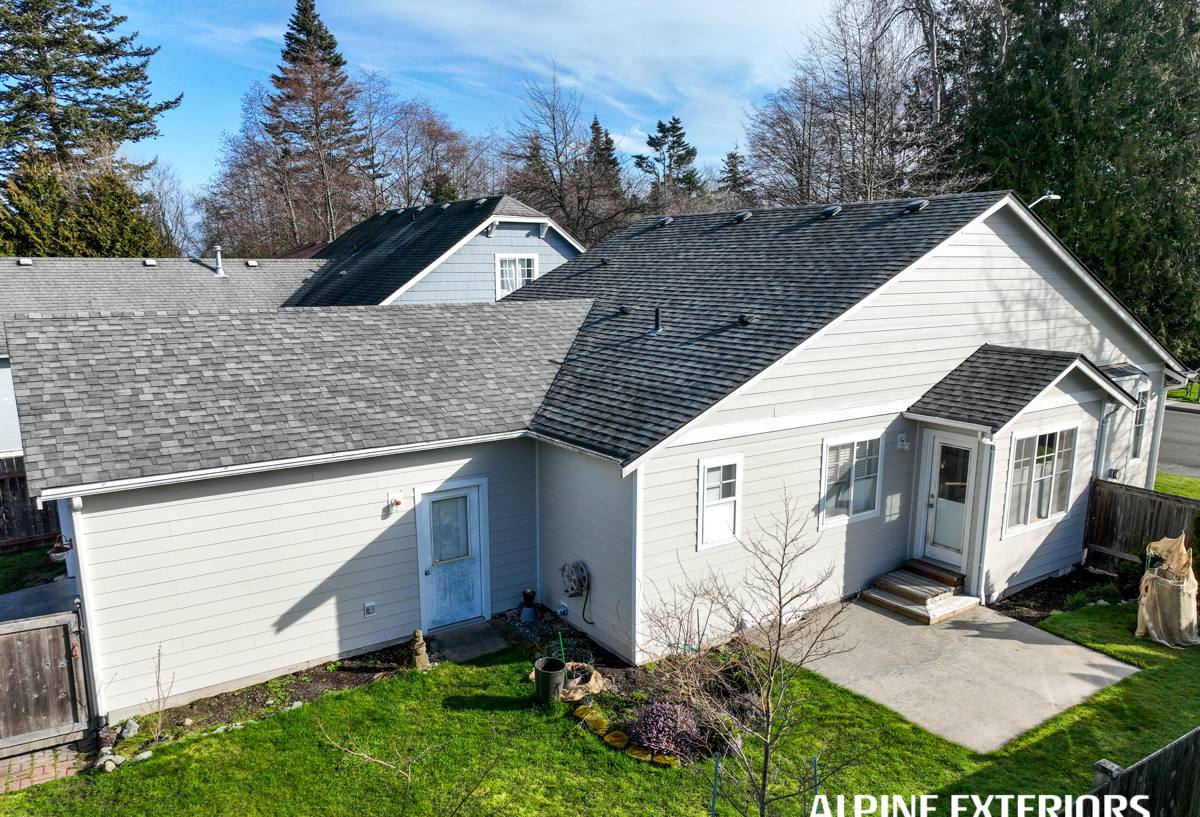
Why Material Choice Matters More Here Than in Drier Climates
In a dry inland climate, a lot of siding materials perform reasonably well because they're rarely tested. Around Aldergrove, the test never really stops. Wood-based products absorb moisture at cut edges and fastener penetrations; if that moisture doesn't get a chance to fully dry before the next rain arrives, it starts a slow cycle of swelling, softening, and eventual rot — usually hidden behind paint or trim until it's already advanced. Vinyl doesn't rot, but it flexes with temperature swings, can crack in a hard freeze, and fades under UV over the years in a way that's difficult to correct short of replacement.
Salt-bearing air adds another layer. It accelerates corrosion on exposed fasteners and trim, and it interacts with organic growth — moss, algae, mildew — that thrives in the shaded, damp microclimates common on the north and west sides of homes in this area. None of this means every other siding product is a bad product. It means the margin for error in material selection and installation is smaller here than it is in a lot of the country, and we'd rather build our reputation on a product engineered for exactly this kind of exposure than manage callbacks on one that isn't.
Why We Install Only James Hardie Fiber Cement
We made the decision years ago to standardize on James Hardie fiber cement siding and not offer alternatives. That's a narrower lineup than some contractors carry, but it means every crew member is deeply familiar with one system, every detail is dialed in for one product's specific requirements, and every homeowner gets the same tested approach rather than a menu of products with different failure modes.
Non-Combustible, Dimensionally Stable
Fiber cement is made primarily from cement, sand, and cellulose fibers. It doesn't burn, it doesn't feed on moisture the way wood does, and it holds its shape through the wet winters and warmer summers this region sees without the expansion and contraction that causes gaps and cracking in other materials over time.
HZ5 Climate-Engineered Product Line
James Hardie engineers its siding by climate zone, and the HZ5 line is built for regions with cold, wet winters — which describes both sides of the Aldergrove-Lynden border well. It's formulated to resist moisture intrusion and hold up through repeated freeze-thaw and wet-dry cycles rather than being a one-size-fits-all product adapted after the fact.
ColorPlus Factory Finish
Most of the siding we install uses Hardie's ColorPlus finish — baked on in a controlled factory environment rather than field-painted. That finish resists fading and chipping far better than a job-site paint job, and it means touch-ups are rare rather than an annual chore. In a climate with this much sun-to-rain variation, a finish that's cured properly the first time matters.
Warranty Backing
Hardie backs its siding with a substantial, transferable limited warranty on the product itself, plus a separate finish warranty on ColorPlus color. Warranties are only as good as correct installation behind them, which is why installation detail — flashing, clearances, fastening — gets as much attention from our crews as the material choice itself.
What We Don't Install, and Why We Made That Call
We get asked fairly often about LP SmartSide, vinyl, and cedar or primed wood siding, since all three are common around older homes in this region. We don't install any of them, not because they're incapable of performing, but because each comes with a trade-off we're not willing to build our workmanship around in this specific climate.
| Product | What It Gets Right | Trade-Off in This Climate |
|---|---|---|
| LP SmartSide | Engineered wood strand product, workable, budget-friendly | Wood-based core is still moisture-sensitive at cut edges and seams; long-term performance depends heavily on maintaining an intact factory coating |
| Vinyl Siding | Low upfront cost, no painting required | Can crack in hard cold snaps, fades under sustained UV, and simply flexes and ages differently than a masonry-based product over decades |
| Cedar / Primed Spruce | Natural look, long regional tradition | Requires ongoing sealing, staining, or painting to keep moisture out; the wet season here shortens the window between maintenance cycles |
| Cemplank / Allura | Fiber cement alternatives, similar core material | Different manufacturing specs, finish systems, and warranty structures than what our crews are trained and certified around |
None of that is a knock on the products or on homeowners who've chosen them — plenty of homes around Aldergrove wear cedar or vinyl just fine with regular upkeep. It's a statement about what we're willing to put our name behind, install to spec, and warranty our labor on.
Siding Is Part of a Bigger Exterior System
Siding doesn't work in isolation. Roofing, windows, and decking all interact with it at the details that actually determine whether water gets in or stays out — the transition where roofline meets wall, the flashing around window openings, the ledger board where a deck ties into the house. We handle all four (siding, roofing, windows, and decks), which means when we're on a project we're looking at the whole envelope, not just the siding panels.
- Roofing: proper drip edge, flashing, and underlayment details that keep water from working sideways behind new siding at the roofline
- Windows: correctly flashed openings so replacement siding ties in without creating a new leak point at every window
- Decks: ledger and flashing details where an attached deck meets the house, an area that's a common hidden moisture entry point
- Siding: the visible finish, but only as good as the water management happening behind it
What Correct Installation Actually Involves
Fiber cement performs the way it's designed to only when it's installed to manufacturer spec, and that's where a lot of the real-world variability in siding outcomes comes from — not the material itself. Correct installation on a home in this climate means a weather-resistant barrier installed and lapped correctly, rainscreen or proper clearance where called for, flashing integrated at every penetration and transition, panels fastened at the specified pattern and spacing, and joints and butt seams sealed or flashed per the manufacturer's climate-zone guidance. Skipping or rushing any one of these steps is how a good product ends up with a bad outcome, and it's usually invisible until years later when moisture has already found its way in.
A Local Crew for a Border-Area Community
Lynden and Aldergrove sit close enough to each other that we treat this as our home service area, not an outlying add-on. That matters in a few practical ways. We're familiar with the specific exposure patterns homes here deal with — which sides of a house tend to hold moss, which lots sit in enough shade to stay damp longer into spring, where wind-driven rain tends to concentrate. We're also close enough to show up for a walkthrough, a warranty check, or a follow-up without a long drive being a factor in whether it happens. For a service-area community like Aldergrove, having a crew that's genuinely local — not a regional outfit passing through — tends to show up in the details of the work and in how easy it is to get someone back out if a question comes up after the job is done.
What Affects Project Cost
Every home is different, but a few factors consistently move the estimate on a siding project in this area. We'll walk through all of these during a free assessment rather than quoting blind.
| Factor | Why It Matters |
|---|---|
| Home size and wall complexity | More corners, gables, and dormers mean more cutting, flashing, and labor time |
| Current siding condition | Rot or water damage found once old siding is removed can add repair scope |
| Siding profile and finish | Lap width, texture, and ColorPlus color selection affect material cost |
| Trim and detail work | Window and corner trim packages add both material and labor |
| Access and site conditions | Tight lots, slopes, or landscaping close to the house affect setup time |
Keeping Fiber Cement Siding Performing Long-Term
One advantage of James Hardie siding is that it asks very little of a homeowner year to year compared to wood or vinyl, but a short annual routine still goes a long way in this climate.
- Rinse down siding once or twice a year to clear pollen, dust, and the start of moss or algae growth before it takes hold
- Keep gutters clear so overflow doesn't run directly down a section of wall
- Trim back landscaping and tree branches that keep a section of siding shaded and damp longer than the rest of the house
- Check caulking at trim joints and penetrations periodically and have gaps resealed before water finds them
- Have flashing at rooflines, windows, and deck ledgers inspected if you notice a recurring damp or moss-heavy spot on the wall
If you're weighing a siding project — or roofing, windows, or a deck — for a home in the Aldergrove area, we're glad to come take a look and put together a straightforward, no-pressure estimate. There's no cost or obligation to have us walk the property and tell you honestly what we see.