 Lynden Siding
 Siding in Kendall: Built for the Whatcom County Weather You Actually Live With
Kendall sits out where Lynden's farmland starts giving way to the foothills near the Nooksack River and the Mount Baker corridor. It's a different setting than the more open valley floor closer to town — more tree cover, more shade, more standing moisture in the air for more of the year. That combination is exactly what wears out the wrong siding product fastest, and it's exactly why we treat Kendall as its own case, not a copy-paste of a Lynden city job.
Whatcom County as a whole deals with a long wet season, driving rain that comes in sideways off frequent storms, and a marine-influenced climate that keeps humidity high even between storms. Out toward Kendall, add in more tree canopy and less direct sun exposure on a lot of lots, and you get siding, trim, and fascia that simply stay damp longer than they would on an open, sunny lot. That's the whole ballgame for exterior durability out here — not any single big storm, but how long your siding stays wet after every one of the dozens of rain events that hit between October and May.
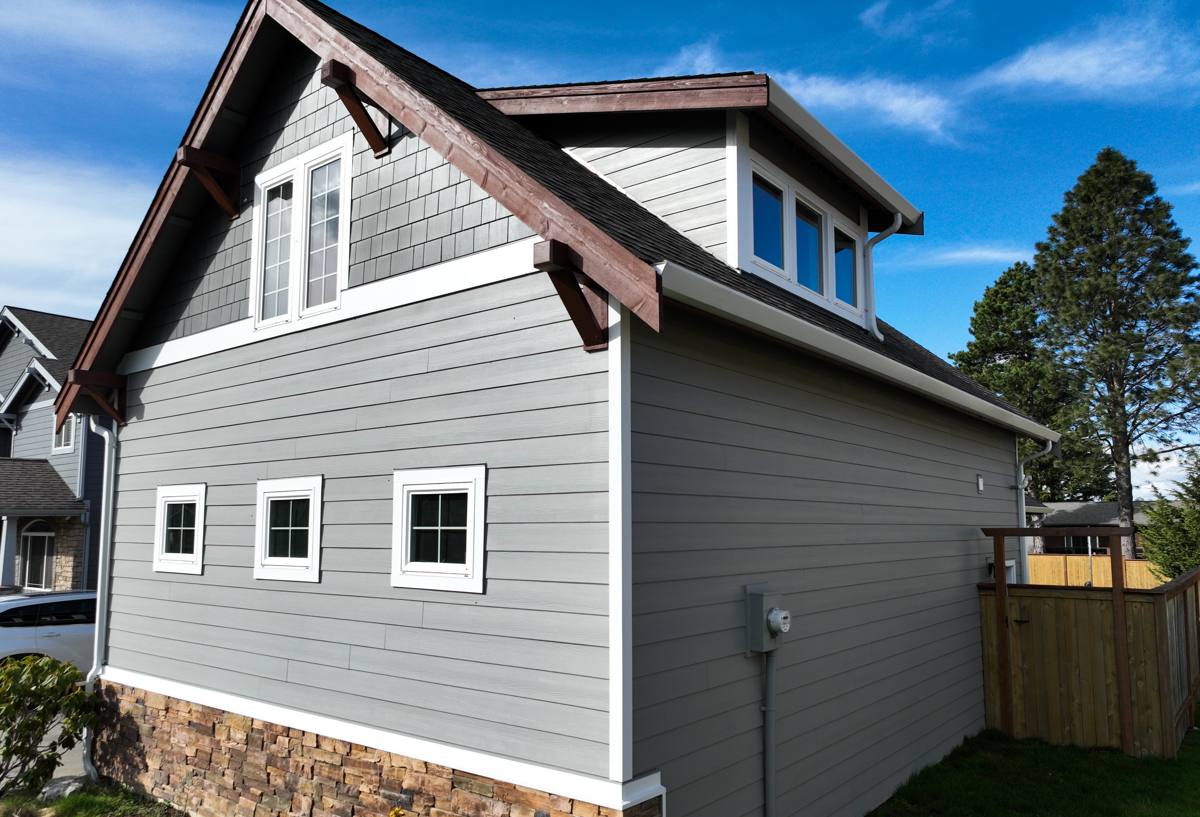
What Kendall's Climate Actually Does to a House
Driving Rain and Wind-Driven Moisture
Storms coming off the Pacific don't just rain straight down — wind pushes water sideways into wall assemblies, especially on the windward side of a home and around window and door openings. Over years, that wind-driven rain finds every weak seam, every gap in old caulking, and every piece of trim that's started to separate from the wall. Siding that swells, delaminates, or holds water against its own surface accelerates that process instead of shedding it.
The Moss and Mildew Problem
A long, cool, damp season is prime growing conditions for moss, algae, and mildew on anything that stays wet for extended stretches — roofs, north-facing walls, and siding tucked under trees or eaves with little sun exposure. On rural and tree-shaded lots like a lot of what you find around Kendall, that shade is a mixed blessing: it's part of what makes the area appealing, but it also means siding on shaded elevations gets less of the natural dry-out that sun exposure provides elsewhere. Products that absorb moisture or trap it against wood fiber give moss and mildew a foothold that's hard to fully reverse once it sets in.
Freeze-Thaw and Temperature Swings
Kendall's proximity to the foothills means slightly cooler overnight temperatures and more frequent frost than you'll see closer to the water. Repeated freeze-thaw cycling stresses any building material that has absorbed moisture — water expands as it freezes, and that expansion is what cracks caulking, pops fasteners, and opens seams in siding that wasn't engineered to handle it.
Why We Only Install James Hardie Fiber Cement
We're a full exterior contractor — siding, roofing, windows, and decks — and on every siding job we do, in Kendall or anywhere else in our service area, we install James Hardie fiber cement and nothing else. We don't offer vinyl, LP SmartSide, Cemplank, Allura, or primed wood siding as options, and that's a deliberate standard, not a lack of familiarity with the alternatives.
Fiber cement is non-combustible and dimensionally stable — it doesn't swell, warp, or rot the way wood-based products can when they take on repeated moisture. James Hardie's ColorPlus factory-applied finish is baked on under controlled conditions, which gives it far more consistent, durable coverage than field-applied paint, and it comes with its own dedicated finish warranty. For a climate that keeps siding wet more often than it dries it, that combination of moisture resistance and finish durability is what actually holds up over the long run, not just in year one.
HZ5 and Climate-Engineered Product Lines
James Hardie engineers its siding by climate zone. The HZ5 product line is formulated for regions like ours — the Pacific Northwest's freeze-thaw cycling and sustained moisture exposure — with a composition tuned to resist that specific stress pattern rather than a one-size-fits-all formula. That's part of why we don't treat "fiber cement" as a generic category; the engineering behind the specific product line matters.
Why We Don't Install the Alternatives
| Product | What it gets right | Why it's not what we put on Kendall homes |
|---|---|---|
| Vinyl siding | Low upfront cost, easy availability | Can warp or crack in temperature swings; seams and panels give wind-driven rain more paths inward; limited fire resistance |
| LP SmartSide | Engineered wood, easier to install than some alternatives | Wood-strand core is still moisture-sensitive at cut edges and seams; long wet seasons stress that weak point over time |
| Cemplank / Allura | Fiber cement composition, similar concept to Hardie | Different engineering, finish systems, and warranty structure than Hardie's climate-zone-specific lines; we standardize on one system we know cold |
| Primed cedar / spruce | Natural look, real wood | Requires ongoing repainting and sealing to stay ahead of moisture; a long moss season shortens the interval between maintenance cycles |
None of these are junk products across the board — they each have a place, and plenty of homes wear them fine in drier climates or with diligent upkeep. Our standard is about what performs with the least maintenance burden in this specific climate, installed by a crew that only works with one system and knows its details cold.
What a Siding Project in Kendall Looks Like
Assessment First
Before we talk product or price, we look at what's actually happening on your walls — moisture staining, soft trim, failing caulk lines, how much shade different elevations get, and whether the existing water-resistive barrier and flashing details need attention as part of the job. A lot of siding failure in this climate traces back to flashing and moisture management underneath the surface material, not the material itself.
Installation to Spec
James Hardie publishes detailed installation requirements — fastener spacing, clearances from grade and roofing, joint treatment, caulking specifications — and those details matter more in a wet climate than a dry one. Skipping or shortcutting them is how even a good product underperforms. We install to those specifications on every job, which is also what keeps the manufacturer's transferable warranty intact if you ever sell the home.
Full Exterior Scope When It Makes Sense
Because we also handle roofing, windows, and decks, a siding project is often a good time to address other exterior components that are dealing with the same moisture exposure — aging roofing, single-pane or failing-seal windows, or a deck that's been absorbing the same driving rain. We'll flag what we see, but we're not going to sell you scope you don't need.
Why a Local Crew Matters Here
Kendall isn't downtown Lynden — lots tend to be larger, tree cover varies a lot from property to property, and driveways and access can be longer or trickier than a standard in-town job. A crew that works this specific area regularly knows what to expect before the trucks show up, and knows which parts of a property are going to need extra attention for drainage, shade, or access. That local familiarity translates into fewer surprises mid-project.
It also means we're not learning Whatcom County's climate on your house. We see the same rain patterns, the same moss growth, and the same freeze-thaw stress on every job we do around here, and that's the experience that goes into how we spec and install every project.
Signs Your Siding Needs Attention
- Visible moss or algae streaking on north-facing or shaded walls
- Soft or spongy spots, especially near the bottom of walls or around window trim
- Paint that's peeling, bubbling, or chalking heavily
- Visible gaps, warping, or separation at seams and corners
- Caulk that's cracked, shrunk, or pulled away from joints
- A musty smell near exterior walls inside the home
- Siding that feels damp to the touch well after a dry day
Any one of these on its own isn't necessarily an emergency, but if you're seeing more than one, it's worth having someone take a real look before it turns into a bigger repair.
Cost Factors for a Kendall Siding Project
| Factor | Why it moves the number |
|---|---|
| Home size and wall complexity | More square footage and more corners, gables, and dormers mean more material and labor |
| Existing condition | Rot repair, sheathing replacement, or flashing corrections add scope beyond the siding itself |
| Access and site layout | Longer driveways, sloped lots, or limited staging space can affect labor time |
| Trim and color complexity | Custom trim details and multiple ColorPlus colors add material and installation time |
| Tear-off vs. overlay | Full removal of old siding versus installing over existing material changes labor and disposal costs |
We don't quote a number without seeing the house — anyone who does is guessing. What we can tell you is that the estimate we give reflects a full-spec James Hardie installation, not a stripped-down version we upsell you out of later.
Get a Free Estimate for Your Kendall Home
If your siding is showing its age, or you're planning ahead before the next wet season sets in, we'll come take a look and give you a straight, no-pressure estimate. There's a form below — reach out and we'll get a time on the calendar.