 Lynden Siding
 Homeowners in Lynden researching new siding almost always end up with the same two names on their shortlist: James Hardie fiber cement and LP SmartSide engineered wood. Both are legitimate step-up products from vinyl, both are widely available through Whatcom County lumber yards and distributors, and both have loyal installer bases. We get asked to compare them often enough that it's worth laying out an honest, specific answer rather than a sales pitch.
We install James Hardie exclusively. That's a business decision we made after years of exterior work in this climate, and we think homeowners deserve to know the reasoning rather than just the conclusion. This page walks through what each product actually is, where they differ in the ways that matter here, and why we standardized on one of them.
What Each Product Actually Is
James Hardie Fiber Cement
James Hardie siding is made from Portland cement, sand, and cellulose fibers, cured into rigid boards and panels. It's not a wood product at all — it's a manufactured composite engineered specifically to resist the things that damage siding: moisture, fire, insects, and UV degradation. Hardie offers several product lines (HardiePlank lap siding, HardiePanel vertical siding, HardieShingle) and, more relevantly for our area, a climate-specific "HZ5" formulation engineered for regions with freeze-thaw cycles and sustained moisture exposure.
LP SmartSide
LP SmartSide is an engineered wood product — strand board or fiberboard made from wood strands bonded with resins, then coated with a wax and zinc-borate treatment for moisture and insect resistance. It's a genuine improvement over old-school primed spruce or cedar lap siding, and LP has invested real engineering into the substrate and its SmartGuard treatment process. It installs similarly to traditional wood lap siding, which is part of its appeal to crews already comfortable with that method.
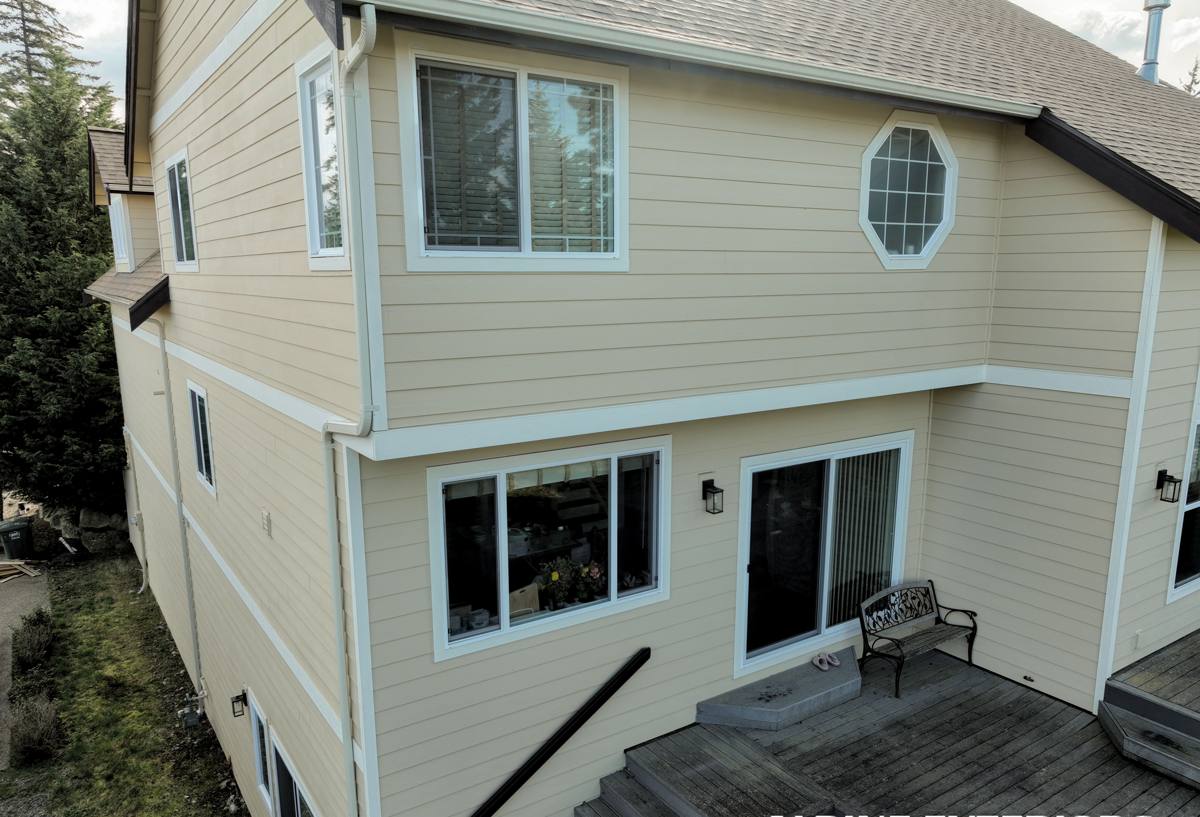
Where the Difference Actually Matters: Whatcom County Climate
On paper, in a dry, moderate climate, either product can perform well for years. Lynden isn't that climate. We sit close enough to the Salish Sea to get salt-tinged air, we get long stretches of driving rain off the Pacific systems that roll through fall and winter, and we have a moss season that can run six months or more on north-facing walls and shaded elevations. That combination is a stress test for any exterior product, and it's where the two materials start to separate.
Moisture Behavior
Fiber cement is not organic material. It doesn't have wood fibers that can absorb water and swell, and it doesn't feed rot fungus even if moisture gets behind a poorly flashed detail. Engineered wood, no matter how well treated, is still a wood-based substrate. The zinc-borate treatment protects against fungal decay and insects, but it doesn't change the fact that the core material is wood strands that can take on moisture at damaged edges, uncapped cuts, or failed caulk joints. In a climate with this much sustained wet weather, that's a meaningful difference over a 15-20 year ownership period, not just a first-five-years difference.
Moss and Algae
Neither product is immune to moss and algae growth — that's a function of shade, moisture, and surface texture more than substrate chemistry. But when moss does take hold and a homeowner has to pressure-wash or scrub a wall, fiber cement tolerates that abuse better over time than an engineered wood surface, where aggressive cleaning can wear through the factory coating and expose the substrate at the cleaned area.
Cut-Edge and Field Exposure
Both products require field-cut edges to be sealed — this isn't unique to one or the other. But the consequence of a missed cut edge differs: an unsealed fiber cement cut edge that gets wet doesn't rot. An unsealed engineered wood cut edge in a wet climate is the single most common point where these products start to fail early, usually years before the rest of the wall shows any wear.
Side-by-Side Comparison
| Factor | James Hardie Fiber Cement | LP SmartSide |
|---|---|---|
| Core material | Cement, sand, cellulose fiber | Wood strands, resin, zinc-borate treatment |
| Combustibility | Non-combustible | Combustible (wood-based) |
| Moisture tolerance | Does not rot; dimensionally stable when wet | Treated against decay, but wood-based core can swell or delaminate if compromised |
| Finish | Factory-baked ColorPlus finish, no field painting required for most lines | Factory primed or pre-finished; many installs still require field paint/caulk maintenance |
| Insect resistance | Immune — not an organic food source | Treated to resist, not inherently immune |
| Typical warranty | 30-year limited, factory-backed, transferable | Manufacturer warranty varies by product line, generally shorter non-prorated period |
| Installation sensitivity | Requires correct fastening, clearances, and joint treatment per Hardie spec | Requires correct sealing of cuts, joints, and fastener penetrations |
| Local climate fit | HZ5 formulation engineered for wet/freeze-thaw regions | General-purpose engineered wood, not regionally differentiated |
Fire Consideration
This matters more each year as wildfire smoke and regional fire risk become a bigger part of Pacific Northwest summers. Fiber cement is non-combustible by composition — it won't ignite or contribute fuel to a fire. Engineered wood, even with treatments, is still a wood-based product and carries the combustibility profile that comes with that. For homeowners weighing insurance considerations or simply wanting one less variable in a wildfire-adjacent region, this is a real, not theoretical, difference.
Finish and Long-Term Appearance
James Hardie's ColorPlus finish is baked on at the factory under controlled conditions, with a warranty that covers the finish itself, not just the substrate. That matters because the finish is usually the first thing to show wear on any siding product — fading, chalking, or peeling. LP SmartSide is available primed or with factory-applied finish options depending on the product line, but many installations still rely on field-applied paint at the seams, cuts, and touch-up areas, which introduces a maintenance cycle that fiber cement with ColorPlus mostly avoids.
Installation: Why the Installer Matters as Much as the Product
We want to be fair here: a huge share of "product failure" complaints for both materials actually trace back to installation, not the material itself. Both products have manufacturer installation manuals that specify clearances above grade and roofing, fastener patterns, joint flashing, and caulking requirements. Skipping those steps will cause problems with either siding. Where fiber cement has an edge is that its failure mode when installed imperfectly tends to be cosmetic or slow — it doesn't rot. Engineered wood installed imperfectly in a wet climate can develop real substrate damage at the point of the mistake.
What to Ask Any Contractor, Regardless of Product
- Are you a certified/preferred installer for the product you're proposing, and can you show it?
- What clearance will you maintain between the siding bottom edge and grade, decks, and roof lines?
- How will you treat and seal every field-cut edge?
- What's your plan for flashing at windows, doors, and butt joints?
- What does the manufacturer warranty actually cover, and does it survive a change of ownership?
- Can you provide a written scope referencing the manufacturer's install manual, not just "standard practice"?
Cost Perspective
LP SmartSide typically carries a lower material cost than James Hardie fiber cement, and that upfront gap is real — it's the main reason SmartSide gets specified on budget-conscious builds. Installed cost also depends on siding profile, home complexity, and trim detailing, so any specific number should come from a walk-through estimate rather than a general figure. The way we think about it with homeowners is less "which is cheaper today" and more "what does the total cost look like across a 20-30 year hold," factoring in repainting cycles, potential moisture-related repairs, and how the warranty actually functions if a claim comes up.
Why We Standardized on James Hardie
We used to install a range of siding products. Over time, the callbacks, moisture-related repairs, and cut-edge failures we saw in this specific climate — heavy rain, salt-tinged coastal air, and long moss seasons on shaded walls — clustered around wood-based products far more than fiber cement, even when installation was done carefully. That pattern led us to stop installing engineered wood siding, vinyl, and primed wood products altogether and standardize on James Hardie's HZ5 line for every full siding replacement we do in Lynden and the surrounding county. It's not that LP SmartSide is an illegitimate product — it's that after years of doing this work in this climate, we decided we'd rather stand behind one system we trust completely than offer a menu that includes products we've watched underperform here.
What This Means for Your Project
If you're set on LP SmartSide, there are contractors who install it well, and the questions above will help you vet them. If you want a straight answer on why a Lynden-based crew that's seen a lot of siding age in this climate chose to install only James Hardie, this page is that answer: non-combustible material, no rot risk, a factory finish warrantied on its own terms, and a product line engineered for exactly the wet, coastal-influenced conditions Whatcom County delivers most of the year.
If you're weighing your options and want a straightforward look at what your home would need — no pressure, no upsell — we're happy to walk the exterior with you and give you a written estimate for a James Hardie installation done to spec.