 Lynden Siding
 Cedar siding has a following for good reason. It looks warm, it takes stain beautifully, and there's a real appeal to putting a natural wood product on a Pacific Northwest home. We get asked about it regularly, and we understand why — cedar has history here. But we don't install it, and we think homeowners in Lynden and the rest of Whatcom County deserve a straight answer about why, not a sales pitch for whatever we do carry.
This isn't a knock on cedar as a material. It's an honest look at what cedar siding actually demands over a 20- or 30-year ownership window in this specific climate, and why we decided we couldn't stand behind installing it and then walk away.
What Cedar Siding Gets Right
Before getting into why we don't install it, it's worth being fair about what cedar does well. It's a genuinely renewable material, it machines and finishes beautifully, and a freshly stained cedar exterior has a depth and warmth that manufactured products spend a lot of R&D money trying to imitate. Western red cedar in particular is naturally rot- and insect-resistant compared to other softwoods, which is part of why it became a Pacific Northwest staple in the first place. None of that is in dispute.
The problem isn't the day it goes up. It's every year after that.
The Maintenance Reality Nobody Budgets For
Cedar siding is a maintenance commitment, not a one-time purchase. Left unfinished or under-maintained, cedar weathers to gray and starts checking (splitting) within a few years. To keep it looking like the reason you chose it, it needs to be re-stained or re-sealed on a cycle — typically every 3 to 5 years depending on exposure, sometimes sooner on south- and west-facing walls that take direct sun and wind-driven rain.
- Re-staining or sealing every 3-5 years, more often on sun- and weather-exposed elevations
- Periodic caulking and re-caulking at joints, seams, and trim as the wood moves seasonally
- Regular inspection for checking, cupping, and warping, especially near grade
- Moss and algae treatment, sometimes annually in shaded or north-facing areas
- Prompt repair of any moisture intrusion before it spreads behind the boards
That's not a homeowner being careless — that's the actual maintenance schedule for a wood exterior product installed correctly. Skip a cycle or two and cedar doesn't just look tired, it starts absorbing moisture at a rate that leads to rot, cupping, and fastener failure. At that point you're not touching up a finish, you're replacing boards.
Who Actually Keeps Up With It
In our experience, very few homeowners keep a wood exterior on the schedule it needs. Life gets busy, a re-stain job gets pushed a year, then two, and by the time it becomes visually obvious that something's wrong, the damage is often already behind the surface. We'd rather not install a product where the single biggest factor in its long-term success is whether the homeowner remembers to re-seal it on time, ten years from now, after we're long gone from the job site.
Why Whatcom County's Climate Is Especially Hard on Cedar
Every siding material has to deal with weather, but Lynden's specific climate stacks the deck against wood siding in a few ways that are worth spelling out.
Driving Rain and Sustained Moisture
Whatcom County gets a lot of rain, and a good share of it comes in sideways off marine weather systems moving in from the Strait of Georgia and Puget Sound. Driving rain hits vertical wall surfaces directly, and cedar's performance depends heavily on the finish staying intact to shed that water. Once the sealant starts breaking down — usually starting at the most exposed edges and end grain first — the wood underneath starts absorbing moisture on a near-constant basis for much of the year, not just during isolated storms.
Salt Air
Being close to Bellingham Bay and the greater Salish Sea coastline means homes throughout this region deal with a measure of salt-laden air, particularly on days with onshore wind. Salt exposure accelerates the breakdown of exterior finishes and can accelerate corrosion on fasteners, which matters a lot on a product where the fasteners are the only thing holding individual boards in place.
Long Moss Season
Our mild, wet winters and shoulder seasons create ideal conditions for moss and algae growth on north-facing and shaded walls — sometimes for eight or nine months of the year. Moss holds moisture directly against the wood surface, which is close to the worst-case scenario for a material that depends on staying dry to resist rot. Keeping cedar clean enough to avoid this takes real, recurring effort.
None of these three factors is unique to cedar — they affect every siding material to some degree. But cedar is the one product on the market where the finish is doing almost all the work of resisting moisture, and our regional climate is unusually good at attacking that finish.
The Installation Side Isn't Simple Either
Cedar siding done right isn't just nail-it-up work. Proper installation requires back-priming or back-sealing every board (finishing the side that won't be visible, which is easy to skip and hard to verify after the fact), correct fastener selection to avoid corrosion staining, careful attention to end-grain sealing at every cut, and rainscreen or drainage detailing behind the siding so moisture that does get in can escape rather than pool. Cut corners on any one of those steps and the failure often doesn't show up for years — by which point it's a expensive problem instead of a cheap one.
We're not willing to install a product where a huge share of its long-term performance depends on installation details that are invisible once the wall is closed up, on a material that also requires the homeowner to maintain a strict re-sealing schedule indefinitely. If either one slips, the siding fails from the inside out.
Cedar Siding vs. What We Install
| Factor | Cedar Siding | James Hardie Fiber Cement |
|---|---|---|
| Refinishing cycle | Re-stain/seal every 3-5 years | ColorPlus factory finish, no repainting for many years |
| Moisture behavior | Absorbs water once finish breaks down | Engineered to resist moisture-related swelling and rot |
| Fire resistance | Combustible | Non-combustible fiber cement |
| Moss/algae exposure | Requires active cleaning to prevent buildup | Factory finish resists staining and buildup |
| Warranty | Typically none from a wood supplier beyond material defects | Strong, transferable manufacturer warranty |
| Climate engineering | Not regionally engineered | HZ5 product line engineered for Pacific Northwest conditions |
This isn't cedar losing on every axis — it genuinely wins on natural material character and that authentic wood look. But on the factors that determine whether a homeowner is dealing with a well-performing exterior in year 15 versus a costly repair project, fiber cement is built for exactly the conditions we're describing above.
Why We Standardized on James Hardie
We made a decision a while back to install one siding system and install it well, rather than carry every product a homeowner might ask for. James Hardie fiber cement is what we chose, for reasons that map directly onto cedar's weak points:
- Non-combustible material — fiber cement doesn't burn, which matters for wildfire-adjacent insurance considerations as much as direct fire exposure
- ColorPlus factory finish — baked-on finish that holds color and resists fading without a homeowner re-staining cycle
- Climate-engineered HZ product lines — Hardie's HZ5 formulation is built for exactly the wet, moisture-heavy conditions common to Western Washington
- Strong, transferable warranty — backed by the manufacturer, not just our installation work
- Proven longevity when installed to spec — decades of real-world performance data in climates similar to ours
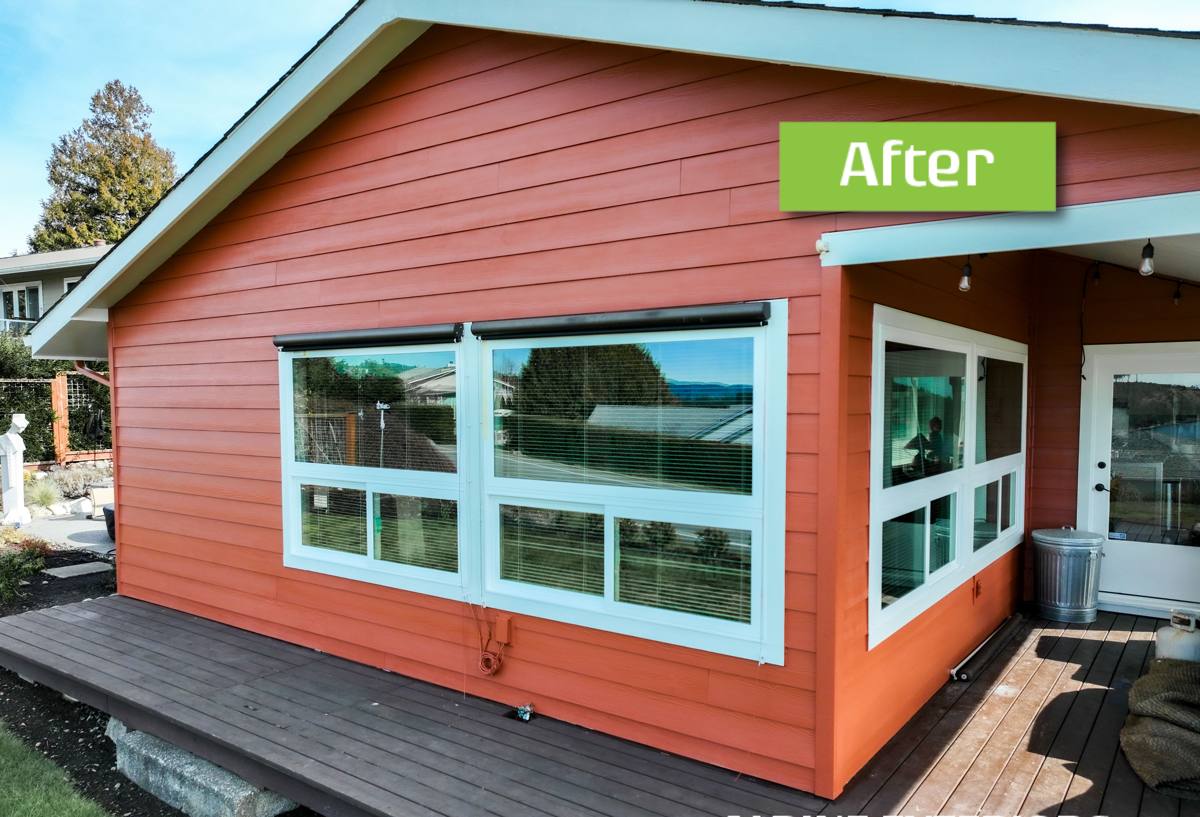
We're not saying cedar is a bad product. We're saying that after years of doing exterior work throughout Lynden and Whatcom County, we don't think it's fair to install a material that requires that level of ongoing homeowner commitment to perform well in our climate, and then hand over the keys. When we put siding on a home, we want it to still be doing its job with minimal fuss well after the invoice is paid.
What This Means If You're Currently Deciding
If you love the look of natural wood and are prepared to commit to a real maintenance schedule — re-sealing every few years, active moss management, prompt repairs — cedar can be a legitimate choice, and there are contractors who specialize in it. If what you actually want is the wood-grain aesthetic without the recurring maintenance obligation, Hardie's lap siding profiles are engineered to get close to that look with none of the re-staining cycle.
We'd rather tell you this upfront than sell you a product we don't believe holds up to Whatcom County weather without more attention than most homeowners realistically want to give it.
If you're weighing your siding options for a home in Lynden or the surrounding area, we're happy to walk through what we install, why, and what it would look like on your specific house. Reach out for a free, no-pressure estimate — there's no obligation, just an honest conversation.