 Lynden Siding
 Our Standard, Stated Plainly
We get asked this a lot, usually by a homeowner who's already gotten a quote for vinyl or LP SmartSide from another crew: why does this company only install James Hardie fiber cement siding? It's a fair question, and it deserves a straight answer rather than a sales pitch. We didn't start out as a Hardie-only shop. Over years of installing, repairing, and tearing off siding in Lynden and the rest of Whatcom County, we settled on one product line because it consistently held up to our specific climate and because the failures we kept seeing in other products traced back to the material itself, not just bad installation.
This page walks through what James Hardie is, why fiber cement behaves differently than the alternatives, and why that difference matters more here than it might in a drier, milder region.
What Makes Whatcom County Siding Different
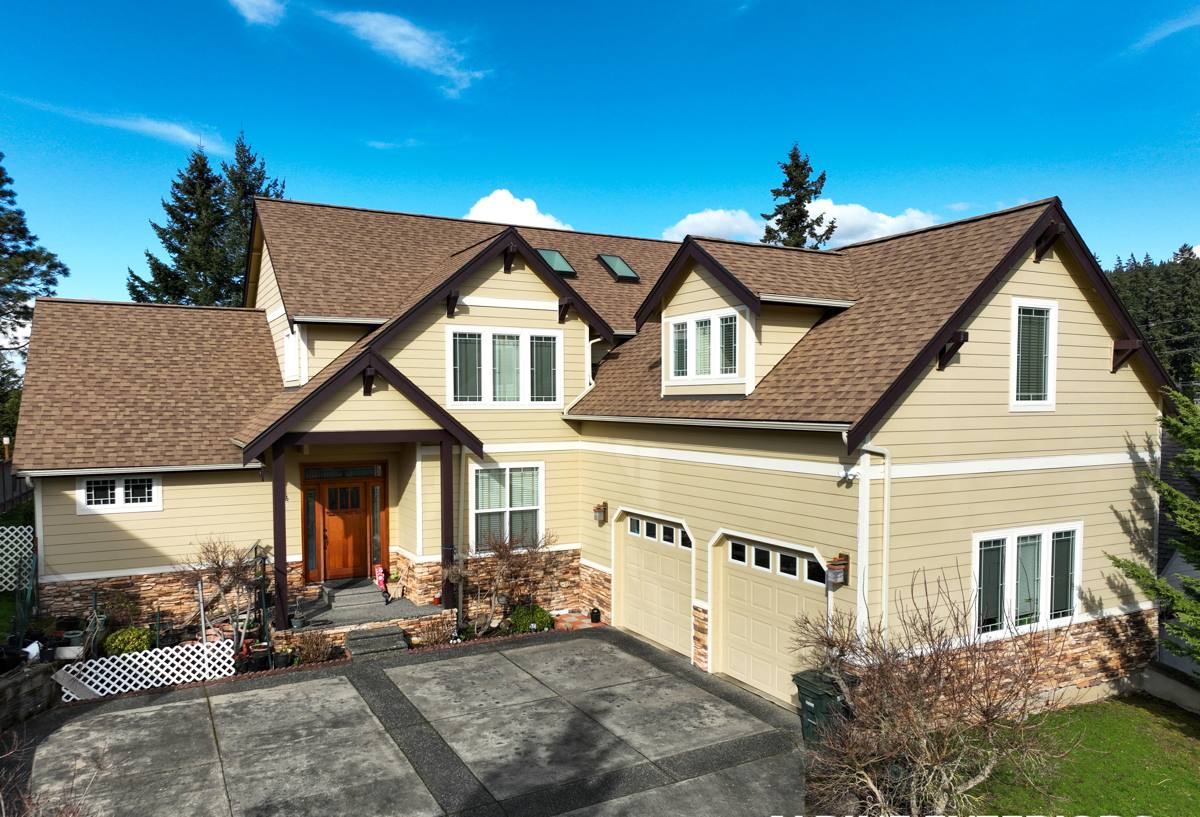
Lynden sits inland from Bellingham Bay, but this is still a marine climate through and through. Homes here deal with three things year-round that stress siding harder than most parts of the country: salt-tinged air rolling in off the Sound, driving rain that hits walls sideways during winter storms, and a moss and algae season that can run eight or nine months out of the year on north- and west-facing walls. Add in the freeze-thaw swings we get in late fall and early spring, and you have a material stress test running constantly on every exterior wall of the house.
Siding that performs fine in Arizona or even in a drier part of Washington east of the Cascades doesn't necessarily perform the same way here. Moisture cycling — wetting, drying, wetting again — is the single biggest driver of siding failure we see on tear-offs, and it's the main reason our material choice narrowed down to one option.
Why Moisture Cycling Matters More Than Rain Totals
It's not just how much rain falls, it's how long a wall stays wet and how often it goes through that cycle. A siding product that absorbs water, swells, dries, and shrinks repeatedly over a season will eventually show it — at the seams, at the fastener points, or in the finish. Whatcom County's long wet season combined with cooler drying periods gives siding less time to fully dry out between rain events than a lot of other regions get.
Why We Stopped Installing the Alternatives
To be clear, we're not saying every other siding product is defective. Vinyl, LP SmartSide (engineered wood), Cemplank and Allura (other fiber cement brands), and primed wood species like spruce or cedar are all legitimate, widely used products with real track records. But each one has a specific trade-off that we ran into often enough, on real homes in this climate, that we decided we could no longer put our name behind installing them.
Vinyl Siding
Vinyl is inexpensive, low-maintenance in a general sense, and easy to install quickly. The trade-offs: it expands and contracts significantly with temperature swings, which over time can telegraph waviness at the panel laps. It's a petroleum-based product that can become brittle with age and UV exposure, and it's not rigid, so it doesn't resist impact or wind-driven debris the way a denser material does. In coastal wind events, we've seen vinyl panels lift or crack at fastener points more than we're comfortable standing behind.
LP SmartSide (Engineered Wood)
LP SmartSide is wood-based — strand board with a resin binder and a factory coating. It has genuinely improved over older generations of engineered wood siding, and it looks good freshly installed. The core trade-off is that it's still a wood product, meaning the cut edges, any breach in the factory finish, and the bottom edge near grade are all points where moisture can get into the substrate. Once wood-based siding takes on water at an edge, it doesn't just get wet, it can swell and begin to deteriorate from the inside, and that damage isn't always visible from the outside until it's advanced. In a climate with our rain totals and humidity, edge sealing and caulk maintenance on this product isn't optional — it's an ongoing commitment, and we've replaced enough failed LP SmartSide to be cautious of it.
Other Fiber Cement Brands (Cemplank, Allura)
This one's less about material science and more about the full system. Cemplank and Allura are also fiber cement, and fiber cement as a category is the right family of product for this climate — non-combustible, dimensionally stable, resistant to moisture absorption at the core. Where we draw the line is the factory finish, the trim system, the warranty structure, and the manufacturer's engineering behind climate-specific product lines. James Hardie has invested specifically in region-tuned formulations (more on that below) and backs their ColorPlus finish with a longer, more specific warranty than what we've found from these other brands. We'd rather install fewer products extremely well than juggle multiple fiber cement lines with different install specs, different trim details, and different warranty fine print.
Primed Spruce and Cedar
Real wood siding has a genuine appeal — it's a traditional look, and cedar in particular has natural rot resistance. But primed wood siding requires the homeowner to maintain the paint film indefinitely. Every crack, chip, or gap in that paint is an entry point for water, and in a climate that stays damp for most of the year, wood siding without a maintained finish is on a countdown to rot, especially at butt joints, corners, and anywhere caulk has failed. We install a lot of cedar trim accents and architectural details, but as a full siding system in this climate, it demands more upkeep than most homeowners realistically keep up with.
Why James Hardie
James Hardie fiber cement is a mix of cement, sand, and cellulose fiber, autoclaved (cured under heat and pressure) into a rigid board. That composition is what makes it behave differently than the alternatives above.
- Non-combustible. Fiber cement doesn't contribute fuel to a fire the way wood-based products can, which matters for both safety and, in some cases, insurance considerations.
- Dimensionally stable. It doesn't expand and contract with temperature the way vinyl does, and it doesn't swell at cut edges the way engineered or solid wood can — the cement core simply isn't as moisture-reactive.
- Climate-engineered product lines. Hardie manufactures different formulations (their "HZ5" line, for example) engineered for specific climate zones, accounting for freeze-thaw and moisture exposure rather than shipping one generic product nationwide.
- ColorPlus factory finish. The color is baked on in a controlled factory environment rather than field-painted, which gives more consistent coverage and a longer color warranty than most site-applied paint jobs achieve.
- Track record. Fiber cement in general, and Hardie specifically, has decades of use in wet coastal and marine climates across North America, including the Pacific Northwest.
Comparing the Options
| Material | Moisture Behavior | Maintenance Need | Fire Rating | Typical Lifespan Range |
|---|---|---|---|---|
| Vinyl | Doesn't absorb, but panels can warp/crack with temperature swings | Low, but limited repairability | Combustible | 20-30 years |
| LP SmartSide | Vulnerable at cut edges and finish breaches | Moderate — edge sealing, caulk upkeep | Combustible (treated) | 15-30 years, edge-dependent |
| Primed Wood (Spruce/Cedar) | High risk without maintained paint film | High — repainting on a cycle | Combustible | 10-25 years, maintenance-dependent |
| Other Fiber Cement | Stable core, finish/warranty varies by brand | Low | Non-combustible | 30-50 years |
| James Hardie | Stable core, climate-engineered formulations | Low | Non-combustible | 30-50+ years with proper install |
These ranges are general industry figures, not guarantees — actual lifespan on any product depends heavily on installation quality, exposure, and upkeep, which is the next point worth making.
Installation Quality Determines Almost Everything
No siding material, including Hardie, performs to its potential if it's installed wrong. This is true of every product on the table above, but it's worth being direct about it here rather than pretending material choice alone solves everything. The details that matter most:
- Correct fastener type, spacing, and depth — over-driven or under-driven nails are one of the most common defects we find on tear-offs.
- Proper clearance from grade, decks, and roof lines so siding isn't sitting in a moisture trap.
- Correctly flashed and caulked penetrations (windows, doors, vents, hose bibs).
- Rainscreen or drainage plane behind the siding, so incidental moisture has somewhere to go.
- Field-cut edges primed or sealed per manufacturer spec, especially on butt joints.
We install to Hardie's published specifications, which is also what keeps their warranty valid. A lot of "siding failures" homeowners attribute to a product were actually installation shortcuts — the wrong nail gun setting, skipped flashing, panels hung tight to a walkway with no clearance.
Warranty and What It Actually Covers
James Hardie backs their siding with a non-prorated limited warranty on the substrate, and a separate warranty on the ColorPlus finish, both of which are transferable to a subsequent homeowner within the coverage terms — something that matters if you sell the house down the road. Warranty terms and lengths vary by product line and are set by the manufacturer, so we'll walk through the specific documentation for whichever Hardie product fits your project rather than quoting numbers here that could be out of date. What we can tell you plainly: warranty coverage typically requires installation according to Hardie's specifications, which is one more reason installation quality and material choice aren't really separate decisions.
What This Means for Your Project
If you're planning a re-side or new build in Lynden or elsewhere in Whatcom County, our recommendation is going to be James Hardie, and now you know why: it's the product we've found holds up best against salt air, sustained wet weather, and moss exposure with the least long-term maintenance burden. We're not going to quote you LP SmartSide or vinyl as an alternative during an estimate, because we don't install them — that's a deliberate standard, not a limitation of what we're capable of doing.
Before you commit to any siding project, here's a short checklist worth going through with any contractor, us included:
- Ask what specific product line and formulation they're quoting, not just the brand name.
- Ask how they handle flashing and drainage behind the siding, not just the visible finish.
- Ask whether the installer is a certified or preferred installer for the product, and what that certification actually required.
- Get the manufacturer warranty documentation in writing, not just a verbal summary.
- Ask what happens to old siding and any hidden sheathing damage found during tear-off — how it's priced and handled.
If you'd like to talk through what a Hardie re-side or new install looks like for your home, we're happy to walk the property, look at your current siding condition, and put together a free, no-pressure estimate.