 Lynden Siding
 Why This Matters More in Lynden Than in Most Places
Lynden sits in a corner of Whatcom County that gets more rain than most people realize, and it gets it in a pattern that's hard on exterior walls: long stretches of steady, driving rain off the Strait, wind that pushes moisture sideways into wall assemblies rather than straight down, and a moss season that can stretch from October through May. Add proximity to salt-laden marine air moving in off Bellingham Bay and the Georgia Strait, and you've got three separate stressors working on your siding at once — not just water, but salt corrosion on fasteners and trim, and organic growth that holds moisture against the wall longer than it should sit there.
None of that means your house is doomed. It means the siding material and the installation details matter more here than they would in a dry climate, and it means small problems don't stay small for long once they start. This page walks through how moisture actually gets behind siding, what rot looks like before it's obvious, and what choices reduce the risk going forward.
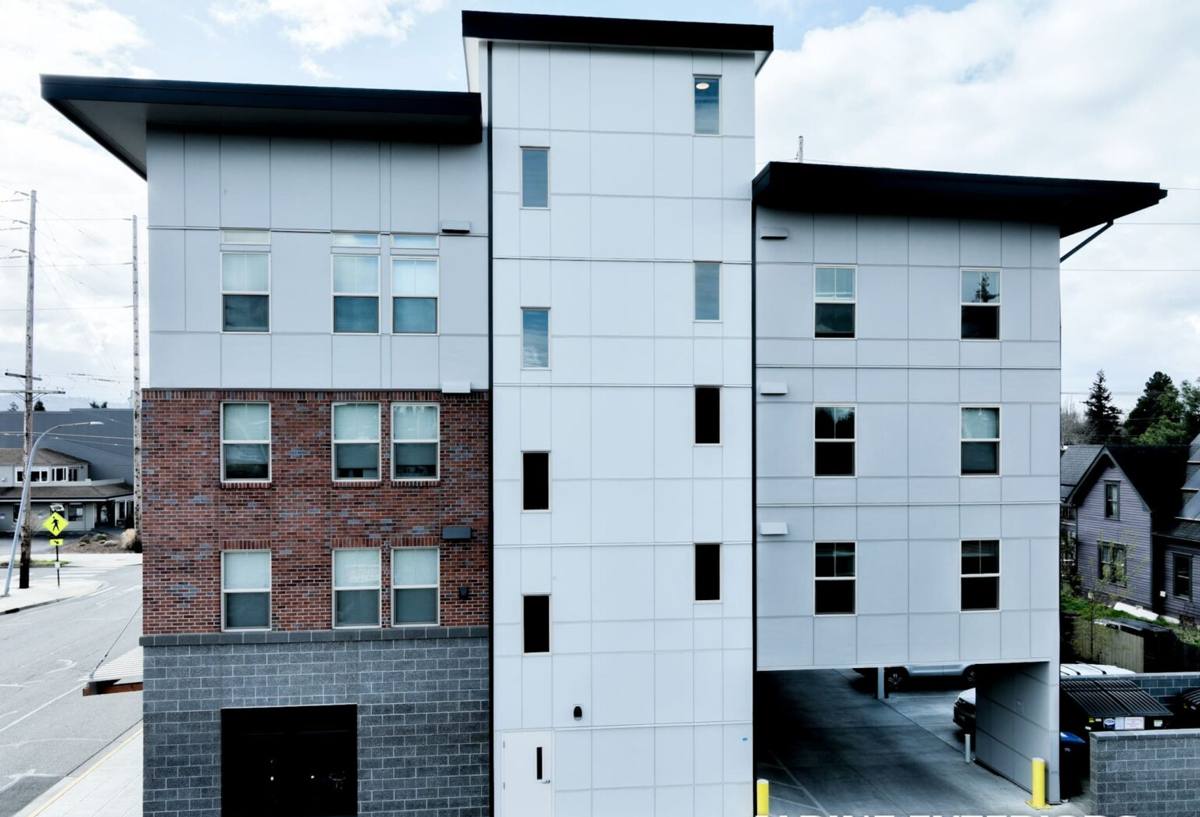
How Water Actually Gets Behind Siding
Most homeowners picture rot as water soaking through the face of the siding itself. That's rarely how it happens. In almost every case we find moisture damage, the water got in through a gap, seam, or penetration — not through the siding panel — and then got trapped behind it with nowhere to go.
The usual entry points
- Butt joints between siding pieces that weren't caulked, or where the caulk has failed
- Window and door trim where flashing was skipped or installed backwards
- Nail penetrations driven too deep or at the wrong angle, opening a path around the fastener
- Corner boards and outside corners where end grain is exposed and untreated
- Deck ledger boards and porch roof tie-ins, where two systems meet and flashing is easy to get wrong
- Missing or torn housewrap under the siding, so any water that does get past the surface has no drainage plane
In Lynden's climate, wind-driven rain finds these gaps more aggressively than it would in a calmer, drier region. A joint that might stay dry for years in eastern Washington can be a steady drip point here, especially on west- and south-facing walls that catch the prevailing weather.
What Rot Looks Like Before It's Obvious
By the time you can see daylight through a wall or push a screwdriver through the siding, the damage has usually been progressing for years. Catching it earlier means watching for quieter signs.
Early warning signs
- Paint that bubbles or peels in one specific spot, rather than uniformly across a wall — this usually means moisture is pushing out from behind, not just weathering from the sun
- Soft spots when you press on siding near the bottom courses, around window sills, or below deck ledgers
- Dark staining or streaking below joints or fastener heads
- Persistent moss or algae growth concentrated in one section rather than spread evenly — it often means that area stays wetter than the rest of the wall
- A musty smell in an adjacent interior room, especially near an exterior corner
- Visible gaps opening up at butt joints or where trim meets siding, where caulk has shrunk, cracked, or fallen out
Any one of these on its own isn't necessarily an emergency. Several of them together, or any of them near a known problem area like a deck attachment or a window without proper head flashing, are worth having a contractor actually pull a piece of siding to look behind it — not just look at the surface.
Why Material Choice Changes the Odds
Every siding material handles moisture differently, and that difference is exactly why we made the call to install one product exclusively. It's worth being straightforward about this rather than vague.
How common materials behave once water gets behind them
| Material | Behavior when moisture gets trapped behind it |
|---|---|
| Primed wood / spruce lap | Wood fiber absorbs moisture readily; once trapped, rot can set in within a single wet season if not caught |
| Cedar | More naturally rot-resistant than spruce, but still an organic material — sustained trapped moisture will eventually break it down, and it needs ongoing finish maintenance to keep water out in the first place |
| Vinyl | The panel itself doesn't rot, but it doesn't stop water either — it's a cladding that lets water pass behind it by design, so trapped moisture damages the wood sheathing and framing behind the vinyl while the vinyl looks fine |
| Fiber cement (general) | Doesn't absorb and swell the way wood does; performance still depends heavily on the specific formulation and factory finish |
This is the core reason we standardized on James Hardie fiber cement rather than offering a mix of products. Hardie's HZ5 formulation is engineered specifically for climates with sustained moisture exposure like ours — it resists moisture-driven swelling and doesn't feed rot the way wood-based products can. The ColorPlus factory finish is baked on under controlled conditions, which gives it more consistent water-shedding performance at the surface than field-applied paint, and it holds up to the freeze-thaw and wet-dry cycling that's common here without the finish failing early and exposing the substrate.
We're not saying every other product is unusable — plenty of homes have wood or vinyl siding that's performed fine for decades. We're saying that after years of tearing into walls and seeing where problems actually start, we decided the moisture math favors one product clearly enough that it's the only one we put our name behind.
The Role of Installation — Not Just Material
A good product installed poorly will fail faster than an average product installed correctly. This is true of every siding material, Hardie included. The moisture problems we see most often trace back to a handful of installation details:
- Flashing installed in the wrong order relative to the housewrap, so water is directed behind the drainage plane instead of over it
- Missing kick-out flashing where a roofline meets a wall, sending roof runoff directly down behind the siding
- Siding installed tight to the ground or to a deck surface with no clearance, wicking up standing water
- Caulk used to "solve" a gap that should have been flashed instead — caulk is a maintenance item, not a substitute for proper water management
- Fasteners driven incorrectly, either too deep (crushing the material and opening a path for water) or at the wrong location on the panel
This is why the installation crew's experience with a specific product matters as much as the product itself. Hardie publishes detailed installation specs for a reason, and following them — proper clearances, correct fastener placement, flashing sequence — is what actually delivers the moisture performance the material is capable of.
What Lynden's Climate Specifically Demands
A few regional details are worth calling out directly rather than leaving general:
Rain volume and direction
Whatcom County's rainfall isn't just heavy in total — it arrives as sustained, wind-driven weather systems that push water sideways into wall assemblies more than a straight-down downpour would. Walls facing the prevailing weather need especially reliable flashing and joint work.
Moss and organic growth
A long, cool, damp season gives moss and algae months to establish on north-facing walls, roof-adjacent siding, and anywhere shade keeps a surface from drying out between rains. Growth that's allowed to persist holds moisture against the surface longer, which accelerates whatever underlying vulnerability the material has.
Salt air
Being close enough to the Strait and Bellingham Bay for salt-laden air to reach inland means fasteners, trim, and any exposed metal flashing are working against corrosion in addition to moisture. Material and fastener choices that ignore this age faster than they should.
A Practical Homeowner Checklist
You don't need to be a contractor to do a basic seasonal check. Twice a year — before the wet season ramps up in fall, and again in spring — walk the exterior and look for:
- Cracked, shrunken, or missing caulk at butt joints, corners, and window/door trim
- Soft or spongy spots when pressed gently near the bottom of walls and under windows
- Paint or finish failure concentrated in specific spots rather than spread evenly
- Moss or algae buildup that's noticeably thicker in one area
- Gutters and downspouts actually carrying water away from the wall, not overflowing onto it
- Vegetation or mulch beds keeping soil and moisture in constant contact with the bottom of the siding
- Any staining below deck ledger boards or roof-to-wall intersections
Anything you find on that list is worth a professional look before it becomes a bigger repair. Catching a failed joint early is a caulk-and-flashing fix; catching it five years later can mean replacing sheathing and framing behind the siding.
When Repair Isn't Enough
Sometimes a homeowner calls about one bad spot and, once we open the wall up, finds the same installation shortcuts repeated at every window and corner on that elevation. In that situation, patching the one visible spot buys a little time but doesn't address what caused it. A full re-side, done to spec, is often the more honest answer — not because a spot repair can't be done, but because the underlying pattern will keep producing the same failure elsewhere.
We'll always tell you honestly which situation you're in. If a repair will genuinely hold, we'll say so. If we think you're looking at recurring failures because of a systemic installation issue, we'll explain why and let you make the call.
If you're seeing any of the warning signs above, or you'd just like a second set of eyes on your siding before the next wet season sets in, we're happy to come take a look. Estimates are free and there's no pressure to move forward — just a straight assessment of what we find.