 Lynden Siding
 Why Siding Fails Faster in Whatcom County
Siding in Lynden works harder than siding almost anywhere else in the state. Between the driving rain that blows in off the Pacific through the Nooksack Valley, the damp air that sits over the fields most of the fall and winter, and a moss and mildew season that can run eight months or longer, your home's exterior is under near-constant moisture pressure. Add in the freeze-thaw swings we get a handful of times each winter, and you have a climate that finds every weak point in a siding system and exploits it.
Most siding doesn't fail all at once. It fails slowly, in ways that are easy to write off as cosmetic — a little discoloration here, a hairline crack there — until the underlying structure of the wall is compromised and the repair bill has grown from "recaulk and repaint" to "replace the sheathing." Knowing what to look for, and what each sign actually means, is the difference between catching a problem at the cheap stage and catching it at the expensive one.
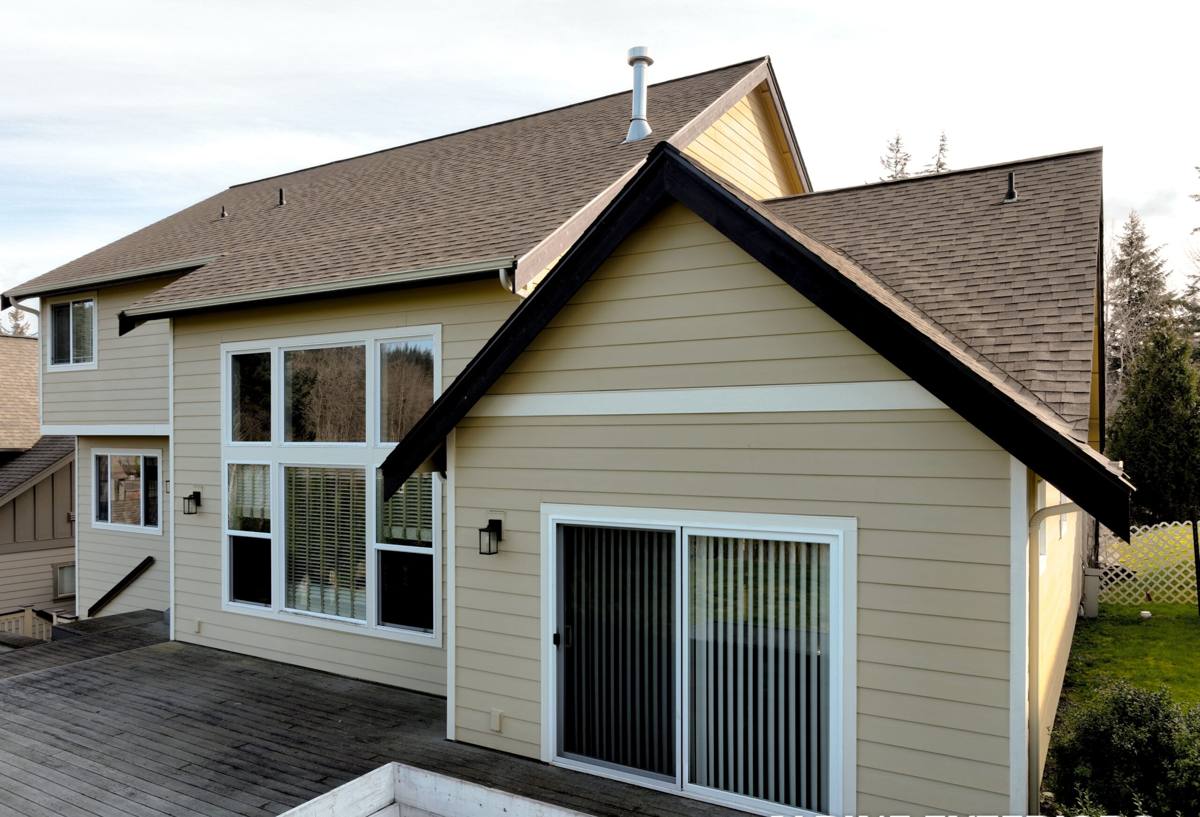
Cracking, Splitting, and Chipped Boards
Cracks in siding are rarely just an appearance issue. A crack is an entry point. Once water gets behind the face of a board, it doesn't evaporate the way it does off the surface — it sits against the wood or substrate underneath, and Whatcom County's humidity means it can stay wet for days after a storm.
What causes it
- Wood and engineered wood siding drying out, swelling with moisture, and drying out again over years — the freeze-thaw cycle accelerates this
- Impact damage from hail, falling branches, or lawn equipment that wasn't sealed properly afterward
- Board edges and butt joints that were never caulked or that lost their caulk years ago
A single small crack, caught early, is a minor repair. A wall covered in hairline cracks usually means the siding itself is past its functional life, not just cosmetically tired.
Bubbling, Peeling, or Chalky Paint
Paint failure on siding almost always means moisture is moving through the material from the inside out, not just weather wearing down the outer coat. When paint bubbles or peels in patches rather than evenly across a wall, that's usually trapped moisture pushing outward as it evaporates.
Chalking — a fine, powdery residue that comes off on your hand when you touch the siding — is different and less urgent. Some chalking is a normal part of a paint film aging in UV light. But heavy, early chalking on siding that's only a few years old can point to a lower-grade paint or primer that wasn't suited to our wet-dry cycle to begin with.
Why this matters for repainting decisions
Homeowners often assume peeling siding just needs a fresh coat of paint. If the peeling is caused by moisture escaping from behind the board, repainting without addressing the moisture source only buys a year or two before it happens again — and each repaint cycle is money that could have gone toward a permanent fix.
Soft, Spongy, or Bulging Spots
This is the sign that should move fastest to the top of your list. Press on the siding near the bottom of walls, around window and door trim, and beneath any deck ledger boards. If it gives under light pressure, flexes, or feels spongy compared to the surrounding wall, water has gotten into the substrate and is breaking it down.
Wood-based siding and trim are the most vulnerable to this because wood loses structural integrity as it absorbs and holds moisture. Left unaddressed, soft spots don't stay small — they spread as rot works outward from the wet zone, and by the time you can see a visible sag or dip in the wall, the sheathing behind the siding is very likely compromised too.
| What you feel | Likely stage | Typical next step |
|---|---|---|
| Slight give, no visible damage | Early moisture intrusion | Localized inspection and repair |
| Noticeable sponginess, board still intact | Active rot in progress | Section replacement, check sheathing |
| Visible sag, crumbling edges | Advanced structural rot | Sheathing repair, full section or wall replacement |
Warping, Buckling, and Gaps at the Seams
Siding that has pulled away from the wall, buckled outward, or developed visible gaps at the seams is telling you it's no longer lying flat against the house — which means it's no longer shedding water the way it was designed to. This is common with lower-grade lap siding that wasn't rated for sustained moisture exposure, and it shows up more in homes with west- and south-facing walls that take the brunt of wind-driven rain coming off the strait.
Common causes locally
- Fasteners that have backed out slightly as the board expanded and contracted through repeated wet-dry cycles
- Siding installed with insufficient expansion gaps at the factory-recommended clearances
- House wrap or flashing behind the siding that failed years earlier, letting moisture cycle the board from behind
Gaps at seams are also simply an efficiency problem — every gap is a place for conditioned air to escape and outside air, insects, and moisture to get in.
Moss, Mildew, and Stubborn Staining
Some moss and mildew on north-facing walls or under eaves is close to unavoidable in Lynden — our moss season stretches from fall through spring, and shaded, slow-drying surfaces will pick up growth no matter how good the siding is. The distinction that matters is between surface growth that washes off and staining that keeps coming back darker and faster after each cleaning.
Recurring, aggressive moss and mildew growth usually means the siding surface has become porous or damaged enough to hold moisture rather than shed it. Once a material starts absorbing water instead of resisting it, growth accelerates every season, and pressure washing — if done too aggressively — can actually force water further into already-compromised boards.
Rising Energy Bills and Interior Drafts
Siding failure doesn't always show up outside first. If you've noticed rooms that are harder to keep warm, drafts near exterior walls, or a heating bill that's crept up without an obvious reason, gaps, warping, or moisture-saturated siding could be part of the cause. Wet insulation loses much of its R-value, and a wall system that's no longer sealed tight lets conditioned air leak out steadily, even when you can't feel a direct draft.
This is one of the more overlooked warning signs because homeowners chase it with furnace tune-ups and attic insulation before ever suspecting the exterior wall assembly.
Repair, or Time to Replace?
Not every warning sign means a full re-side. A lot of early-stage issues — a cracked board, a failed caulk joint, isolated peeling — are legitimate spot repairs. The judgment call is whether the damage is isolated or systemic.
| Sign | Repair usually makes sense | Replacement usually makes sense |
|---|---|---|
| Cracking | A few isolated boards | Cracking spread across most of a wall |
| Soft spots | Small area, sheathing still solid | Multiple soft areas, sheathing compromised |
| Paint failure | Isolated peeling, siding is sound underneath | Chronic bubbling tied to moisture intrusion |
| Gaps/buckling | A few boards, fasteners can be reset | Widespread, siding no longer lying flat |
| Age | Siding under 15 years, good condition otherwise | Siding past its expected service life |
If more than one of these signs is showing up in the same area of the house, that's usually a sign of a systemic problem rather than an isolated one — and it's worth having someone look at the whole wall assembly, not just the visible symptom.
What We Look For, and What We Recommend
When we inspect siding on a Lynden home, we're checking more than the surface — we pull back trim where we can, check for soft spots at the base of walls, and look at how the siding has performed at corners, seams, and around penetrations like hose bibs and vents, since those are where failure tends to start first in our climate.
When a homeowner is facing a full re-side rather than a repair, we only install James Hardie fiber cement siding. It's the one product we've found holds up consistently against the specific combination of driving rain, sustained humidity, and long moss seasons that Whatcom County throws at a house year after year. It's non-combustible, it's engineered specifically for Pacific Northwest moisture conditions in Hardie's HZ5 product line, it holds a factory-applied ColorPlus finish that doesn't chalk or fade the way field-applied paint does, and it carries a strong transferable warranty when installed to spec. We won't tell you every failing siding needs to be replaced with it — plenty of the signs above are honest repairs — but when replacement is the right call, it's what we put on our own recommendations list without hesitation.
Quick Self-Inspection Checklist
- Press firmly on siding near the bottom of walls, around windows, and under deck ledgers — check for give or sponginess
- Look for cracking or chipping concentrated on south- and west-facing walls
- Check for paint that's bubbling or peeling in patches rather than wearing evenly
- Look at seams and corners for gaps, buckling, or boards pulling away from the wall
- Note whether moss or mildew comes back quickly and darker after cleaning
- Compare recent heating bills to the same months in prior years
If you're seeing one or more of these signs on your home, we're happy to take a look and give you an honest read on whether it's a repair or a replacement — no pressure, no hard sell, just a straight answer. Reach out for a free estimate and we'll walk the exterior with you.