 Lynden Siding
 Siding Repair in Everson: A Nooksack Valley Community With Its Own Wear Pattern
Everson sits along the Nooksack River just a few miles from Lynden, in the flat farmland that defines this part of Whatcom County. It's inland compared to the waterfront communities out toward Birch Bay or Drayton Harbor, but it still sits squarely inside the marine weather pattern that governs the whole county — winter storms push moist, salt-influenced air off the Salish Sea and carry it up the river valleys, and the open agricultural terrain around Everson does little to slow driving rain down once it starts moving sideways. Combine that with mild, wet conditions most of the year and you get a long moss and mildew season on shaded siding. None of that is unique to Everson, but the way it shows up on a home's exterior — where the damage tends to concentrate, how fast a small problem spreads if it's ignored — is specific enough that a siding repair here deserves more than a generic patch job.
We work siding, roofing, windows, and decks throughout Lynden and the surrounding Nooksack Valley communities, and Everson is regular territory for us, not an occasional stop. That matters for repair work specifically, because knowing what a house in this area typically looks like under its siding — what's usually failing, where, and why — is the difference between a repair that actually holds and one that's papering over a problem that resurfaces in a year or two.
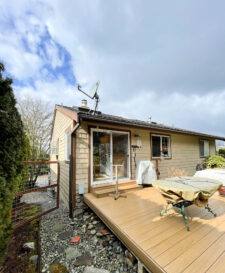
What Everson's Climate Does to Siding
Driving Rain and Wind Exposure
Flat, open farmland doesn't offer much of a windbreak, and storms moving up the Nooksack Valley push rain into wall surfaces at an angle rather than straight down. That matters for siding repair because water doesn't just land on a surface and run off — it gets driven into laps, seams, butt joints, and any spot where caulk or flashing has started to fail. A crack or gap that would stay dry in a calmer climate becomes an active water entry point here.
Salt-Influenced Marine Air
Everson doesn't take direct salt spray the way a true waterfront property does, but the marine air that moves inland on winter storms still carries enough salt to accelerate corrosion on fasteners, hardware, and lower-grade trim over the years. On older homes, the first sign of trouble often isn't the siding panel itself but the nails or staples holding it, which have started to rust and let panels work loose.
Moss, Mildew, and Standing Moisture
Mild, wet conditions for most of the year create ideal growth conditions for moss and mildew, and siding is one of the first places it shows up — especially on north-facing walls, under eaves with poor airflow, and anywhere water is slow to drain off a horizontal surface. Left alone, moss and mildew hold moisture directly against the siding surface far longer than open air would, which accelerates whatever underlying damage is already present.
Freeze-Thaw and Seasonal Movement
Whatcom County doesn't see extreme cold most winters, but it does see enough freeze-thaw cycling to stress siding that's already compromised. Water that's worked its way into a crack or seam and then freezes expands that damage; a hairline gap in the fall can be a real problem by spring.
Signs an Everson Home Needs Siding Repair
Some damage is obvious from the ground. Some isn't, and that's usually the kind that costs more to ignore. Worth checking for:
- Visible cracking, splitting, or buckling in individual siding panels or boards
- Soft spots when pressed, especially near the bottom courses or around window and door trim
- Paint or finish that's peeling, bubbling, or discoloring faster than the rest of the wall
- Moss or dark staining concentrated in one area rather than spread evenly across the exterior
- Gaps opening up at seams, corners, or where siding meets trim, flashing, or the foundation
- Interior signs — a musty smell, discoloration on interior walls, or soft drywall near an exterior wall
- Siding panels that feel loose or move when pushed by hand
Common Siding Repair Situations We Handle in Everson
Not every repair call is the same problem, and what's actually failing changes what the right fix looks like.
| What We're Seeing | Likely Cause | Typical Fix |
|---|---|---|
| Isolated cracked or split boards | Impact damage, material fatigue, or fastener stress | Remove and replace affected boards, matched to the existing profile |
| Soft, spongy siding near the base of walls | Splash-back moisture, poor grade slope, or failed flashing | Replace damaged material and correct the underlying moisture source |
| Cracking or gapping around window and door trim | Failed caulking or flashing that was never lapped correctly | Re-flash the opening properly, then repair or replace trim and siding |
| Widespread moss and staining | Poor airflow, shade, and long-term moisture exposure | Clean, assess for hidden rot, repair as needed, address drainage or airflow where possible |
| Loose or popped panels | Corroded fasteners or an original installation error | Re-fasten or replace with corrosion-resistant hardware |
What a Correct Siding Repair Actually Involves
A siding repair that just replaces the visibly damaged board and stops there is a cosmetic fix, not a real one. We treat every repair call as an investigation first: pull the damaged material, look at what's behind it — the weather-resistive barrier, the sheathing, the flashing at any nearby penetration — and only then decide what the repair actually needs to include.
Matching Structure, Not Just Appearance
Replacement boards need to match the existing siding's profile, exposure, and fastening pattern, or the repair will be visible and, worse, may not shed water the same way the surrounding siding does. Butt joints and laps have to be built the same way the rest of the wall was built, not just close enough to look right from the street.
Checking What's Behind the Siding
If we find soft sheathing, a compromised weather barrier, or flashing that was never installed correctly, patching the visible siding without fixing that underlying issue guarantees the same repair call again in a year or two. This step is what separates a lasting repair from a temporary one.
Sealing and Flashing Details
Any repair that touches a window, door, corner, or penetration gets flashing corrected as part of the job, not caulk applied over the old problem. Caulk is a supplement to proper flashing, never a substitute for it — and in a climate that drives rain sideways into walls, that distinction matters more than it would somewhere drier.
Why We Repair — and Rebuild — in James Hardie, Not Whatever's Already There
A lot of the repair calls we get in Everson involve homes originally sided in cedar, vinyl, or engineered wood products like LP SmartSide. When a section of any of those materials fails, the honest options are: patch it with more of the same, or use the repair as an opportunity to transition that section — or the whole elevation — to James Hardie fiber cement, which is the only siding product we install as a company.
We don't say that to sell an upgrade nobody asked for. It's a straightforward material trade-off. Cedar looks good but demands a strict maintenance schedule to keep moisture from working into it over time; vinyl can crack in cold snaps and doesn't carry the same structural rigidity as a fiber cement board; LP SmartSide is engineered wood, which means it's still wood at its core and depends on caulking and paint staying intact to keep moisture out. James Hardie's fiber cement doesn't rot, doesn't attract insects, and isn't combustible — and its factory-applied ColorPlus finish holds color longer than field-applied paint on wood-based products. In a climate that runs wet for most of the year, that's a real difference in how often a homeowner ends up back on a ladder or back on the phone with a repair crew.
The Color-Matching Trade-Off, Told Straight
One honest limitation: if only part of a wall is being repaired and the rest is older, weathered Hardie siding, matching the new board's ColorPlus finish to sun-faded existing siding isn't always seamless. We'll tell you upfront when a repair is likely to be visible for that reason, and talk through whether a slight color difference is an acceptable trade-off against replacing more of the wall than is actually damaged.
Repair vs. Full Re-Side: How We Help Everson Homeowners Decide
| Situation | Repair Usually Makes Sense | Full Re-Side Usually Makes Sense |
|---|---|---|
| Damage limited to one or two isolated areas | Yes | Not necessary yet |
| Underlying sheathing and weather barrier are sound | Yes | Not required for that reason alone |
| Damage is spread across multiple elevations | Rarely cost-effective long-term | Yes |
| Original material is failing structurally, not just cosmetically | Short-term only | Yes |
| Home is 20+ years old with no siding upgrades and recurring repairs | Case-by-case | Often the better long-term value |
We'll always give a straight answer on which side of that line a given home falls on, rather than defaulting to whichever option is better for us.
Why a Crew That Already Works Everson Matters
A contractor who regularly works this part of Whatcom County already has a sense of what's typically found behind Everson siding before the first board comes off — what installation shortcuts were common in a given era of construction, how moisture tends to travel through a wall assembly built the way homes here were built, and which repairs are worth doing versus which ones are a stopgap. That local pattern recognition doesn't replace an on-site inspection, but it does mean fewer surprises and a more accurate scope from the start.
Our Process
We start with an on-site inspection of the damaged area and a check of what's around it — trim, flashing, nearby penetrations, and any spots where water may be traveling beyond where the damage is visible. From there we give a straightforward assessment: what needs to be repaired, what, if anything, needs to be replaced instead, and why. Every job gets a written scope before work starts, and every repair that touches flashing or moisture-barrier detail gets that corrected as standard practice, not offered as an upsell.
If you've got a section of damaged, cracked, or moss-covered siding on an Everson property — or you're just not sure whether it's a repair or something bigger — we're glad to take a look. Reach out below for a free, no-pressure estimate.