 Lynden Siding
 Siding Repair in Sumas: What Local Homes Are Up Against
Sumas sits at the northern edge of Whatcom County, tucked against the foothills where the valley narrows into what locals and meteorologists alike call the Sumas Gap. That geography matters for siding. In winter, cold outflow air funnels down through the gap from the Fraser Valley, driving temperatures lower and wind harder than you'll see just a few miles south. In the wetter months, moist marine air pushes up the Nooksack River valley and settles against the same foothills, which means long stretches of fog, drizzle, and driving rain that don't burn off quickly.
That combination — salt-tinged marine air, sideways rain, and short winter cold snaps — is hard on exterior siding no matter what it's made of. Add in the shade from mature trees and the valley's naturally damp air, and you get a long moss and algae season that can run from fall through spring. Homes here don't fail because owners neglect them; they fail because the climate asks more of the siding than a lot of products were built to handle over decades of exposure.
We repair siding throughout the Sumas area, and the patterns we see are consistent: moisture finding its way behind panels through failed caulk or old fastener holes, moss holding water against north-facing walls, and paint or coatings breaking down faster than homeowners expect. A good repair addresses the actual cause, not just the visible damage.
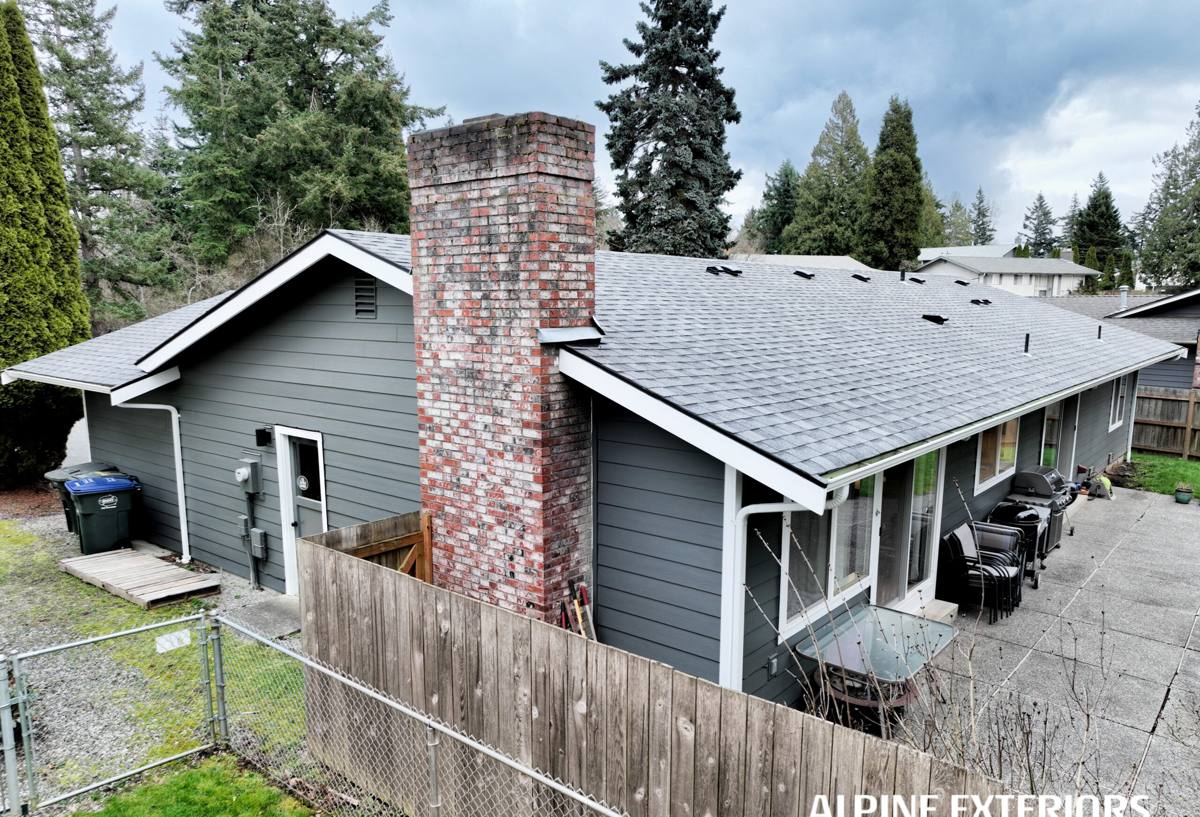
Signs Your Sumas Home May Need Siding Repair
Moisture and Rot Signs
- Soft or spongy spots when you press on the siding, especially near the bottom courses
- Dark staining or streaking below seams, trim, or window flashing
- Paint that's bubbling, peeling, or flaking in localized patches rather than evenly across a wall
- A musty smell near an exterior wall from the inside of the house
- Visible gaps where panels have pulled away from trim or from each other
Moss, Algae, and Surface Wear
A light green film on north-facing or shaded walls is common in this climate and isn't automatically a repair issue — it's a maintenance one. But moss that's been left to build up in laps, seams, or behind trim boards holds moisture against the siding material for months at a time. On some materials that constant damp contact eventually breaks down the surface or the substrate underneath, which turns a cleaning job into a repair job if it's ignored too long.
What a Correct Siding Repair Actually Involves
A siding repair isn't just cutting out a bad piece and nailing up a new one. Done right, it starts with figuring out why that section failed in the first place — a flashing detail that was never installed correctly, a caulk joint that opened up years ago, a fastener that was overdriven and cracked the material around it. If you replace the damaged piece without fixing the underlying cause, you're scheduling the same repair again in a few years.
It's Not Just Patching a Hole
A proper repair also has to deal with what's behind the siding. If water has been getting in for a while, the house wrap or building paper underneath may need attention, and any sheathing that's gone soft needs to be identified before new siding goes back over it. Covering rot with a fresh piece of siding hides the problem instead of solving it. We check what's underneath before we close anything back up.
Matching is the other piece homeowners underestimate. Siding that's weathered for ten or fifteen years won't look identical to a brand-new piece straight out of the box, even in the same color and profile. A repair crew that does this regularly knows how to blend a patch into an existing wall — matching reveal lines, coursing, and trim details — so the fix doesn't stand out as an obvious patch job.
Common Repair Scenarios We See Around Sumas
- Impact damage: cracked or dented panels from storm debris, ladders, or yard equipment
- Moisture-damaged bottom courses: the lowest rows of siding, closest to grade and splashback, tend to show wear first
- Failed caulking and trim gaps: open joints around windows, doors, and corner boards that let water track behind the siding
- Moss-driven surface breakdown: sections where moss or algae was left unaddressed long enough to affect the material underneath
- Fastener and seam issues: nails that have backed out, split panels around fasteners, or seams that have opened with age
- Repairs after other trade work: siding removed and poorly reinstalled around a new window, vent, or electrical service
Repair or Replace? Weighing the Real Factors
Not every damaged wall needs a full re-side, and not every repair is worth doing on its own. The honest answer usually depends on how much of the house is affected, how old the existing siding is, and what's causing the damage. Here's how we think through it:
| Factor | Repair usually makes sense | Replacement usually makes sense |
|---|---|---|
| Extent of damage | Isolated to one wall, corner, or a handful of panels | Showing up in multiple areas across the house |
| Age of existing siding | Siding is under 10-15 years old and otherwise sound | Siding is at or past its expected service life |
| Underlying material | Sheathing and house wrap behind the damage are intact | Water damage has spread to sheathing in several spots |
| Product type | James Hardie fiber cement in good general condition | Vinyl, LP SmartSide, or wood products showing widespread wear |
| Cause of damage | A single event (impact, one bad flashing detail) | A systemic issue affecting the whole envelope |
We'll always tell you honestly which side of that table your home falls on. A targeted repair that solves the actual problem is often the right call — we don't push full replacements when they aren't needed.
Why We Repair Exclusively with James Hardie Fiber Cement
When a repair calls for new material, we install James Hardie fiber cement — that's the only siding product we put on a home, whether it's a full project or a patch on an existing wall. We made that call because fiber cement holds up to exactly the conditions Sumas deals with: it's non-combustible, it doesn't swell or rot when it stays damp through a long moss season, and it's engineered specifically for Pacific Northwest moisture rather than a generic national spec.
That matters for repair work specifically. If your home already has Hardie siding, we can match the existing panels closely in profile and, in many cases, order factory ColorPlus finish that's engineered to weather at the same rate as what's already on the wall — so a repair blends in rather than aging differently from everything around it. If your home currently has vinyl, LP SmartSide, or another product we don't install, we'll say so plainly and explain the trade-offs, but we won't patch it with a different material or pretend a mismatched repair is a long-term fix. In those cases we'll talk through whether a full re-side to Hardie makes more sense than continuing to chase repairs on a product that's reaching the end of what it can reasonably do.
Our Siding Repair Process, Start to Finish
- On-site inspection of the damaged area and a look at what's happening behind the siding, not just what's visible
- An honest assessment of the cause — flashing, caulking, fastening, or material failure — and whether repair or partial replacement is the right fix
- A written scope and price before any work starts, so there are no surprises
- Removal of the damaged material and inspection of the house wrap and sheathing underneath
- Correction of the underlying issue (re-flashing, re-wrapping, or sheathing repair as needed) before new siding goes back on
- Installation of new James Hardie material, matched to the existing coursing, reveal, and finish as closely as possible
- Proper sealing and detailing at all seams, trim, and penetrations to prevent the same failure from recurring
- A final walkthrough so you can see exactly what was done and why
Why Hire a Crew That Already Works in Sumas
Repair work rewards local knowledge in a way full new-construction siding sometimes doesn't. A crew that's already worked on homes in and around Sumas has seen how this valley's wind, rain, and moss pattern actually plays out on a wall over ten or twenty years — which corners take the worst of the weather, which details tend to fail first, which older siding products were common in this area and how they age. That's useful when you're trying to match an existing repair or figure out why a particular section of the house keeps giving you trouble.
It also means straightforward logistics: a crew based in Whatcom County isn't traveling hours to get to a repair call, get material, or come back for a follow-up detail. For a repair — often a shorter, more schedule-sensitive job than a full re-side — that local footprint matters.
Keeping Your Siding in Good Shape After the Repair
A good repair should be the last time you deal with that particular problem. A little regular attention keeps it that way, especially given how long the moss season runs here:
- Rinse siding annually, focusing on shaded, north-facing walls where moss and algae build up fastest
- Keep gutters clear so overflow isn't running down the siding face during heavy rain
- Trim back landscaping and tree limbs that keep walls shaded and damp longer than they need to be
- Walk the exterior once or twice a year and check caulking around windows, doors, and trim for cracks or gaps
- Address small issues — a loose piece of trim, a cracked caulk joint — before the next wet season, not after
- Avoid pressure washing directly at seams and edges, which can force water behind the siding instead of removing it
If you're noticing damage, staining, or moss buildup on your Sumas home and want a straight answer on whether it's a repair or something bigger, we're glad to take a look. We offer free, no-pressure estimates — no obligation, just an honest assessment of what your siding actually needs.