 Lynden Siding
 Why Birch Bay's Coastline Is Tougher on Decks Than Most People Expect
Birch Bay sits right on the water, and that changes what a deck has to deal with compared to a home a few miles inland in Lynden. Salt-laden air moves off the bay and settles on everything — railings, fasteners, board surfaces — and it doesn't take a storm to do it. A steady onshore breeze on an ordinary afternoon carries enough salt to accelerate corrosion on the wrong hardware and dull the finish on the wrong decking material over a few seasons.
Add in Whatcom County's long stretch of driving rain each fall and winter, plus shaded, damp corners of the yard where moss and algae get a head start every year, and you've got a deck environment that's genuinely harder on materials than what you'd see in a drier or more inland part of Washington. None of this means composite decking is a bad choice for Birch Bay — it's actually one of the better ones — but it does mean the product selection and the build details matter more here than they would somewhere with a milder climate.
What a Correct Composite Deck Build Involves in This Climate
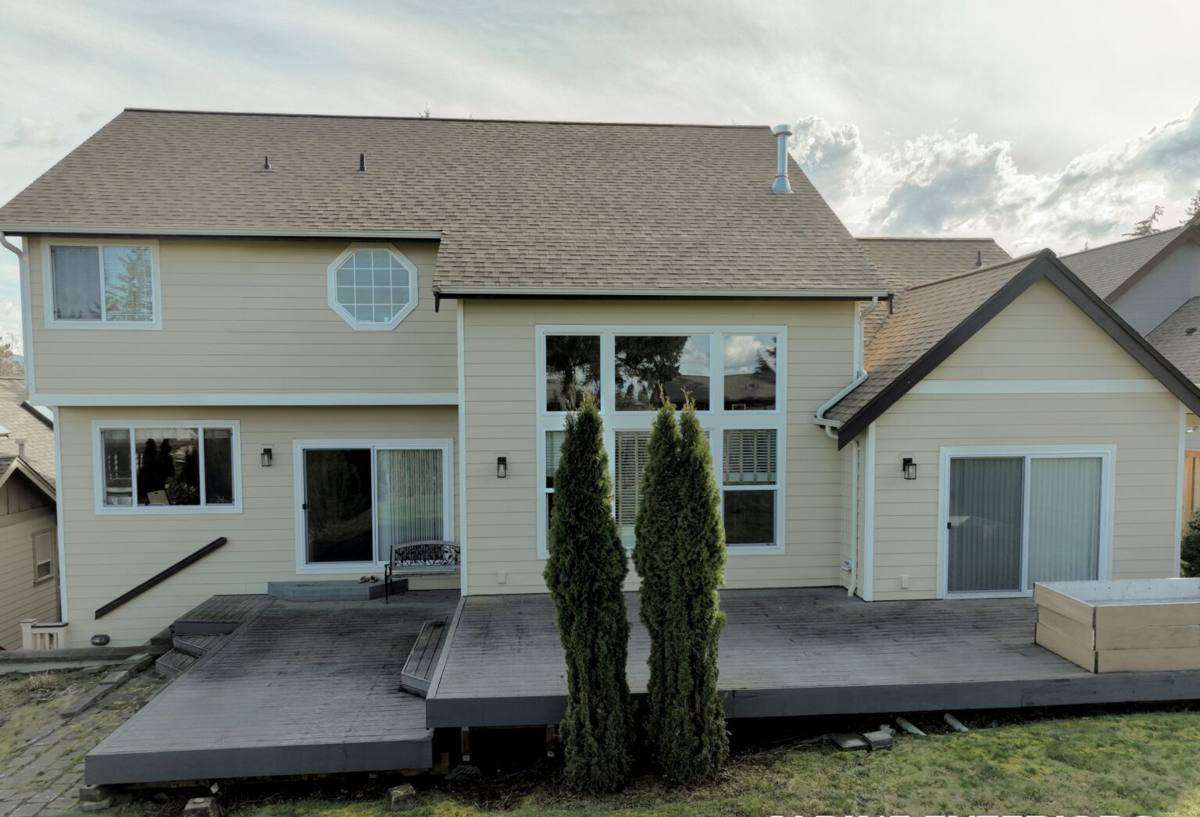
A deck that holds up on the Birch Bay shoreline isn't just "composite boards screwed to a frame." The framing underneath, the hardware holding it together, the airflow beneath the boards, and the drainage path water takes all matter as much as the decking surface itself. Skimping on any one of those is how a homeowner ends up with a deck that looks fine for two or three years and then starts showing problems that are expensive to fix after the fact.
Framing and Ventilation
Composite boards need airflow underneath them to dry out between rain events. A deck built low to the ground, or with poor grading beneath it, traps moisture against the joists and the underside of the boards. Over time that's what leads to mold, mildew staining, and premature wear — not the composite material failing on its own, but the framing conditions around it working against it.
Drainage and Grading
Water needs somewhere to go. On a property near the bay, ground moisture is already higher than average, so the grading under and around a deck has to actively move water away from the structure rather than let it pool. This is a detail that's easy to get wrong and hard to see once the deck is finished — which is exactly why it needs to be done right the first time.
Choosing the Right Composite Board for Salt Air Exposure
Not all composite decking is built the same way, and in a salt-air environment the difference matters more than it would elsewhere. Capped composite boards — where a protective polymer shell surrounds the wood-plastic core — resist moisture absorption, staining, and fading far better than older-generation uncapped composite. In a coastal setting, that cap is doing real work against salt residue and constant damp-dry cycling.
Board color and texture also play a role. Darker boards absorb more heat and can accelerate expansion and contraction, while certain surface textures shed water and resist slip better in a climate where the deck surface is wet more often than it's dry. We walk homeowners through these tradeoffs based on how the deck will actually be used — a shaded, moss-prone deck near tree cover needs different considerations than an open deck that gets full exposure to bay winds.
Fasteners, Framing Hardware, and Where Corrosion Actually Starts
This is the part of a deck build that homeowners rarely think about but that determines how long the whole structure lasts near the water. Standard-grade screws, brackets, and joist hangers corrode faster in salt air, and once hardware starts failing, it doesn't matter how good the decking boards are — the structure underneath them is compromised.
- Stainless steel or coated corrosion-resistant fasteners rated for coastal or treated-lumber use
- Hidden fastener systems compatible with the specific board profile being installed
- Joist hangers and structural connectors matched to the fastener's corrosion rating, not just the cheapest option that fits
- Ledger board flashing and waterproofing where the deck attaches to the house
Using mismatched or under-rated hardware is one of the most common shortcuts we see on decks that were built by crews without regular experience in coastal conditions. It's not always visible at installation — it shows up two or three winters later.
Moss, Mildew, and Managing the Shade-and-Moisture Season
Birch Bay's tree cover and marine humidity combine to create a long moss season on shaded surfaces, and decks are no exception. Composite decking resists rot the way wood doesn't, but moss and algae can still take hold on the surface if a deck stays damp and shaded for extended stretches, particularly in the darker months of the year.
The build itself can reduce how much of a problem this becomes. Proper board spacing, airflow underneath the deck, and keeping overhanging vegetation trimmed back all reduce the conditions moss needs to establish. Board texture matters too — a heavily textured, low-sheen surface can hold organic growth longer than a smoother capped board in a shaded location. We factor this into the product recommendation when a deck sits under tree cover or on the shaded side of a home.
Our Installation Process for Birch Bay Homes
The process starts with a site visit, not a generic quote. We look at sun and shade exposure, proximity to the water, existing drainage patterns, and the condition of any structure the new deck will tie into. From there:
- We assess the substructure — whether it's a new build or replacing an existing deck surface — and confirm the framing meets current load and spacing requirements before any composite goes down.
- We select board type, color, and fastener system based on the deck's actual exposure to sun, shade, and salt air, not a one-size-fits-all default.
- We install with corrosion-rated hardware and confirm proper ventilation and drainage beneath the deck surface.
- We finish with railing, stair, and edge details that match the home, and walk the homeowner through basic seasonal care before we consider the job done.
We don't rush the substructure step to get to the visible decking faster. That's where the long-term durability of the whole deck actually gets decided.
Composite vs. Wood vs. PVC Decking: What Actually Fits This Climate
Homeowners in Birch Bay often ask us to compare their options directly, since each material behaves differently in a wet, salty, shaded environment. Here's how they generally stack up for a coastal Whatcom County property:
| Material | Moisture & Salt Air Behavior | Maintenance Burden | Typical Lifespan |
|---|---|---|---|
| Pressure-treated wood | Absorbs moisture, prone to splintering and rot in shaded, damp areas | Annual staining/sealing required | 10–15 years with upkeep |
| Capped composite | Resists moisture absorption and salt staining well | Occasional washing, no sealing/staining | 25+ years, backed by manufacturer warranty |
| PVC decking | Fully moisture-resistant, unaffected by salt exposure | Low; similar washing routine to composite | Comparable to or longer than composite, at a higher material cost |
We install composite for the large majority of Birch Bay projects because it strikes the best balance of upfront cost, coastal durability, and low maintenance. PVC is a reasonable step up for homeowners who want maximum moisture resistance and are willing to pay more for it. We're honest about that tradeoff rather than pushing whichever product has the best margin.
Maintenance Checklist for a Composite Deck Near the Water
Composite decking is low-maintenance, not no-maintenance — especially this close to the bay. A little seasonal attention keeps a properly built deck looking and performing the way it should for decades.
- Rinse the deck surface periodically to remove salt residue, especially after windy weather off the water
- Sweep debris and organic matter out of shaded corners before it has a chance to hold moisture
- Check that gaps between boards stay clear so water keeps draining properly underneath
- Inspect railing posts and stair connections for looseness once a year
- Trim back overhanging vegetation that keeps sections of the deck shaded and damp
- Address any surface staining early with a mild composite-safe cleaner rather than letting it set in
Why It Matters That Your Crew Already Works Birch Bay
A lot of what determines whether a composite deck lasts near the water comes down to decisions made before the first board is installed — fastener selection, framing spacing, drainage grading, board choice for sun and shade exposure. Those are exactly the details a crew learns from building decks repeatedly in this specific environment, not from a general decking job somewhere inland.
We're based in Lynden and work throughout Whatcom County, including the coastal communities like Birch Bay where salt air and moisture are part of every build decision. That local familiarity isn't a marketing line — it's the difference between a deck that's built to the manufacturer's spec sheet and one that's actually built for the conditions it will sit in for the next twenty-five years.
If you're considering a new composite deck or replacing an aging one near Birch Bay, we're happy to walk the property, talk through material options honestly, and put together a straightforward estimate — no pressure, no obligation. Use the form below to get started.