 Lynden Siding
 Storm Damage Roofing in Maple Falls
Maple Falls sits up in the foothills east of Lynden, close enough to the Mt. Baker corridor that homes here deal with a different set of roofing stresses than houses closer to town. Heavier tree canopy, more sustained rain through the fall and winter, and long stretches of shade that never quite let a roof dry out all add up. When a windstorm rolls through the Nooksack valley or a heavy wet snow load sits on a roof for days, the damage doesn't always show up as a dramatic hole — it's often a lifted shingle tab, a cracked pipe boot, or a seam that's been quietly letting water in for weeks before anyone notices a stain on the ceiling.
We work storm damage calls throughout Whatcom County, and Maple Falls comes with its own pattern of problems tied to its setting: more debris impact from surrounding trees, more moss and moisture retention from shade, and driveways and roof access that can be trickier than a flat in-town lot. Knowing that going in changes how we inspect and how we repair.
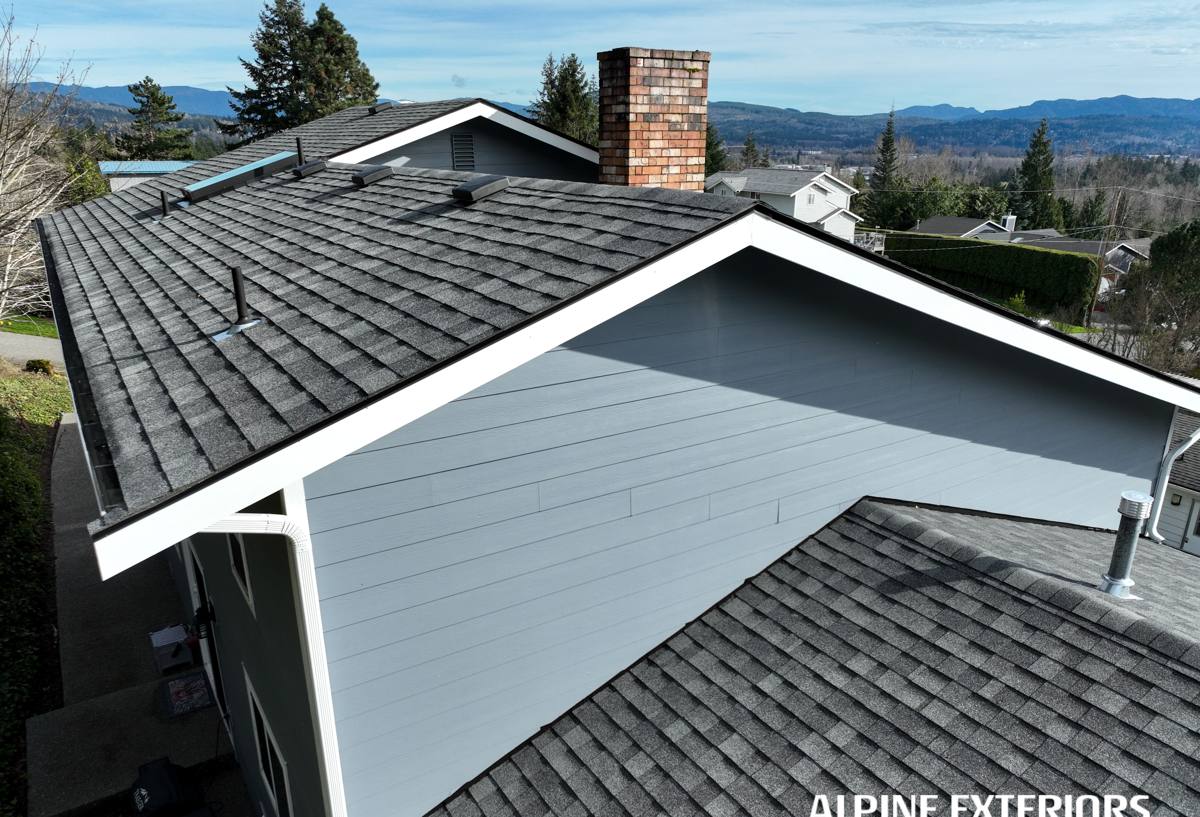
What Storm Damage Actually Looks Like Here
Not every storm-damaged roof looks damaged from the ground. That's the part that catches homeowners off guard. In our experience working this area, storm damage on Maple Falls roofs tends to fall into a few categories:
Wind and Impact Damage
- Shingle tabs lifted, cracked, or torn off entirely, usually on the side of the roof facing the prevailing wind
- Branches or falling limbs cracking shingles, denting metal flashing, or puncturing the roof deck outright
- Ridge cap shingles pulled loose — often the first thing to go in a hard gust because they take the most direct wind pressure
- Gutters pulled away from the fascia or bent from wind-driven debris
Moisture and Moss-Related Damage
- Moss and organic buildup holding water against the shingle surface long after a storm has passed, accelerating granule loss
- Softened or delaminating decking under areas where moss and debris have trapped moisture over multiple seasons
- Flashing around chimneys, skylights, and valleys corroding or separating where standing water sits longest
Slow Leaks That Started With a Storm
A lot of the calls we get aren't "the roof is leaking right now" — they're "we noticed a stain after that last windstorm and it's gotten worse since." That's a roof that took damage during the event but didn't fail completely until weeks of follow-on rain worked through the opening. This is common enough in the Maple Falls area that we always ask about recent weather, not just current symptoms, when we're scoping a repair.
Why Moss and Shade Matter More Here Than in Town
Whatcom County as a whole deals with a long wet season and enough salt-laden air off the Puget Sound corridor to shorten the working life of exposed roofing materials. Maple Falls adds another layer to that: heavier tree cover means more shaded roof sections, and shaded roof sections dry out slower after every storm. Moss doesn't just look bad — it lifts shingle edges as it grows, holds moisture against the roofing material, and turns a roof that should be shedding water into one that's absorbing it. After a storm, moss-covered areas are usually where we find the softest decking and the most granule loss, because that section of roof never got a real chance to dry between one weather event and the next.
If your roof backs up to trees or sits mostly in shade, that's a reason to have storm damage checked sooner rather than later, not later. Damage that would dry out and cause no real harm on a sun-exposed roof can sit wet and keep working against a shaded one.
What a Correct Storm Repair Involves
A storm repair done right isn't just patching the spot someone can see from the ground. It's a full accounting of what the storm actually did, because wind and impact damage is rarely limited to one obvious point.
Our Process
- Full roof inspection — not just the reported problem area. We check the whole roof plane, valleys, flashing points, and any section under tree cover, since that's where secondary damage tends to hide.
- Documentation — clear notes and photos of what we find, useful for your own records and for any insurance claim you may need to file.
- Deck assessment — if shingles were torn off or water got underneath, we check the sheathing itself. Soft or delaminated decking has to be replaced before new roofing goes down, not covered over.
- Matching materials — repairs should match your existing shingle type, profile, and as close to the existing color as the manufacturer allows, so the patch doesn't stand out.
- Flashing and moss treatment — any flashing disturbed by the storm gets resealed or replaced, and moss in the repair zone gets cleared so the new work isn't sitting under the same conditions that caused the original problem.
- Final walkthrough — we go over what was found and what was fixed before we call the job done.
Emergency Response vs. Scheduled Repair
Not every storm call needs the same urgency, and it's worth understanding the difference before you decide how fast to act.
| Situation | Timeline | Why |
|---|---|---|
| Active leak into living space | Same-day tarp, repair scheduled ASAP | Interior water damage compounds fast, especially with insulation and drywall |
| Missing shingles, no active leak yet | Within a few days | Exposed decking will take on water with the next rain, which in this area isn't far off |
| Bent gutters, cosmetic wind damage | Scheduled repair, no rush | Not a moisture-intrusion risk, but left alone it can affect drainage over time |
| Suspected damage, nothing visible | Inspection within a couple weeks | Catching hidden damage early avoids a bigger repair once decking is compromised |
Cost Factors for Storm Damage Repair
Every storm repair is different, and we won't quote a number without seeing the roof, but a few things consistently drive the cost up or down on jobs in this area:
- Roof pitch and access — steeper roofs and homes on tighter, sloped Maple Falls lots take longer to work safely
- Extent of decking damage — a shingle-only repair is far less involved than one that requires replacing wet or soft sheathing
- Age and condition of the surrounding roof — matching new shingles to a roof that's already partway through its service life sometimes means a larger repair area to avoid an obvious patch
- Moss and debris removal — a roof with heavy moss buildup needs that cleared before repair work can be assessed accurately, which adds time
- Number of damage points — one clean localized repair versus wind damage scattered across multiple roof planes
Insurance and Storm Claims
Most homeowners' policies cover sudden storm damage — wind, falling limbs, impact — though coverage details and deductibles vary by policy. We're happy to document damage clearly enough to support a claim, but we'd rather be straight with you: we're not adjusters, and we won't tell you what your policy covers. What we can do is give you an honest assessment of what happened to the roof, what it'll take to fix it right, and photos that hold up whether you're filing a claim or just paying for the repair directly.
Before You Call Someone After a Storm
- Don't get on the roof yourself, especially after rain — wet shingles and moss-covered surfaces are genuinely dangerous
- Take photos from the ground of anything visibly wrong — missing shingles, debris, sagging
- Note when the storm happened and when you first noticed a problem, since that timeline matters for both repair scoping and any insurance claim
- Watch for interior signs — ceiling stains, musty smell in the attic, daylight visible through the roof deck from inside
- Be cautious of door-to-door storm chasers who show up right after a weather event with pressure to sign same-day — a local, established crew will give you the same honest assessment without the rush
Why a Crew That Already Works Maple Falls Matters
A roofer who mostly works flat, in-town lots in Lynden or Bellingham isn't necessarily prepared for what a Maple Falls roof throws at them — steeper access, more tree cover to work around safely, and roofing that's dealt with years of shade-driven moss growth on top of normal storm wear. We know what damage patterns to expect out here, we know moss buildup needs to be cleared before you can properly assess what's underneath, and we don't treat every repair like a cookie-cutter in-town job. That local familiarity is the difference between a repair that gets done fast and one that gets done right the first time, in an area where a follow-up trip isn't a quick drive.
If a recent storm has left you with missing shingles, a leak, or just a nagging feeling that something's not right up there, we'll come take an honest look. Reach out for a free, no-pressure estimate — we'll tell you exactly what we find and what it would take to fix it, no obligation.