 Lynden Siding
 Siding Installation for Sumas Homes
Sumas sits at the far edge of Whatcom County, tucked against the Canadian border and the Nooksack River lowlands, and homes here take a different kind of beating than siding in a typical Puget Sound suburb. You've got the marine-influenced weather rolling in off the water to the west, driving rain that comes sideways more often than straight down, and a moss season that can run eight or nine months out of the year in shaded, north-facing spots. Add in the humidity that settles into these river-bottom flats overnight, and you've got a climate that will find every weak point in a siding installation within a few years if the job wasn't done right the first time.
We install James Hardie fiber cement siding for homeowners throughout the Lynden and Sumas area, and this page is about what a correct Sumas installation actually involves — not a generic overview of siding in general, but the specific things that matter for a house sitting in this particular corner of Whatcom County.
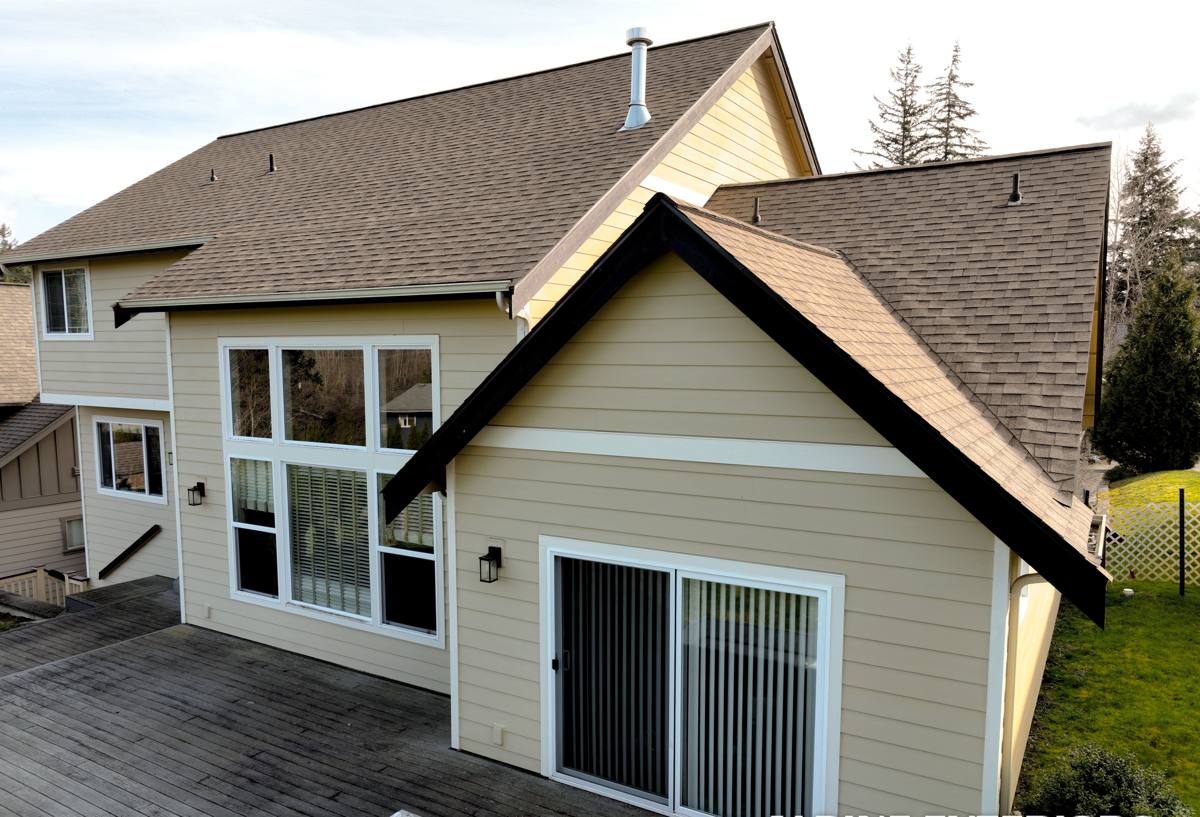
What Sumas's Climate Actually Does to Siding
Salt Air and Moisture Drift
Sumas isn't coastal in the way Bellingham or the San Juans are, but the marine air pattern that moves through the Fraser Valley and Nooksack corridor still carries moisture and salt content further inland than most homeowners expect. Over years, that steady low-grade exposure degrades paint films, corrodes fasteners, and accelerates the breakdown of siding materials that aren't engineered to shrug it off. It's a slow process — you won't see damage in year one — which is exactly why it gets ignored until it's expensive.
Driving Rain
Wind-driven rain doesn't just wet the surface of a wall — it pushes water sideways into laps, seams, and fastener penetrations that a calm, straight-down rain would never reach. Siding systems that rely on tight, well-executed water-shedding details (correct lap exposure, properly flashed penetrations, sealed but not over-caulked joints) hold up. Systems installed loosely, or with shortcuts at trim and window returns, let water in behind the cladding where it does the real damage — to sheathing, framing, and insulation you can't see until there's a problem.
Long Moss Season
Shaded elevations, tree cover, and the persistent damp common to this part of Whatcom County mean moss and algae growth isn't a seasonal nuisance here — it's close to a year-round condition on north- and east-facing walls. Porous or absorbent siding materials give moss something to root into over time, and that surface growth traps additional moisture against the wall, which compounds the original problem. A dense, factory-finished material resists that growth far better than a material that's constantly re-absorbing rainwater.
Why We Only Install James Hardie
James Hardie fiber cement is engineered around exactly these conditions. It's non-combustible, dimensionally stable, and doesn't absorb and release moisture the way wood-based products do, which matters directly in a climate where the wall is rarely fully dry. The ColorPlus factory finish is baked on under controlled conditions rather than field-painted, which gives it stronger adhesion and better resistance to the kind of UV and moisture cycling this region produces. Hardie's HZ5 product line, used throughout the Pacific Northwest, is specifically formulated for climates with sustained moisture exposure — freeze-thaw resilience isn't the primary concern here so much as year-round dampness, and HZ5 is built for that reality.
We standardized on Hardie because we were tired of watching other materials fail in exactly the ways this climate is designed to expose. That's not a knock on every alternative product in isolation — it's a statement about what holds up, unmaintained, on a Sumas wall for 30 years.
What a Correct Installation Involves
Fiber cement siding is only as good as the installation behind it. Hardie's own warranty terms are explicit about this — installation that doesn't follow their published specifications can void coverage, regardless of the product's own durability. A correct job includes:
- A weather-resistant barrier installed and lapped correctly behind the siding, with all penetrations properly flashed before the first board goes up
- Rainscreen or drainage gap detailing where conditions call for it, so incidental moisture behind the siding has somewhere to go
- Correct lap exposure and fastener placement per Hardie's specifications — not "close enough," but to the published nailing pattern and reveal
- Proper clearance at grade, roof lines, decks, and hardscape so the bottom edge of the siding never sits in standing water or constant splash-back
- Factory-mitered or properly caulked joints at trim, corners, and window/door returns, using sealants rated for the temperature and moisture range this region sees
- Field-touch-up of any cut edges with Hardie's matched touch-up product, so exposed fiber cement isn't left unsealed
Skip any one of these and you haven't installed Hardie siding to spec — you've installed a good material badly, which is worse in some ways than installing a mediocre material well, because it hides the failure points behind a product with a strong reputation.
Our Process for a Sumas Project
1. On-Site Assessment
We walk the exterior with you, looking at existing siding condition, moisture staining, moss buildup patterns, and any areas where water has clearly been finding its way in — vents, deck ledgers, window returns, and grade clearance are the usual suspects.
2. Sheathing and Barrier Check
Once old siding comes off, we inspect the sheathing underneath. In a climate this wet, it's not unusual to find soft spots or prior water intrusion that needs to be addressed before new siding goes on — covering a compromised wall with new material just delays the same problem.
3. Weather Barrier and Drainage Detail
We install the weather-resistant barrier and drainage plane detailing appropriate to the wall assembly, with particular attention to flashing at every penetration — this is the step that determines whether driving rain stays out or works its way in over the next decade.
4. Hardie Installation to Spec
Boards are installed to Hardie's published fastening schedule and reveal, with attention to expansion gaps, corner details, and trim integration.
5. Final Walkthrough
We review the finished work with you directly, including care and maintenance basics specific to a Sumas property — what to watch for, and what normal weathering looks like versus something that needs attention.
Cost Factors for a Sumas Siding Project
| Factor | Why It Matters Here |
|---|---|
| Home size and wall complexity | More corners, dormers, and trim details mean more labor for correct flashing and fitting |
| Existing wall condition | Sheathing repair or moisture remediation adds scope but is not optional if damage is found |
| Siding profile and plank width | Lap siding, board-and-batten, and shingle-style Hardie products carry different material and labor costs |
| Trim and accessory scope | Corner boards, window trim, and fascia work are often bundled into a full siding project |
| Access and site conditions | Setback, landscaping, and multi-story sections affect scaffolding and staging time |
We give you a firm, itemized quote after the on-site assessment — not a ballpark over the phone, because the wall condition underneath the old siding matters as much as the square footage on top.
Signs Your Sumas Home May Need New Siding
- Persistent moss or algae growth that returns within weeks of cleaning
- Paint that's peeling, bubbling, or chalking faster than a normal repaint cycle would explain
- Soft or spongy spots when pressing on siding, especially near the bottom courses or under windows
- Visible warping, cupping, or separation at seams and corners
- Interior signs — musty smells, staining, or soft drywall near exterior walls — that point to moisture getting in from outside
Why Local Experience in Sumas Matters
A crew that's worked houses throughout Lynden and out toward Sumas already knows which wall orientations hold onto moss the longest, which older homes tend to have marginal weather barriers underneath their original siding, and how the driving-rain pattern off the valley typically hits a given elevation. That's not something you get from a general contractor passing through the area once — it comes from doing this work repeatedly in this specific climate, on this specific building stock, and seeing what actually fails and what actually holds up.
If you're looking at your siding and wondering whether it's protecting your home the way it should, we're happy to take a look. Reach out for a free, no-pressure estimate — we'll walk the exterior with you, tell you honestly what we see, and lay out what a correct James Hardie installation would involve for your home.