 Lynden Siding
 Ferndale's Weather Is Hard on Roofs
Ferndale sits close enough to Bellingham Bay and the open water of the Strait of Georgia that roofs here deal with a combination most inland Whatcom County homes don't face all at once: salt-laden air moving in off the water, wind-driven rain that comes in sideways during fall and winter storms, and a moss season that can run eight months or longer on shaded, north-facing slopes. Each of these does something different to a roof, and a repair that only addresses the visible damage while ignoring the others tends to fail again within a year or two.
What Each Factor Actually Does
Salt air speeds up corrosion on exposed metal — nail heads, flashing edges, gutter fasteners — long before it would rust out on a home twenty miles inland. Driving rain doesn't behave like a normal vertical downpour; it gets pushed sideways and upward under shingle laps, around flashing, and into valleys that would stay bone dry in a calmer storm. And moss doesn't just look bad — it holds moisture against the shingle surface, lifts tabs at the edges, and over time roots into the shingle mat itself, which is a slower but just as damaging form of storm-related wear.
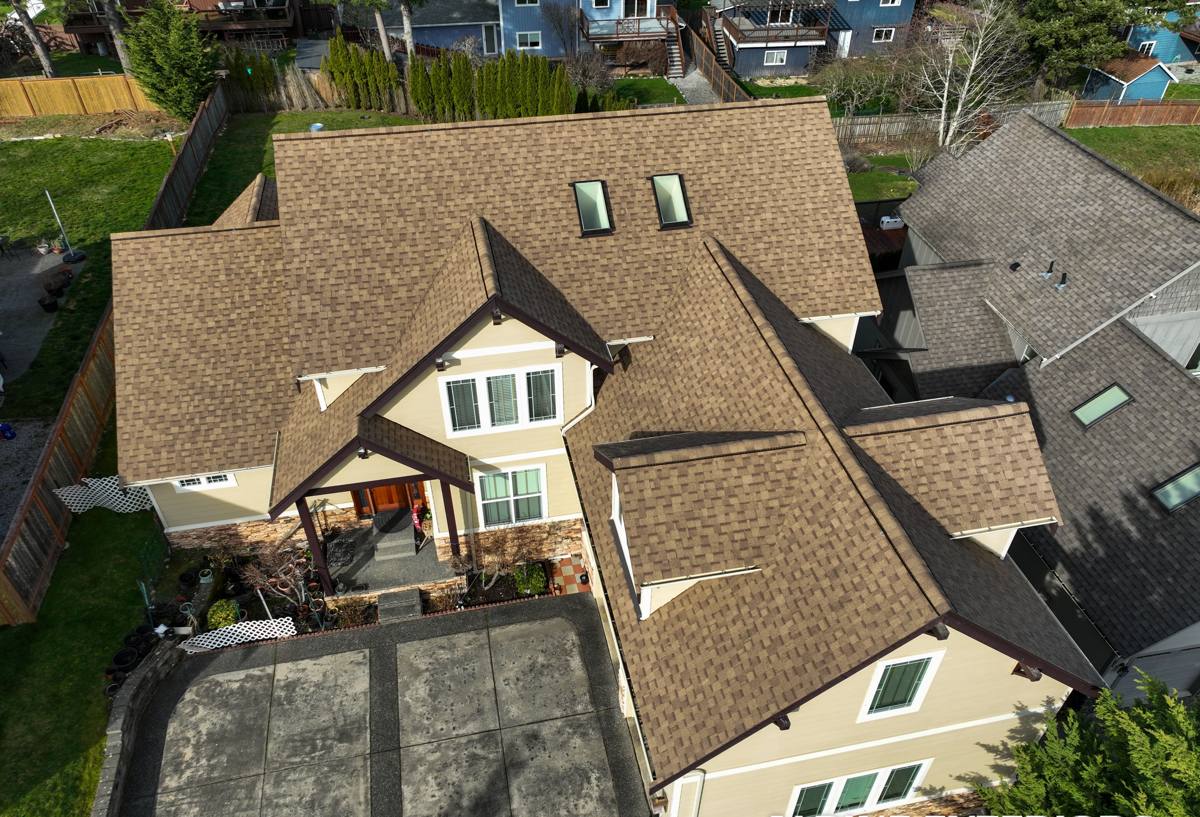
Signs of Storm Damage Worth a Closer Look
What You Can Spot From the Ground
- Shingles that are torn, curled, or missing outright after a windstorm
- A sudden increase in granules collecting in gutters or at downspout outlets
- Gutter sections pulled loose, bent, or sagging away from the fascia
- Flashing around the chimney, skylight, or roof-to-wall joints that looks lifted or bent
- Fresh moss or algae growth concentrated in one area right after a wet stretch
- Debris strikes — broken branches or dents from wind-blown material
What Shows Up Inside
Not all storm damage announces itself on the roof surface. Water stains on ceilings or the underside of attic decking, damp or compressed insulation, daylight visible through roof boards, and a musty smell in the attic after a storm are all signs that water found a way in somewhere — even if nothing looks obviously wrong from the yard.
What a Correct Storm Damage Repair Involves
A Real Inspection, Not Just a Patch
A storm rarely damages just one spot. Wind that tore loose one section of shingles usually stressed the fasteners and flashing around it too. A proper repair starts with checking the full roof plane — not just the obvious damage — plus the attic side, so nothing gets missed and painted over.
Decking and Underlayment
If water has been getting under the shingles for any length of time, the plywood or OSB decking underneath can be soft, delaminating, or rotted. Replacing shingles over compromised decking just hides the problem. We check the deck at every repair and replace underlayment in the affected section rather than reusing torn or waterlogged material.
Flashing First, Shingles Second
Most leaks that follow a storm trace back to flashing, not the shingle field — chimney step flashing, valley flashing, and roof-to-wall transitions take the brunt of wind-driven rain. We treat flashing repair as its own step, not an afterthought bundled into shingle work.
Matching What's Already There
A patch that doesn't match the existing shingle color, profile, or age reads as an obvious repair and can affect how the roof looks and, in some cases, how water sheds at the seam. We source materials that match as closely as possible, and we're upfront when an exact match isn't available due to discontinued product lines.
Our Repair Process, Step by Step
- Inspection and documentation — we walk the roof and attic, photograph the damage, and note anything that could become a problem even if it isn't leaking yet.
- Temporary protection if needed — for active leaks or exposed decking, we tarp or dry-in the area the same visit to stop further water intrusion.
- Written scope and estimate — a clear breakdown of what's being repaired and why, with an honest range rather than a vague number.
- The repair itself — decking, underlayment, flashing, and shingle work done in that order, not shortcuts stacked on top of each other.
- Cleanup — nails, torn shingle debris, and old flashing removed from the property and gutters.
- Final walkthrough — we show you what was done and what to watch for going forward.
Repair or Replace? How We Decide
Not every storm-damaged roof needs a full replacement, and not every roof is a good candidate for another round of patchwork. We weigh a few factors honestly before recommending either path.
| Factor | Leans Toward Repair | Leans Toward Replacement |
|---|---|---|
| Roof age | Under 12–15 years, otherwise sound | Near or past expected shingle lifespan |
| Extent of storm damage | Isolated to one slope or section | Spread across multiple slopes or the whole roof |
| Deck condition | Solid, dry decking under the damaged area | Widespread soft spots or rot found during inspection |
| Repair history | First or second repair on this roof | Third-plus patch in the same general area |
| Moss and moisture history | Minor, surface-level growth | Long-term moss intrusion into the shingle mat |
When a roof falls in the middle — say, sound decking but a long moss history — we'll walk through the trade-offs with you rather than defaulting to the bigger job.
Materials We Use for This Climate
Given the salt air and moisture exposure common to Ferndale roofs, we're deliberate about what goes into a repair rather than grabbing whatever's on the truck.
- Corrosion-resistant fasteners and flashing — standard galvanized hardware corrodes noticeably faster this close to the water, so we favor coated or stainless options at flashing and fastener points that stay exposed.
- Self-adhered ice-and-water barrier at eaves and valleys — the areas most exposed to wind-driven rain and moss buildup get this extra layer of protection under the shingles, not just standard felt.
- Matching shingle profiles — we avoid mixing incompatible shingle types or thicknesses in a repair, since mismatched layers can trap moisture at the seams.
We're also careful about mixing dissimilar metals in flashing repairs — pairing the wrong metals together in a salt-air environment accelerates corrosion at the joint through galvanic reaction, which is a slower-motion version of the same problem the storm just caused.
Storm Damage and Insurance Claims
Many storm repairs in this area do get filed as insurance claims, and we can help make that process straightforward without overpromising what it will cover. We document the damage thoroughly with photos and a written scope, which gives you something concrete to bring to your adjuster. We're also glad to meet an adjuster on-site to walk the roof together if that's useful. What we won't do is guess at coverage or tell you what your policy will pay — that's between you and your insurer, and we stick to what we can verify: the condition of the roof and what it actually needs.
Why a Crew That Already Works Ferndale Matters
A roofer who works this area regularly has already seen how the local wind patterns hit different roof orientations, which slopes tend to hold moss the longest, and which older homes have flashing details that need extra attention during a repair. That familiarity translates into faster, more accurate inspections and fewer surprises once a repair is underway. It also means a faster response after a storm — when a section of your roof is exposed, waiting days for a crew to drive in from farther away isn't a small inconvenience, it's more time for water to find its way into the decking and insulation.
A Simple Checklist for Catching Storm Damage Early
Between storms, a few minutes of ground-level checking can catch problems before they turn into interior water damage.
- Walk the perimeter after any windstorm and look for shingle debris on the ground
- Check gutters for an unusual amount of granules after a storm
- Look at chimney and vent flashing from the ground with binoculars for anything visibly lifted
- Check the attic for damp spots, new stains, or daylight after heavy rain
- Note any moss growth that seems to be spreading faster than in previous years
- Have the roof looked at professionally once a year, ideally before the fall storm season
If a recent storm has left you with missing shingles, a leak, or just some uncertainty about what's going on up there, we're happy to take a look. Estimates are free and there's no pressure to move forward — just an honest read on what your roof actually needs.