 Lynden Siding
 Why Aldergrove Roofs Wear Out Faster Than the Brochures Say
Aldergrove sits in that stretch of the Pacific Northwest where the weather never really commits to one extreme — it just stays damp, mild, and persistent for most of the year. That's the part that catches homeowners off guard. A roof here isn't fighting one brutal winter storm; it's fighting months of low-grade moisture exposure that never fully dries out between rain events. Add in salt-laden air moving inland off the coast, driving rain that gets pushed sideways under poorly sealed flashing, and a moss season that can run from fall through spring, and you have a climate that's genuinely tough on roofing systems — even good ones installed wrong.
Most roof failures we see in this area aren't dramatic. They're slow: a shingle mat that absorbed moisture for a few too many winters, a valley that was never flashed correctly, decking that stayed damp under a moss mat long enough to start losing structural integrity. By the time it shows up as a stain on a ceiling, the underlying damage has usually been building for years.
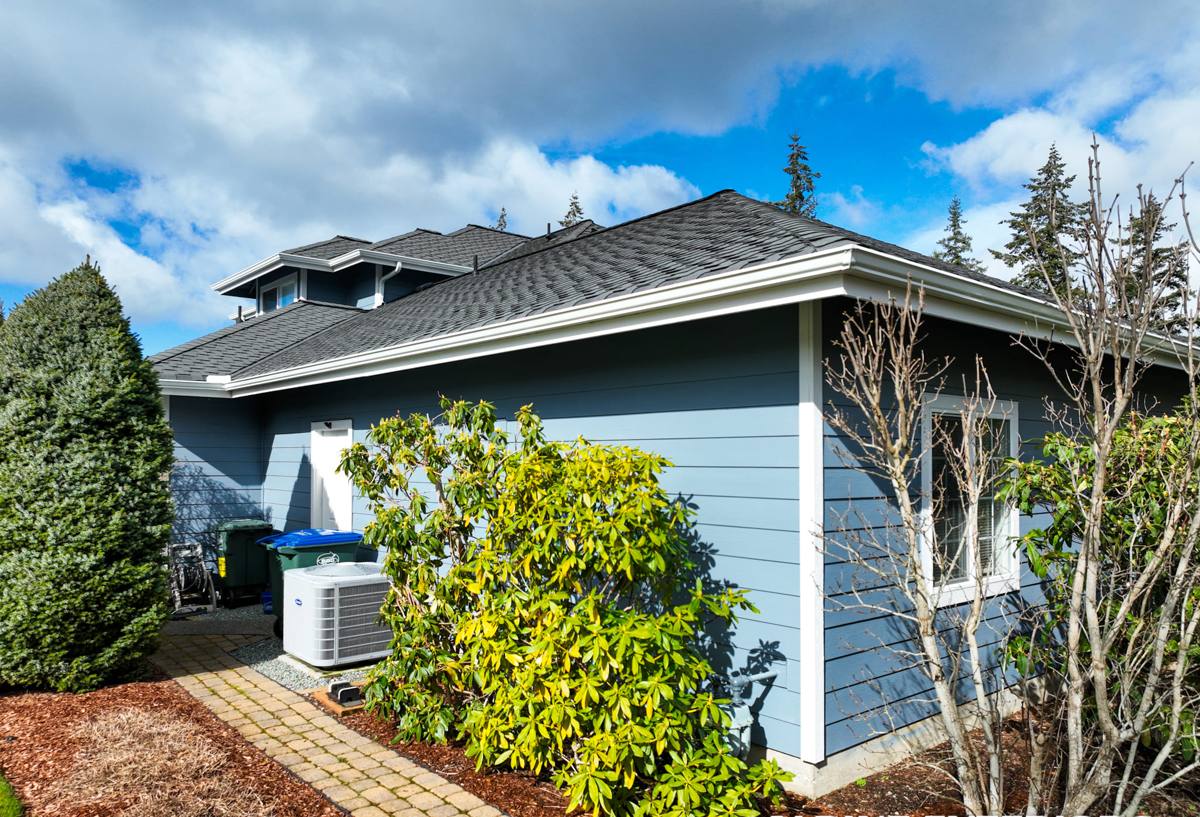
Signs an Aldergrove Home May Need a Roof Replacement
Not every roofing problem means a full replacement — some are legitimately repairable. But there's a point where patching a roof costs more over time than replacing it once, correctly. Here's what we look for when we're deciding which side of that line a roof is on:
- Granule loss heavy enough that you're finding grit in gutters and downspouts every time it rains
- Shingles that are curling, cupping, or cracking, especially on south- and west-facing slopes
- Moss or algae that keeps returning within a season or two of cleaning, even after treatment
- Soft or spongy decking felt underfoot during inspection, a sign moisture has reached the sheathing
- Daylight visible through the roof deck from inside the attic
- Flashing around chimneys, skylights, and vents that's rusted, lifted, or sealed with visible caulk patches
- A roof that's 20+ years old (for asphalt) with multiple prior repairs in different areas
- Rising energy bills tied to poor attic ventilation or insulation gaps at the roofline
If you're seeing two or three of these at once, it's usually time for a real inspection rather than another round of spot repairs.
What a Correct Roof Replacement Actually Involves
The material on top gets all the attention, but the majority of a roof's long-term performance in a climate like this comes from what's underneath it. A roof replacement done right addresses every layer, not just the visible one.
Tear-Off and Deck Inspection
Every layer of old roofing comes off down to the deck. This isn't optional in our process — roofing over existing layers traps moisture and hides rot, and it's exactly how a small leak becomes a structural repair. Once the deck is exposed, we check every sheet for soft spots, delamination, or water staining and replace any section that doesn't pass, before anything new goes down.
Underlayment Built for Wet Climates
In a region that sees sustained rain rather than occasional downpours, underlayment choice matters more than most homeowners realize. We use synthetic underlayment across the field for its water resistance and durability, with self-adhering ice-and-water membrane at the eaves, valleys, and any low-slope transitions — the spots where wind-driven rain is most likely to work its way backward under the shingle line.
Flashing Details
Flashing failures cause more leaks than worn-out shingles do. Chimneys, skylights, sidewall intersections, and roof-to-wall transitions all need step flashing or counter-flashing installed correctly and integrated with the underlayment — not just caulked over. Caulk is a maintenance item, not a flashing system, and it's usually the first thing to fail in driving rain.
Ventilation
A roof deck that can't breathe stays damp longer after every storm, which is exactly what accelerates moss growth and shortens shingle life. We check intake at the soffits and exhaust at the ridge or roof vents, and correct imbalances as part of the replacement rather than treating ventilation as an afterthought.
Choosing a Roofing Material for This Climate
There's no single "best" roofing material — there's the right material for a given roof pitch, budget, and exposure. Here's how the common options stack up for a coastal-influenced, moss-prone climate like Aldergrove's:
| Material | Moss & Moisture Resistance | Wind Performance | Typical Lifespan | Maintenance |
|---|---|---|---|---|
| Architectural asphalt shingle | Good, especially algae-resistant lines | Rated to 110–130 mph when installed correctly | 25–30 years | Periodic moss/debris removal |
| 3-tab asphalt shingle | Fair; wears faster in constant damp | Lower wind rating than architectural | 15–20 years | More frequent inspection |
| Standing seam metal | Excellent; sheds moisture and resists moss | Very high, few exposed fastener points | 40–60 years | Minimal |
| Cedar shake | Poor without diligent upkeep; traps moisture | Moderate | 20–30 years with maintenance | High; regular treatment needed |
We install asphalt shingle and metal roofing as our primary systems. We generally steer homeowners away from cedar shake in this specific climate — not because it's a bad-looking product, but because untreated wood shakes hold moisture against the roof deck through a long wet season, and the maintenance schedule needed to keep them performing well is more than most homeowners want to commit to. That's a trade-off worth knowing before you commit to it, not after the first moss outbreak.
What Roofing Costs Depend On
We don't publish flat prices because roofing genuinely isn't a flat-rate job — two houses with the same square footage can cost very differently to re-roof. The main variables:
| Factor | Why It Matters |
|---|---|
| Roof pitch and complexity | Steep or multi-valley roofs take longer and need more safety setup |
| Layers to remove | Multiple existing layers add tear-off time and disposal cost |
| Deck condition | Rotten sheathing found during tear-off adds material and labor |
| Material choice | Asphalt, metal, and premium shingle lines vary significantly in cost |
| Access | Tight lots or steep driveways affect staging and disposal logistics |
Straightforward asphalt shingle replacements on a standard single-story roof tend to fall in a moderate range; steep, complex rooflines or metal systems run higher. We'll never quote a number without seeing the roof — anyone who does is guessing, and guesses turn into change orders mid-project.
Our Roof Replacement Process
- Inspection and estimate. We walk the roof, check the attic where accessible, and note deck condition, flashing points, and ventilation before quoting anything.
- Material selection. We go over the honest trade-offs of each option for your roof specifically, not a generic pitch.
- Scheduling around weather windows. Given how much rain this region gets, we plan tear-off days around forecasts that give us a real window to get the deck dried in and covered.
- Tear-off and deck repair. Old roofing comes off, the deck gets inspected, and any compromised sheathing is replaced before underlayment goes down.
- Underlayment, flashing, and ventilation correction. Every detail layer gets installed to spec, not just the parts that show.
- Final installation and cleanup. New roofing goes on, site is magnet-swept for debris, and we walk the finished roof with you.
Why a Crew That Already Works Aldergrove, BC Matters
We're based out of Lynden, in Whatcom County, and Aldergrove is close enough that it's a regular part of our service area rather than a special trip. That matters for a few practical reasons. First, we've seen how roofs in this specific corridor actually fail — the moss patterns, the wind-driven rain angles, the deck rot spots that recur on certain roof designs — which shapes how we flash and ventilate a new roof, not just what shingle we sell you. Second, working across the border regularly means we've already sorted out the logistics of scheduling, material delivery, and coordinating a job on that side of the line, so it doesn't become your problem mid-project. Third, a crew that's local to the area has a reputation to protect with neighbors, not just a one-time transaction to close.
A roofing crew that only shows up for a single job and then disappears has little incentive to get every detail right, because they're not the ones who'll hear about a callback next winter. We are.
Reducing Moss Regrowth After Your New Roof Goes On
No roofing material is completely moss-proof in a climate this damp, but a correctly installed roof with proper ventilation will resist moss far longer than one without. A few habits extend that further:
- Keep overhanging branches trimmed back so the roof gets more sun and airflow, which slows moss establishment
- Clear gutters and valleys of debris at least twice a year — trapped organic matter holds moisture against the roof
- Have moss physically removed rather than pressure-washed off, which can strip granules and shorten shingle life
- Consider zinc or copper strips near the ridge on new installations, which release compounds that inhibit moss growth over time
- Schedule a roof check after major windstorms to catch lifted shingles or flashing before the next rain
Get an Honest Look at Your Roof
If your roof is showing its age or you just want a straight answer about how many years it has left, we'll come take a look and give you an honest assessment — no pressure, no inflated urgency. Use the form below to request a free estimate.