 Lynden Siding
 Roofing in Sumas Isn't the Same as Roofing Somewhere Dry
Sumas sits at the edge of Whatcom County against the Canadian border, tucked into the low ground near the Fraser Valley gap. That location matters more than most homeowners realize when it comes to a roof. Moisture-laden marine air moves inland off the Salish Sea and settles into this valley, and in the colder months the same gap that lets marine air in can also funnel sharp, dry outflow wind events down from the Fraser Valley. A roof here has to handle both extremes: long stretches of driving rain and damp, still air that never quite dries out, plus the occasional hard wind day that tests every flashing detail and shingle tab on the house.
We install roofs across Lynden and the surrounding Whatcom County towns, and Sumas comes with its own pattern of wear. Homes tucked under fir and cedar cover deal with heavier moss growth than open lots. Properties near farmland get more airborne debris and organic buildup in the valleys and gutters. None of this means a roof in Sumas needs to be exotic or over-built — it means the ordinary parts of the job (ventilation, underlayment, flashing, fastening) have to be done correctly, every time, with no shortcuts.
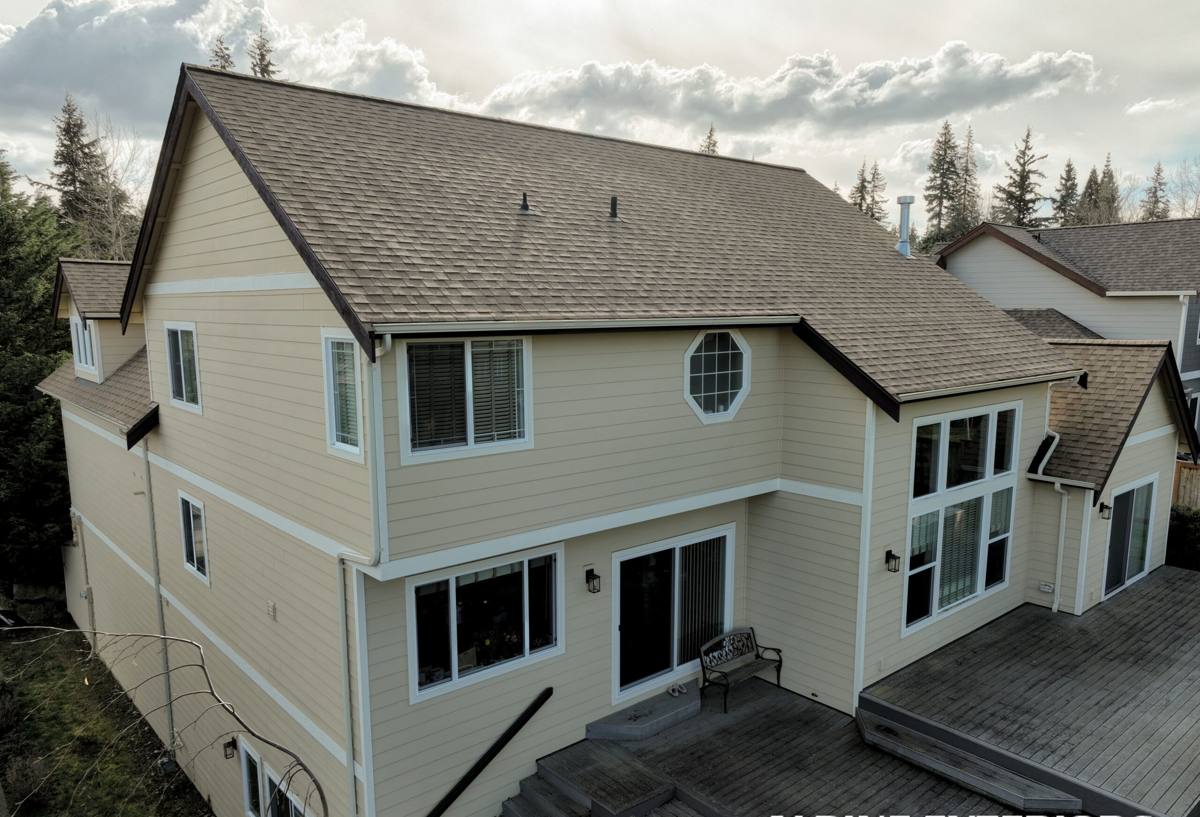
How Long a Roof Actually Lasts Out Here
Manufacturer lifespan numbers are based on lab conditions, not a roof that sits under conifer shade and takes on driving rain nine months a year. In this climate, moss and moisture are the two things that shorten a roof's real service life the most:
- Moss holds water against the shingle surface and lifts tabs as it grows, which is how small leaks start in roofs that are otherwise structurally fine.
- Trapped moisture in a poorly ventilated attic works from underneath, rotting decking and rusting fasteners years before the shingles themselves would have failed.
- Wind events find every shingle that wasn't sealed or fastened correctly and work it loose, one gust at a time.
A correctly installed, correctly ventilated roof in a Sumas climate should get you the full service life the material is rated for. A roof that skipped ventilation upgrades or used minimum-spec underlayment usually won't — and the difference doesn't show up until year eight or ten, long after the crew that installed it is gone.
Signs a Sumas Home Needs Replacement, Not Another Repair
We'd rather tell a homeowner the truth than sell a roof that isn't needed yet. Repair makes sense when the damage is localized — a few damaged shingles, one bad flashing point, a small leak with a clear source. Replacement is the honest answer when:
- Granule loss is widespread and shingles are visibly cupping or curling across multiple slopes, not just one spot.
- Moss has been established for more than a season or two and has lifted shingles in more than one area.
- There's soft decking, visible sagging, or daylight through the roof deck from the attic.
- The roof has taken repeated small leaks in different locations rather than one recurring source.
- The roof is already past or near the end of its rated life and a repair would just be a stopgap before a bigger failure.
If a repair genuinely solves the problem, that's what we'll recommend. A full replacement only makes sense when the underlying material and structure are actually at the end of their usable life.
What a Correct Installation Actually Involves
Tear-Off and Deck Inspection
We don't install new roofing over old material or over a deck we haven't looked at. Full tear-off lets us inspect the sheathing for soft spots, rot, or delamination caused by years of trapped moisture — common in homes with older or undersized attic ventilation. Any bad decking gets replaced before anything new goes down. Skipping this step is the single most common shortcut that causes early failures.
Underlayment and Ice/Water Protection
Given how much of the year Sumas sees sustained rain, we don't treat underlayment as an afterthought. Synthetic underlayment across the full deck, with self-adhering ice-and-water membrane at eaves, valleys, and any low-slope transitions, gives the roof a second line of defense if wind-driven rain ever gets past the shingle layer.
Flashing at Every Penetration
Chimneys, vents, skylights, and wall-to-roof transitions are where the overwhelming majority of leaks start — not in the open field of shingles. Correct step flashing, counter-flashing, and pipe boot detail work matters more in a climate that sees this much sustained moisture, because a marginal flashing detail here gets tested constantly instead of occasionally.
Ventilation
Balanced intake (soffit) and exhaust (ridge) ventilation keeps the attic temperature and moisture level close to outside conditions. That protects the decking from the underside and also reduces how fast moss and algae can take hold on the shingle surface above, since a cooler, drier roof surface holds less moisture between rain events.
Fastening and Wind Resistance
Correct nail placement, count, and pattern — not staples, not overdriven or underdriven nails — is what actually determines whether shingles hold through a wind event. This is a detail that's invisible once the roof is finished, which is exactly why it's worth asking about.
Material Options for a Sumas Roof
There's no single "right" material for every house — it depends on budget, roof pitch, how much shade and moss exposure the lot has, and how long the homeowner plans to stay in the house. Here's how the common options actually compare in this climate:
| Material | Typical Lifespan Here | Moss/Moisture Behavior | Relative Upfront Cost |
|---|---|---|---|
| Architectural asphalt shingle | 20–30 years | Good with algae-resistant granules and proper ventilation; still needs periodic moss removal in shaded areas | Lower |
| Standing seam metal | 40–50+ years | Sheds moisture fast, minimal moss adhesion on smooth panels | Higher |
| Synthetic/composite shingle | 30–40 years | Good moisture resistance, less prone to granule loss than asphalt | Mid-to-higher |
| Basic 3-tab asphalt | 15–20 years | More vulnerable to moss lift and wind uplift over time | Lowest |
For most Sumas homes, a mid-to-upper-tier architectural shingle with algae-resistant granules hits the right balance of cost and durability. Metal earns its higher price tag on steeper roofs, heavily shaded lots, or for homeowners planning to stay long enough to value the extended lifespan.
What Actually Drives the Price
Beyond the material line item, a handful of site-specific factors move the number more than people expect:
| Factor | Why It Matters |
|---|---|
| Roof pitch and complexity | Steep or multi-plane roofs take longer, need more safety setup, and use more material at valleys and hips |
| Layers being removed | Tearing off two layers of old roofing costs more in labor and disposal than one |
| Decking condition | Rot found during tear-off means replacement sheathing, which isn't knowable until the old roof is off |
| Ventilation upgrades needed | Older Sumas homes often need soffit or ridge vent upgrades to meet current airflow standards |
| Access and site conditions | Tree cover, driveway access, and setback all affect how efficiently a crew can stage material |
How We Handle the Job
- On-site inspection — we look at the current roof, attic ventilation, and any visible moisture or moss issues before quoting anything.
- Written estimate — material options, scope, and cost factors specific to your roof, not a generic per-square number.
- Tear-off and deck inspection — full removal of old material, with any compromised decking replaced and documented.
- Underlayment, ice/water shield, and flashing — installed to handle this area's rain load, not just minimum code.
- Ventilation check and correction — intake and exhaust balanced for the specific attic, not assumed.
- Final walkthrough — we go over the completed roof with you before calling the job done.
Living With Moss Season
No roof in this part of Whatcom County stays moss-free forever without some homeowner maintenance, and it's worth setting that expectation honestly. A new roof with algae-resistant shingles and correct ventilation will resist moss far longer than an older roof, and full sun exposure helps, but shaded valleys, north-facing slopes, and roofs under conifers will still need periodic soft-washing or moss removal every few years. That's routine maintenance, not a sign the roof was installed wrong — and it's a lot cheaper and easier than dealing with moss that's been left to establish for a decade.
What to Check Before You Hire Anyone for This
- Do they inspect the roof and attic in person before quoting, or price it off a satellite photo?
- Is full tear-off and deck inspection included, or is "overlay" on the table?
- Does the estimate specify underlayment type and ice/water shield locations, or just "underlayment included"?
- Do they address ventilation as part of the job, or only the shingles themselves?
- Are they licensed and insured to work in Washington, and will they show you proof without being asked twice?
- Do they know this area specifically — moss patterns, wind exposure, valley moisture — or is Sumas just another dot on a service map to them?
Why a Crew That Already Works Sumas Makes a Difference
A roofing crew that's already done work in and around Sumas has seen how the local conditions actually play out over time — which slopes hold moss, which attic setups tend to run damp, how a roof here weathers a hard wind day versus a roof somewhere drier. That's not a marketing point, it's practical: it means fewer surprises during tear-off, a ventilation plan that matches what this climate actually requires, and a crew that isn't guessing at material choices for the first time on your house. We're a Lynden-based crew that works Whatcom County regularly, and Sumas is well within our normal service area — not a special trip.
If you're weighing a repair against a full replacement, or just want a straight answer on what your current roof needs, we're happy to take a look. Use the form below to request a free, no-pressure estimate for your Sumas home.