 Lynden Siding
 Roofing for a Wet, Wooded Corner of Whatcom County
Maple Falls sits in a part of Whatcom County where trees stay green year-round for a reason — the moisture never really lets up. Between the driving rain that blows in off the Pacific through much of the year, the salt-laden air that reaches inland across this region, and a moss season that can stretch from fall through spring, a roof here works harder than one in a drier climate ever will. Asphalt shingles are built to shed water for a while. Metal roofing is built to do it for decades, and that difference matters most on homes tucked under tree cover where a roof rarely gets a full day of sun to dry out.
This page is about one job in one place: installing metal roofing correctly on Maple Falls homes. Not a general rundown of metal roofing everywhere — the specific conditions this roof type has to stand up to here, what a correct installation actually involves, and how we approach the work.
What This Climate Does to a Roof Over Time
Moisture That Never Fully Dries
Homes shaded by fir and cedar canopy lose the midday sun that would otherwise dry out a roof deck after a storm. That constant low-grade dampness is exactly what shortens the life of asphalt shingles — granule loss speeds up, and moisture works its way under tabs at the edges. Metal sheds water fast and doesn't hold moisture against its surface the way a shingle mat does, which matters a great deal on a roof that rarely gets a chance to dry completely.
Moss and Organic Growth
A long moss season isn't just cosmetic. Moss holds water against roofing material, and on shingles that means accelerated wear right where the moss takes hold — usually the shaded north-facing slopes and areas under overhanging branches. Metal roofing gives moss far less to grip, and without the rough mat surface that shingles provide, growth that does start is much easier to remove without damaging the roof underneath.
Driving Rain and Wind-Driven Water
Rain that comes in sideways during a storm doesn't just land on the roof — it gets pushed uphill under laps, around penetrations, and into any gap in the flashing. This is where most leaks on any roof type actually originate, and it's also where installation quality matters more than material choice. A well-built metal roof with correctly lapped panels and properly integrated flashing handles wind-driven rain that would find its way under standard shingle laps.
Salt Air and Corrosion
Air carrying salt content, even well inland, slowly attacks unprotected or poorly coated metal — fasteners, flashing, and panel edges are usually the first places it shows up. This is why fastener quality and panel coating aren't places to cut corners on a metal roof in this region. A roof installed with the wrong-grade hardware will show rust streaks at every screw head years before the panels themselves show any wear.
Why Metal Roofing Makes Sense for Maple Falls Homes
Metal isn't the right fit for every roof or every budget, and we'll tell a homeowner that honestly during an estimate. But for homes carrying tree cover, shaded slopes, and steady moisture exposure — which describes a lot of properties in and around Maple Falls — metal roofing solves problems that asphalt shingles simply can't:
- Sheds standing water and reduces the conditions moss needs to establish itself
- Handles wind-driven rain better when laps and flashing are installed correctly
- Doesn't absorb moisture the way a shingle mat does, so it dries faster after storms
- Holds up to decades of freeze-thaw cycling without the granule loss shingles experience
- Sheds snow and ice off steep slopes rather than letting it build up and back up under the surface
The trade-off is upfront cost — metal roofing costs more to install than asphalt shingles. For homeowners planning to stay in a Maple Falls property long term, that cost is usually offset by a roof that outlasts two or three shingle replacements and needs far less maintenance in between.
Choosing the Right Metal Roofing System
Not all metal roofing is the same, and the right system depends on the home's roofline, budget, and how visible the roof is from the street. Here's how the common options compare for this climate:
| System | Typical Lifespan | Fastener Exposure | Best Fit |
|---|---|---|---|
| Standing seam (concealed fastener) | 40–70 years | None — fasteners are hidden under the seam | Homes wanting the longest service life and cleanest look; best moisture performance |
| Exposed-fastener panel | 25–40 years | Fasteners penetrate the panel face | Budget-conscious projects, outbuildings, or simpler rooflines |
| Metal shingle / shake profile | 40–60 years | Typically concealed | Homeowners who want a traditional shingle or shake look with metal's durability |
Exposed-fastener systems cost less to install, but every screw is a potential leak point that has to be re-sealed or replaced over the roof's life — a real maintenance consideration on a home that already deals with driving rain and salt-influenced air. Standing seam avoids that entirely, which is a big part of why we recommend it as the default for full roof replacements in this area.
What a Correct Metal Roof Installation Actually Involves
The Underlayment Comes First
A metal roof is only as water-resistant as what's underneath it. We install a high-temperature synthetic or ice-and-water underlayment across the full deck, with extra protection at eaves, valleys, and any low-slope transitions — the spots where wind-driven rain and ice most often find a way in.
Flashing Detail Work
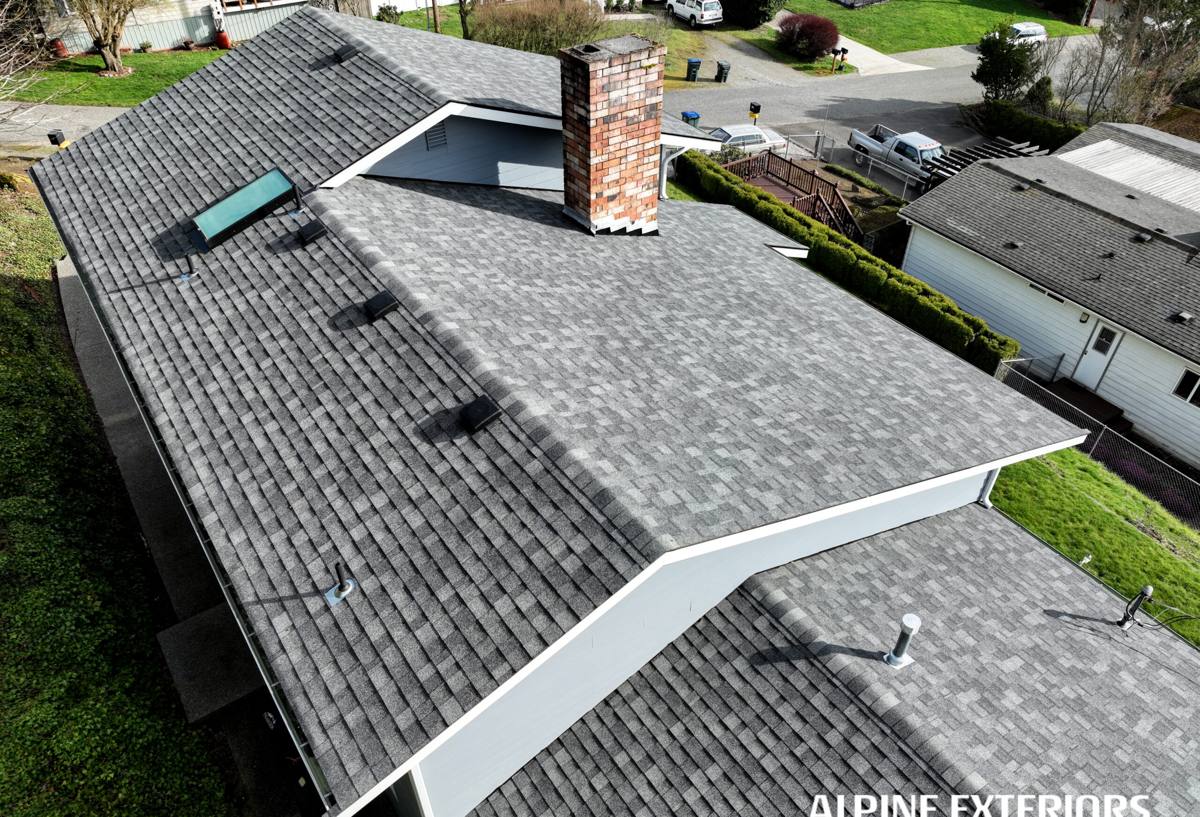
Chimneys, skylights, vent stacks, and wall-to-roof transitions are where the majority of roof leaks actually start, on any roof type. Metal roofing requires custom-formed flashing at every one of these points, properly lapped with the panel system rather than caulked over as an afterthought. This is detail work that separates a roof that performs for decades from one that leaks within a few years.
Fasteners and Panel Attachment
We use fasteners and clips rated for the coastal and marine-influenced air common to this part of Whatcom County — not general-purpose hardware that will streak and corrode at the panel edges within a few seasons. On standing seam systems, concealed clips allow the panel to expand and contract with temperature swings without stressing the fastening points.
Ventilation
A sealed, waterproof roof still needs to breathe. Proper ridge and soffit ventilation keeps moisture from condensing on the underside of the deck — a real risk on shaded, tree-covered homes where humidity sits longer than it does on an open lot. We check and correct attic ventilation as part of every metal roof installation, not as an upsell after the fact.
Our Process From Estimate to Finished Roof
- On-site assessment — we inspect the existing roof deck, flashing points, ventilation, and any moss or moisture damage before quoting anything
- Honest system recommendation — standing seam, exposed-fastener, or shingle-profile metal, based on the home's roofline and the homeowner's budget and priorities
- Written estimate — clear scope, material specifications, and timeline, with no vague allowances
- Tear-off and deck inspection — old roofing removed and the deck checked for rot or damage before anything new goes down
- Underlayment and flashing installation — the protective layer that does the real work under the metal
- Panel installation — precise fastening or seaming, correct panel overlap, and clean trim work at every edge
- Final walkthrough — we go over the finished roof with the homeowner before calling the job done
Living With a Metal Roof in This Climate: Maintenance That Matters
Metal roofing is low-maintenance, not no-maintenance. A few simple habits go a long way toward getting the full lifespan out of the investment:
- Clear overhanging branches back from the roofline to reduce shade, debris buildup, and moss pressure
- Keep gutters clear so water isn't backing up against eave flashing during heavy rain
- Rinse off accumulated needles and debris once or twice a year, especially on shaded slopes
- Watch for any rust streaking at fasteners or trim, which usually signals a hardware issue worth catching early
- Have flashing points checked periodically, since these — not the metal panels themselves — are where most roof leaks originate
Why It Matters to Hire a Crew That Already Works in Maple Falls
Roofing crews that mainly work drier, sunnier regions often under-detail flashing and underlayment because their usual conditions don't punish mistakes the way this climate does. A crew that regularly works Lynden, Maple Falls, and the surrounding Whatcom County foothills already knows where wind-driven rain tends to find gaps, how much moss pressure a shaded slope will see, and what fastener and coating specs actually hold up to the salt-influenced, wet air here year-round. That local experience shows up in the small decisions — where extra underlayment goes, how flashing is lapped, what hardware gets specified — that determine whether a metal roof performs for forty years or needs attention in five.
If you're weighing a metal roof for your Maple Falls home, we're happy to take a look and walk you through what your specific roofline needs. Reach out below for a free, no-pressure estimate.