 Lynden Siding
 Why Ferndale Roofs Take More Punishment Than People Expect
Ferndale sits close enough to open water that salt-laden air is a real, daily factor on anything installed outdoors — including a roof. Add Whatcom County's driving winter rain, which comes in sideways more often than straight down, and a long gray stretch of moss season every year, and you've got a climate that's genuinely harder on roofing than most manufacturers' spec sheets assume. A metal roof can handle all of this extremely well. It just has to be the right system, installed the right way, with the coastal exposure accounted for from the start. That's the difference between a metal roof that looks great for thirty-plus years and one that starts showing rust streaks, loose fasteners, or leaking flashing within a decade.
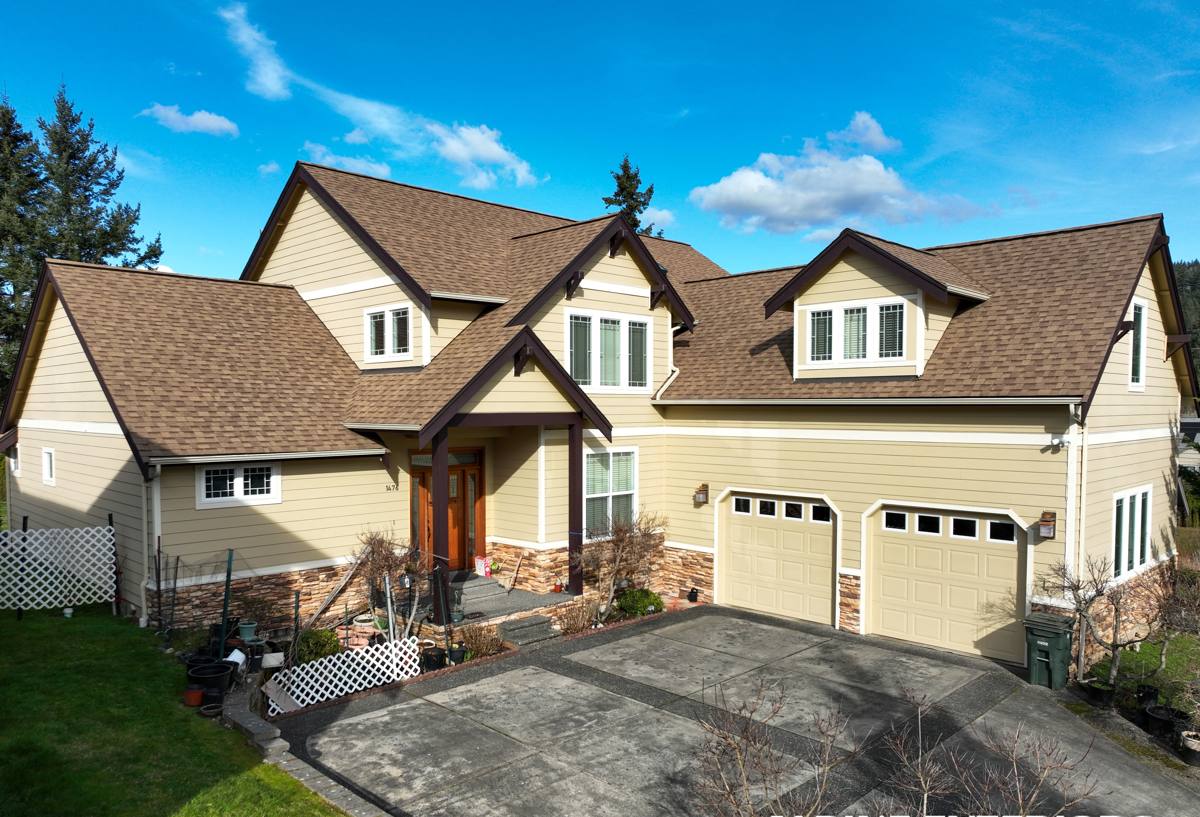
What a Correctly Specified Metal Roof Looks Like Here
Panel type: standing seam vs. exposed fastener
Standing seam panels use hidden clips and interlocking seams, so there are no fastener heads punched through the panel face. Exposed-fastener panels are screwed directly through the panel, with a rubber washer sealing each screw. Both are legitimate systems, but they behave differently in a wet, salt-air climate — the fasteners on an exposed system are the first thing exposed to weather and the first thing that eventually needs attention.
Gauge and coating matter as much as the panel style
A thicker panel (lower gauge number) resists denting from hail, debris, and foot traffic during maintenance. The factory finish matters just as much: a PVDF (often sold as Kynar 500) coating holds color and resists chalking and fading far longer than a basic polyester finish, which matters in a climate where the roof is rarely dry long enough to "recover" from UV and moisture stress the way it might in a drier region.
The Details That Actually Cause Leaks
Almost every metal roof failure we get called out to inspect traces back to a handful of details, not the panel itself. Flashing at valleys, chimneys, skylights, and roof-to-wall intersections is where water finds its way in. Underlayment choice matters too — a self-adhering ice-and-water membrane at eaves, valleys, and penetrations gives you a backup layer if wind-driven rain ever gets past the panel seams, which is a real possibility during a strong Whatcom County windstorm.
| Factor | Standing Seam | Exposed Fastener |
|---|---|---|
| Fastener exposure | Hidden clips, no punctures in panel face | Screws through panel face, sealed by washers |
| Handles panel expansion/contraction | Yes, floating clip system | Limited — panels are fixed at each screw |
| Typical maintenance | Minimal; occasional sealant check at penetrations | Washer inspection and gasket replacement over time |
| Upfront cost | Higher | Lower |
| Best fit | Long-term, low-maintenance install | Budget-conscious projects, outbuildings, simpler roofs |
Neither option is wrong. The mistake is picking exposed-fastener panels for a complex roofline with lots of valleys and penetrations, where the sheer number of fastener points multiplies the long-term maintenance burden.
Coastal Corrosion: Getting the Metals and Fasteners Right
Salt air accelerates corrosion, and the failure mode we see most often isn't the panel rusting through — it's galvanic corrosion where two dissimilar metals touch and one eats away at the other. Copper flashing against a steel panel, or the wrong fastener alloy against aluminum, can cause premature pitting and staining. Every fastener, flashing piece, and trim component needs to be compatible with the panel metal, not just close enough. We also specify corrosion-resistant fastener coatings rather than the cheapest screw available, because in a salt-air environment that choice shows up as rust streaks within a few years if it's wrong.
Moss and Algae: Why Metal Changes the Equation
Whatcom County's moss season runs long, and moss needs a damp, organic surface to get a foothold — which is exactly what asphalt shingle granules provide. A metal panel's slick, non-porous surface gives moss spores far less to grab onto, and rain sheets off faster than it does off a textured shingle. That said, metal roofing isn't moss-proof on its own. Debris that collects in valleys, behind chimneys, or under overhanging branches still holds moisture against the panel, and that's where we do see moss and streaking start. Keeping valleys and low-slope transitions clear of needles and leaves matters more on a metal roof's appearance than on its actual waterproofing, since the moss risk to the panel itself is low — but nobody wants a green roof, either.
Our Installation Process
A metal roofing job is not one task, it's a sequence, and skipping steps is how corners get cut without a homeowner ever knowing it happened.
- Roof and deck inspection — checking the existing deck for soft spots, rot, or inadequate ventilation before anything new goes on.
- Tear-off or overlay decision — some roofs can accept metal panels over a single layer of existing shingles; many older or already-repaired roofs need a full tear-off to install properly.
- Underlayment — synthetic underlayment across the field, with self-adhering ice-and-water membrane at eaves, valleys, and all penetrations.
- Panel layout and fastening — laid out square to the roofline, fastened per the manufacturer's spacing, not "close enough."
- Flashing and trim — custom-formed flashing at every valley, wall intersection, chimney, and penetration, using metal compatible with the panel.
- Ridge venting and closures — proper closure strips at ridge and eave to keep wind-driven rain and pests out while still allowing airflow.
- Final walk-through and cleanup — magnetic sweep for stray fasteners, gutters checked and cleared, site cleaned up.
Here's a shorter checklist worth keeping on hand when you're comparing quotes or checking a finished job:
- Ice-and-water membrane specified at eaves, valleys, and all penetrations — not just synthetic felt everywhere
- Flashing metal compatible with the panel metal, not mixed without a barrier
- Fastener type and coating specified in writing, not left to "whatever's in the truck"
- Ridge and eave closures included, not left open or foam-only
- Written scope covers tear-off vs. overlay, disposal, and who handles permitting
- Manufacturer's finish warranty and the installer's workmanship warranty are both explained, in writing, separately
Ventilation: What's Happening Underneath the Panels
A metal roof that isn't ventilated properly can trap moist air against the underside of the deck, especially in a climate as humid as this one. Intake at the soffit and exhaust at the ridge keep air moving through the attic space, which prevents condensation from forming on the underside of the roof deck and reduces the risk of hidden rot that has nothing to do with the panel itself. This is easy to overlook because it doesn't show up as a leak right away — it shows up years later as deck damage that could have been avoided with a properly balanced vent system installed at the same time as the roof.
What Drives the Cost of a Metal Roof in Ferndale
Metal roofing costs more upfront than asphalt shingles, and the final number depends on more than just square footage.
| Cost Factor | Why It Matters |
|---|---|
| Panel type | Standing seam costs more than exposed-fastener due to material and labor |
| Roof complexity | Valleys, dormers, and multiple planes increase flashing and labor time |
| Tear-off vs. overlay | Full tear-off adds disposal and deck-repair costs but often extends service life |
| Coating grade | PVDF/Kynar finishes cost more than basic polyester but last significantly longer |
| Accessories | Snow retention, gutter integration, and ridge venting add to the total |
We give honest, itemized numbers rather than a single lump figure, so you can see exactly what's driving the cost and where there's room to adjust the scope if needed.
Why It Matters That We Already Work in Ferndale
A crew that installs roofs and siding across Whatcom County day in and day out already knows how this region's rain behaves against a roofline, which flashing details actually hold up near the water, and which fastener and coating choices are worth the extra cost here versus somewhere drier inland. Because we work on siding and roofing together, we pay particular attention to the roof-to-wall intersections — kick-out flashing, step flashing, and the transition where a roof edge meets siding — since that junction is one of the most common places water finds its way into a wall system when it's handled by a crew that only thinks about the roof deck and stops there.
If you're weighing a metal roof for a Ferndale home, we're glad to walk the roof with you, look at your specific exposure and rooflines, and put together a clear, no-pressure estimate using the form below.