 Lynden Siding
 Fiber Cement Siding Built for Custer's Weather, Not Just Its Curb Appeal
Custer sits in the part of Whatcom County where three weather factors stack on top of each other year after year: salt-laden air moving in off the water, rain that comes in sideways more often than straight down, and a moss and mildew season that runs long because the temperature rarely gets cold enough or dry enough to shut it off. None of those three things is unusual by itself in the Pacific Northwest. Together, on a house that sits through twenty or thirty of these cycles, they're a real test of whatever material is on the walls.
This page is about one service in one area: installing fiber cement siding on homes in and around Custer, as part of our regular Lynden-area work. We're not going to repeat a generic rundown of what fiber cement is in the abstract. We're going to walk through what this specific climate demands from a siding system, what a correct installation actually looks like on a Custer job, and why a crew that already works this area consistently gets better long-term results than a crew passing through once.
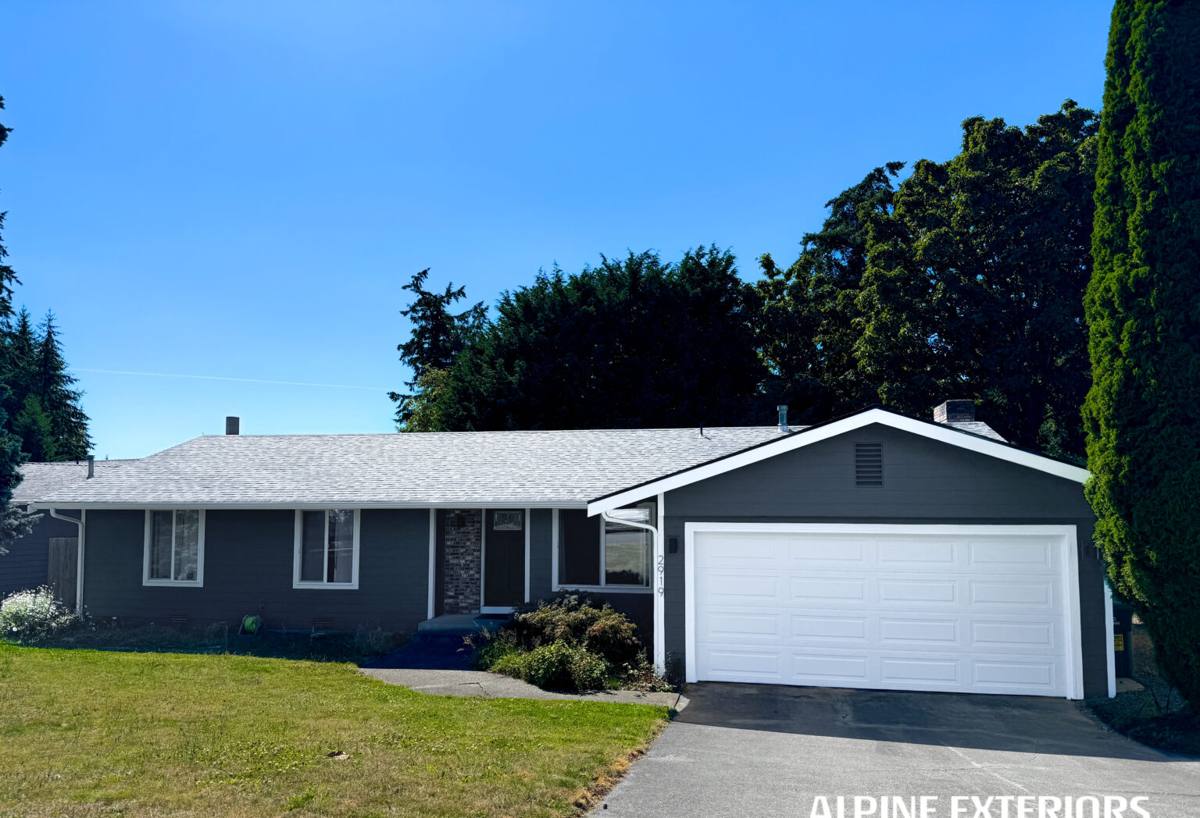
What Salt Air, Driving Rain, and Moss Actually Do to a Wall Assembly
Homeowners tend to think about siding failure as one dramatic event — a board that cracks, a section that rots out. In practice, most of the siding problems we see in this area develop slowly, from three ordinary conditions working on the same wall at the same time.
Salt Air
Custer doesn't have to be waterfront to feel salt exposure. Air moving inland off Puget Sound and the Strait of Georgia carries salt further than most people expect, and it settles on exterior surfaces even on lots that feel well inland. Salt exposure accelerates the breakdown of factory finishes over time and speeds up corrosion on fasteners, flashing, and trim hardware. A finish that holds up fine in a drier, inland market doesn't necessarily perform the same way here — and that gap usually shows up as fading, chalking, or fastener staining years down the road, not as an obvious defect on day one.
Wind-Driven Rain
Rain that's pushed sideways by wind behaves differently than rain falling straight down. It finds its way into lap joints, under trim boards, and into any seam where the flashing or caulking isn't done to spec. That's a much harder test of a wall's water management than a simple annual rainfall number suggests, and it's the reason we treat flashing and clearances as non-negotiable rather than as details to speed through.
A Long Moss and Mildew Season
Mild temperatures and steady moisture add up to active moss and mildew growth for most of the year on shaded, tree-lined lots — which describes a large share of properties around Custer and the broader Lynden area. Organic growth on a siding surface holds moisture against the wall behind it, and that trapped moisture is where a lot of long-term siding damage actually starts, well before anyone notices a visible problem from the street.
Why Fiber Cement Is the Right Answer for This Specific Climate
Fiber cement is a blend of Portland cement, sand, and cellulose fiber, cured into rigid boards and panels. Because it's an inorganic material, it doesn't have a wood-based or foam core that absorbs water, swells, or feeds rot and insects the way organic siding materials can. That matters directly in a climate where wet conditions are the default rather than the exception.
We install James Hardie fiber cement specifically, using the HZ5 product line engineered for regions with freeze-thaw cycles and sustained moisture exposure — a closer match to Whatcom County's winters than a product line engineered for hot, dry climates. The factory-applied ColorPlus finish is baked on in a controlled environment before the boards ever reach the job site, which gives it more consistent, longer-lasting color retention under salt air and UV exposure than a field-applied coating.
None of that engineering does much good, though, if the installation around it is wrong. That's the part of this page that's specific to what we actually do on a Custer job.
What a Correct Fiber Cement Installation Involves
Fiber cement's reputation depends heavily on installation quality. A rushed or out-of-spec install can undercut even a well-engineered product, especially in a climate that gives water every opportunity to find a weak point.
| Installation Detail | Why It Matters on a Custer Home |
|---|---|
| Manufacturer-specified clearances at grade, roofline, and decks | Keeps splash-back and standing moisture away from board edges through a wet, rainy season |
| Correct fastener type, spacing, and depth | Prevents cracking and keeps the water-resistive barrier behind the siding intact |
| Properly lapped, sealed flashing at windows, doors, and penetrations | Directs wind-driven rain away from seams instead of letting it collect there |
| Factory-cut edges used wherever possible; field cuts sealed to spec | Preserves the factory finish's protection at every cut edge |
| Rain screen or drainage gap behind the siding | Gives any moisture that does get past the surface a way to drain and dry instead of sitting against the sheathing |
| Proper joint and fastener-head caulking, matched to the finish system | Keeps salt-air corrosion and coating breakdown from starting at exposed fastener heads |
Our Process for a Custer Fiber Cement Job
The steps themselves aren't unusual for the trade, but the sequence and the level of attention at each stage are where jobs succeed or fail in this climate. Here's the order we work in on a typical re-side:
- Site walk and assessment. We look at existing siding, trim, and any visible moisture staining, and we talk through sun exposure, wind exposure, and shade on the specific lot — factors that vary block to block even within a small community like Custer.
- Tear-off and sheathing inspection. Once the old siding is off, we check the sheathing and framing underneath for hidden moisture damage before anything new goes up. This is the point where problems that built up over years, unseen, actually surface.
- Water-resistive barrier and flashing. House wrap, window and door flashing, and any penetration flashing go in before the first piece of siding, following manufacturer spec rather than a generic approach.
- Rain screen or drainage gap installation. Given how much of this area's siding failure traces back to trapped moisture, we build in a drainage path behind the cladding rather than treating it as optional.
- Fiber cement installation to spec. Clearances, fastener placement, and joint treatment follow James Hardie's published installation guide, not shortcuts based on what's faster.
- Trim, caulking, and final detailing. This is where a lot of long-term performance is actually decided — the visible finish work is also the functional water management layer.
- Final walkthrough. We go over the finished job with the homeowner before calling it done, not just from the street.
Cost Factors on a Custer Fiber Cement Project
Every job is different, but the same handful of variables drive most of the cost difference between one Custer home and the next.
| Cost Factor | How It Plays Out Locally |
|---|---|
| Square footage and home shape | More corners, gables, and dormers mean more cutting, flashing, and labor time regardless of material cost |
| Condition of existing sheathing | Hidden rot found during tear-off (more common on older, shaded lots) adds repair scope before new siding can go on |
| Siding profile | Lap siding, shingle-style panels, and board-and-batten all install differently and carry different labor time |
| Trim and detail work | Homes with more windows, dormers, and architectural trim take longer to flash and finish correctly |
| Site exposure | Wind- and rain-exposed elevations sometimes warrant extra flashing or sealant attention, which adds modest labor cost but reduces future risk |
As a general rule, fiber cement runs higher upfront than vinyl and in a similar range to or somewhat above engineered wood siding, reflecting the heavier material and more labor-intensive installation. Where it tends to even out is in reduced maintenance cost over the life of the siding, since there's no wood-based core requiring a repainting or recaulking schedule to keep water out.
Why a Crew That Already Works Custer Matters
A siding crew that only shows up in this specific pocket of Whatcom County occasionally has to relearn the local conditions on every job. A crew that works Custer and the surrounding Lynden area regularly already has a working sense of which lots run shadier and hold moss longer, which elevations take the brunt of wind-driven rain, and what the local permitting and inspection process actually expects. That familiarity shows up in small decisions — where to add extra flashing attention, how much drainage capacity to build in, which trim details tend to need more caulking maintenance over time — that a generic installation approach doesn't account for.
It also matters for accountability. If a question comes up two or five years after installation, a local crew is a phone call away, not a company that finished a job in the area once and moved on to the next region.
Maintenance After Your New Siding Goes On
Fiber cement is a low-maintenance material, but "low-maintenance" doesn't mean "no maintenance," especially in a climate that pushes moss and mildew growth most of the year.
- Rinse siding periodically to clear pollen, dust, and early moss growth before it establishes, especially on shaded north-facing walls.
- Keep gutters clear and functioning so overflow doesn't run down the siding face repeatedly in heavy rain.
- Keep landscaping trimmed back from the siding to maintain airflow and reduce shaded, damp conditions against the wall.
- Have caulking at trim joints and penetrations inspected periodically, since caulking has a shorter service life than the siding itself.
If you're weighing a re-side for a home in Custer or elsewhere around Lynden, we're glad to walk the property, look at what's on the walls now, and give you a straight answer about what the job actually involves. Reach out using the form below to schedule a free, no-pressure estimate.