 Lynden Siding
 Wiser Lake's Climate Is Harder on Siding Than It Looks
Wiser Lake sits in the quieter, semi-rural stretch south of Lynden, where lakefront lots back up to pasture, timber, and low-lying ground that stays damp long after the rest of Whatcom County has dried out. That combination — standing water nearby, heavy tree cover, and marine air moving in off the Salish Sea — creates a microclimate that's tougher on exterior building materials than a typical in-town lot. Moisture sits longer, shade keeps siding wet after a storm, and salt-laced air corrodes anything that isn't built to resist it.
Homeowners around the lake tend to notice the same three problems on the wrong siding: green-black streaking from moss and algae, swelling or soft spots where trim meets siding, and paint that fails years ahead of schedule because it never gets a full day of sun to dry out. None of that is a workmanship problem by itself — it's the climate doing exactly what it does here, and it's why the material you choose matters more at Wiser Lake than it might in a drier part of the state.
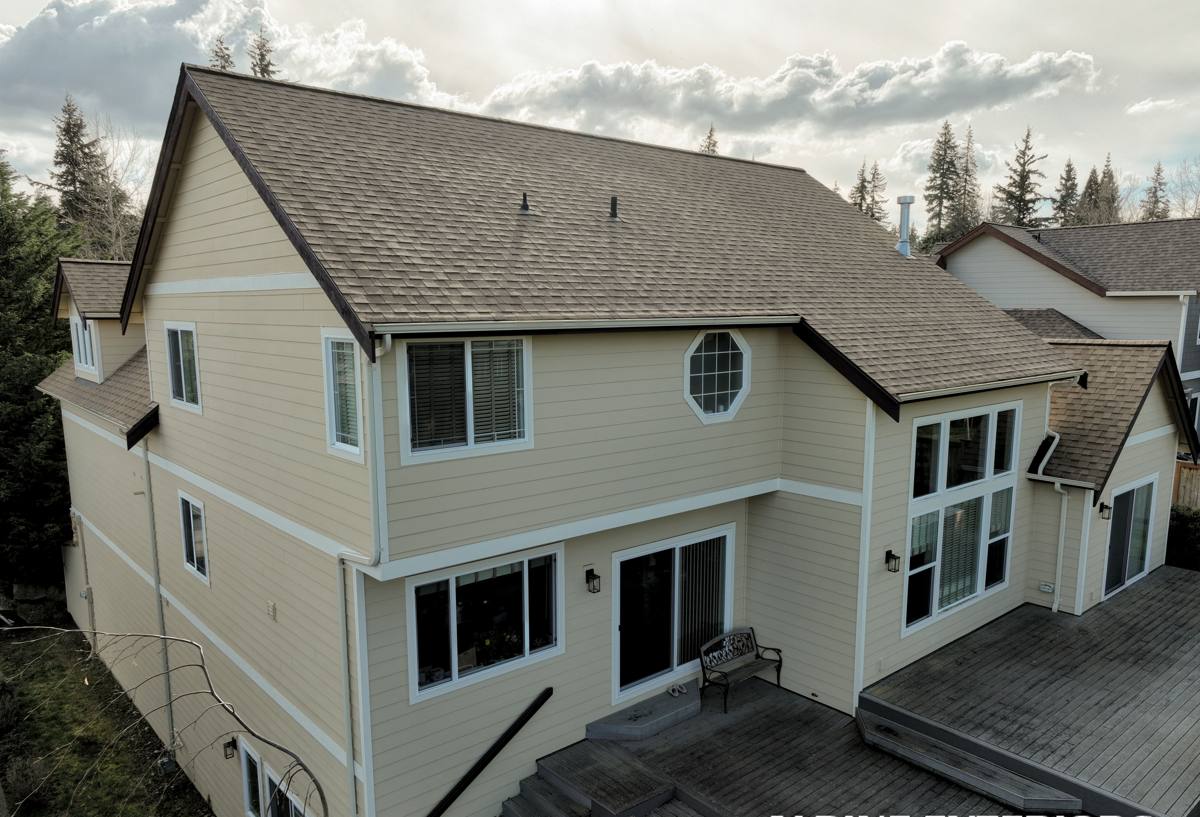
What Driving Rain, Salt Air, and Moss Actually Do to Siding
It helps to understand the mechanism, not just the symptom. Whatcom County's weather pattern pushes wind-driven rain sideways into walls, not just straight down onto roofs. That means water is forced up under laps and around trim, not just sheeted off the surface. Add a long moss season — cool, shaded, and wet from fall through spring — and any organic-based or absorbent siding material becomes a place for spores to take hold and stay.
Wood-based products, including primed spruce, cedar, and OSB-core siding like LP SmartSide, are vulnerable here in a specific way: their core can absorb moisture at cut edges, seams, and fastener penetrations, and once that happens the swelling and soft spots don't reverse themselves. Vinyl doesn't rot, but it distorts under sun and cold cycling, and its butt joints and lap seams are actual openings that trap the fine spray this region produces. None of these are defects in the product — they're trade-offs, and in a climate like Wiser Lake's, those trade-offs show up faster and more visibly than they would somewhere drier.
Why We Install Only James Hardie Here
This is the reason our company standardized on James Hardie fiber cement and doesn't install vinyl, LP SmartSide, Cemplank, Allura, primed spruce, or cedar. Fiber cement is non-combustible and dimensionally stable — it doesn't expand, contract, or absorb water the way wood-based or vinyl products do. That stability matters most in exactly the conditions Wiser Lake produces: sustained dampness, shade, and salt-bearing wind.
Hardie's Climate-Engineered HZ Product Lines
James Hardie manufactures its siding in climate-specific formulations, called HZ5 and HZ10, engineered for different combinations of moisture and freeze-thaw exposure. Western Washington falls into the wetter, milder HZ5 zone, and Hardie's HZ5 formulation is built with that moisture load in mind rather than a one-size-fits-all mix used nationwide. That distinction is part of why we only install James Hardie: fewer manufacturers engineer specifically for a marine, high-moisture climate like this one.
ColorPlus Finish vs. Field-Applied Paint
Hardie's ColorPlus finish is baked on at the factory under controlled conditions, which gives it better fade and moisture resistance than paint applied on site, especially in a climate where siding rarely gets a long dry window to cure properly. It also means touch-ups use a matched factory-formulated product rather than a repaint, which keeps color consistent on a home that's shaded half the year.
What a Correct Installation Involves
Fiber cement performs the way it's rated to only when it's installed correctly. Around Wiser Lake specifically, we pay close attention to a handful of details that matter more here than they would on a dry, open, in-town lot:
- Minimum clearances between siding and grade, roof lines, decks, and hardscape, so splashback and standing water don't sit against the bottom course
- A continuous weather-resistive barrier behind the siding, with all seams properly lapped and taped
- Flashing at every window, door, and penetration — the single most common failure point when driving rain gets forced sideways into a wall
- Corrosion-resistant fasteners driven at the correct depth and pattern, since over- or under-driven nails are a leading cause of premature siding failure
- Caulking only where Hardie's installation instructions call for it — sealing joints that should be left to drain traps moisture instead of shedding it
- Proper gapping and shimming so panels can move slightly with temperature changes without cracking at the joints
Any one of these done wrong can undercut the material's performance, no matter how good the siding itself is. This is also why we don't treat installation as an afterthought to the sale — it's the part of the job that determines whether the siding actually holds up to this climate for decades or needs attention in a few years.
Our Process for a Wiser Lake Project
Every property around the lake is a little different — some are close to the water with heavy tree cover and constant shade, others sit on more open rural acreage with more sun exposure but longer wind fetch. We start with an on-site walk to look at drainage, grading, existing moisture damage, tree canopy, and how the home is oriented to prevailing wind and rain. That assessment shapes decisions on underlayment, flashing details, and where extra attention is needed, rather than applying the same spec to every house.
From there, the sequence is straightforward: remove the old siding and inspect the sheathing underneath for any hidden rot or moisture damage, repair or replace any compromised sheathing before covering it up, install a correctly lapped weather-resistive barrier, then install the James Hardie panels, trim, and flashing to manufacturer spec. We do a final walk-through before calling the job finished, checking clearances, caulk lines, and fastener patterns rather than just the visual result from the curb.
Cost Factors for This Job
Every siding quote is specific to the house, but a few factors consistently move the price up or down on Wiser Lake properties. It's worth understanding these before you get quotes, so you can compare them on an apples-to-apples basis rather than just the bottom line.
| Factor | Why It Matters | Effect on Cost |
|---|---|---|
| Home size and number of stories | More surface area and taller walls mean more material and labor, plus added scaffolding or lift access | Higher |
| Trim and architectural detail | Multiple gables, bay windows, and dormers all add cutting, flashing, and finish time | Higher |
| Condition of the sheathing underneath | Hidden moisture damage found during tear-off has to be repaired before new siding goes on | Variable, can raise cost |
| Tree cover and site access | Heavy canopy near lakefront lots can slow tear-off and staging and may require extra protection for landscaping | Moderate increase |
| New construction vs. re-side | New construction has no tear-off or hidden damage to address, simplifying the job | Lower |
| Panel style and color selection | Lap width, panel texture, and custom ColorPlus colors can shift material pricing | Minor to moderate |
Maintenance in a Damp, Moss-Prone Climate
Even the right material still needs basic upkeep, and Wiser Lake's shade and moisture make a little routine maintenance go a long way. A yearly gentle wash — low-pressure water and a soft brush, not a pressure washer aimed directly at seams — keeps moss and algae from establishing on the surface. Keeping gutters clear and checking that downspouts direct water away from the foundation prevents splashback from constantly hitting the lower courses. It's also worth doing a visual check of caulk lines and trim joints once a year, since that's where small problems show up first, long before they become bigger repairs.
Because ColorPlus finish is factory-applied, it doesn't need repainting on the same cycle field-painted wood or vinyl often does. That's a real advantage in a climate where a full dry week to paint an exterior isn't something you can count on for much of the year.
Why Local Experience Around Wiser Lake Matters
A crew that already works this specific area understands things a general contractor from further inland might not think to check: how much shade a lakefront lot actually holds onto after a storm, how far wind-driven rain typically pushes water up a wall on an open rural lot, and which details on a house need extra attention because of how close the property sits to standing water. That local pattern recognition doesn't replace following manufacturer spec — it adds to it, because it tells us where to look closest on your specific home.
If you're planning a siding project on or near Wiser Lake, we're happy to walk the property, look at what your home is dealing with, and talk through what correct James Hardie installation looks like for your situation. Reach out for a free, no-pressure estimate using the form below.