 Lynden Siding
 Why Ferndale Homes Wear Out Siding Faster Than You'd Expect
Ferndale sits close enough to the Salish Sea and the Nooksack River delta that salt-laden air is a real factor in how exterior materials age here, not just a talking point. Add Whatcom County's long, wet winters and the driving rain that comes off Bellingham Bay during a southwesterly blow, and you have a climate that tests siding on three fronts at once: moisture intrusion, corrosion, and sustained organic growth. Most siding products are engineered for an "average" American climate. Ferndale isn't average. It's wetter, greener, and closer to salt water than most manufacturer test data assumes.
The result is a local pattern we see over and over: siding that looks fine from the street but is quietly failing behind the surface, or siding that's visibly chalking, staining, and growing moss well before it should. Homeowners in Ferndale often replace siding not because it's ugly, but because it's no longer doing its job of keeping water out of the wall assembly.
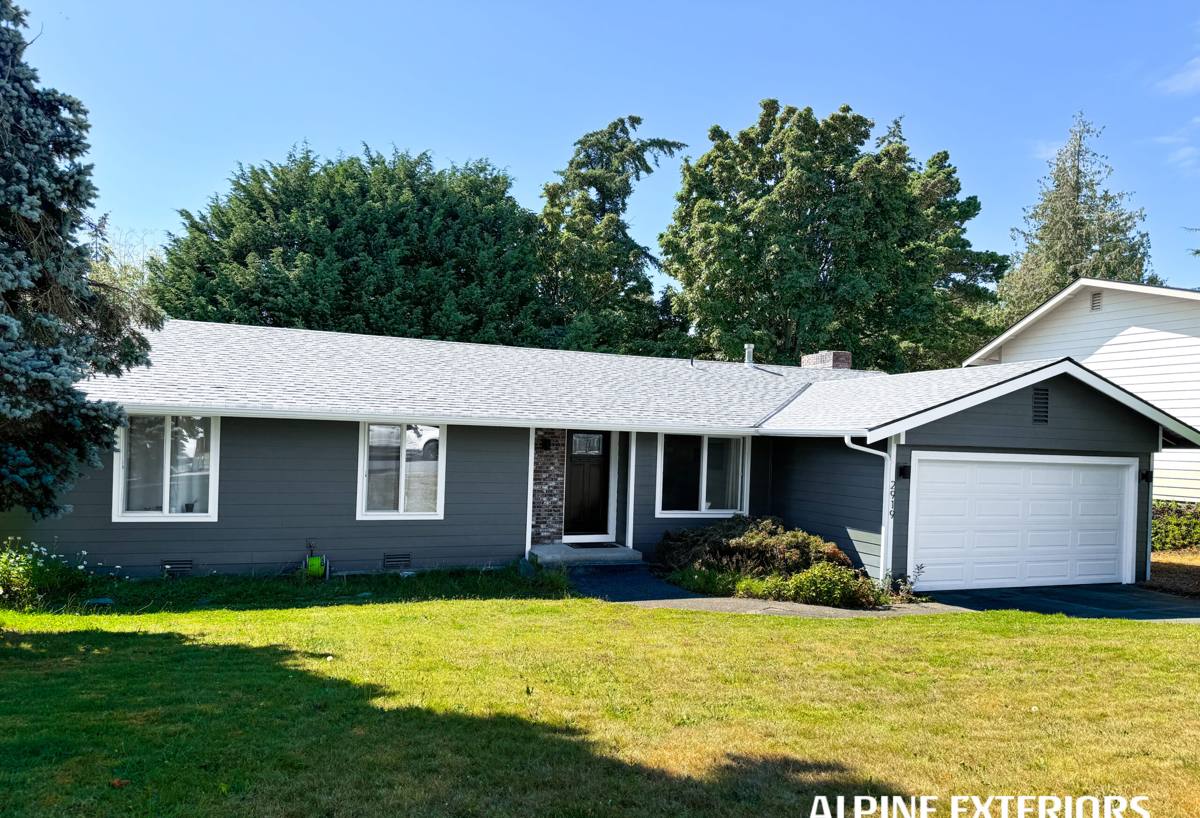
What a Long Moss Season Actually Does to Siding
Whatcom County's moss season isn't a few weeks in spring — on shaded, north-facing, or tree-lined lots in and around Ferndale, conditions favorable to moss and algae growth can persist most of the year. Moss itself isn't just cosmetic. It holds moisture against the siding surface far longer than open air ever would, and on materials that aren't dimensionally stable or properly sealed, that sustained dampness accelerates swelling, cracking, and paint failure. On wood-based products in particular, trapped moisture behind moss growth is one of the more common paths to hidden rot.
This is one of the reasons product choice matters as much as installation quality. A siding material that resists moisture absorption at the core, not just at the paint layer, holds up to a Ferndale moss season in a way that painted wood or wood-composite products generally don't.
Salt Air and Driving Rain: The Other Two Stressors
Salt air accelerates corrosion of exposed fasteners, trim metal, and any unprotected cut edges. Driving rain, especially on west- and south-facing walls that catch storms coming off the water, pushes water sideways into laps, seams, and butt joints that a fair-weather installation might get away with elsewhere. Combined, these three factors — salt, rain, and moss — mean Ferndale siding needs to perform on every seam, not just look good on the wall.
Signs a Ferndale Home Needs Siding Replacement, Not Just Repair
Not every siding problem calls for a full replacement. But there's a point where patching stops making sense and a full re-side is the honest recommendation. In our experience working this area, these are the signals that tip a home into replacement territory:
- Soft or spongy spots when you press on the siding, especially near the bottom courses or around windows
- Paint that's failing repeatedly in the same spots within a year or two of repainting
- Persistent moss or algae staining that returns within months of cleaning
- Visible gaps, warping, or buckling at seams and butt joints
- Rust streaking from fasteners or trim, a sign salt air is working on exposed metal
- Interior signs like musty smells, peeling interior paint near exterior walls, or unexplained humidity
- Siding that's original to a home built more than 20-25 years ago, particularly if it's wood, hardboard, or early-generation composite
If you're seeing two or more of these at once, it usually means the water-resistive barrier behind the siding has been compromised, and patching the visible symptom won't fix the underlying problem.
What a Correct Siding Replacement Actually Involves
A siding replacement is a wall system project, not a cosmetic one. The visible siding is the last layer installed and the first one people judge, but the layers behind it determine whether the job holds up through a Ferndale winter. A correct job includes:
Full Tear-Off and Inspection
Old siding comes off entirely so the sheathing underneath can be inspected. This is the point where hidden rot, soft sheathing, or prior water damage gets found and dealt with — not covered up. Skipping this step is the single biggest shortcut in the industry, because it's invisible once the new siding goes up.
Correcting Sheathing and Framing Issues
Any damaged sheathing gets replaced before anything else happens. Installing new siding over compromised sheathing just delays a bigger, more expensive repair.
Weather-Resistive Barrier
A continuous, properly lapped water-resistive barrier is installed over the sheathing. In a climate with as much driving rain as Ferndale sees, how this barrier is lapped and sealed at penetrations matters as much as the siding itself.
Flashing at Every Penetration
Windows, doors, hose bibs, vents, and any other wall penetration need proper flashing that directs water out and away, not behind the barrier. This is where a lot of failures start on homes that otherwise "look" well built.
Correct Fastening and Clearances
Fastener spacing, siding overlap, and clearances from grade, roof lines, and decks all follow manufacturer specification, not general habit. Getting these wrong is one of the more common ways manufacturer warranties get voided without the homeowner ever knowing.
Factory-Finished Exterior
The final siding and trim go on with attention to caulking, corner treatment, and paint line consistency, so the finished product both performs and looks intentional.
Why We Only Install James Hardie Fiber Cement
We install James Hardie fiber cement siding exclusively. We don't offer vinyl, LP SmartSide, or cedar as alternatives, and that's a deliberate standard, not a limitation of what we're capable of installing.
In a climate like Ferndale's, the core material matters more than the finish. Fiber cement is non-combustible and doesn't absorb moisture the way wood-based products do, which matters directly in a long moss season where siding stays damp for extended stretches. Hardie's ColorPlus factory finish is baked on under controlled conditions, which holds color and resists the chalking and fading that site-applied paint struggles with under coastal sun and salt exposure. Hardie also engineers specific product lines (HZ5, for example) for regions with more moisture and temperature swing, which the Pacific Northwest qualifies as.
None of this means other products are junk. Vinyl is inexpensive and low-maintenance in mild climates. Wood has a look some homeowners genuinely prefer. But we've made a professional decision, based on what we see on Whatcom County homes, that fiber cement gives our customers the best long-term outcome for the money, backed by a strong transferable warranty. We'd rather stand behind one product we trust completely than offer several we have reservations about.
Comparing Common Siding Options for a Ferndale Climate
| Factor | James Hardie Fiber Cement | Vinyl | Wood / Engineered Wood |
|---|---|---|---|
| Moisture resistance | High — cement core doesn't swell or rot | Moderate — seams can allow intrusion | Lower — susceptible to swelling and rot if finish fails |
| Salt air / coastal exposure | Strong, factory-sealed finish | Can become brittle over time in sun/salt cycles | Finish breaks down faster, exposing substrate |
| Moss/algae resistance | Good — doesn't feed organic growth | Fair — surface growth cleans off, doesn't structurally harm | Poor — trapped moisture under growth accelerates decay |
| Fire resistance | Non-combustible | Combustible | Combustible |
| Maintenance | Low — factory finish, occasional caulking | Low, but cracks/fades over time | Higher — repainting/sealing on a cycle |
How Our Process Works for Ferndale Projects
We start with an on-site assessment, not a phone quote. Because we work throughout the Lynden and Ferndale area regularly, we already have a working sense of which streets and exposures tend to run wetter or catch more wind-driven rain, and that shapes how we scope flashing and drainage details before we ever price the job.
- Walk-through assessment of current siding, trim, and any visible moisture damage
- Written scope covering tear-off, sheathing repair allowances, barrier and flashing details, and product selection
- Full tear-off with sheathing inspection before any new material is ordered or installed
- Installation of weather-resistive barrier, flashing, and James Hardie siding to manufacturer specification
- Final walkthrough covering warranty registration and care recommendations specific to this climate
Why Hiring a Crew That Already Works Ferndale Matters
Siding installation quality is only half the equation — the other half is judgment calls that don't show up in a spec sheet: how much overlap to add on a west-facing wall that takes direct storm exposure, where to expect moss regrowth and how to detail around it, which grade transitions in this area tend to trap water against the bottom course. A crew that installs siding across all kinds of climates has to relearn these details on the fly. A crew that works Whatcom County regularly already knows them.
There's also a practical accountability angle. A local contractor is easy to reach if a question comes up two years after the job, and has a reputation in the community that depends on the work holding up through actual Ferndale winters, not just looking good at handoff.
A Quick Homeowner Checklist Before You Call Anyone
- Note where you see moss, staining, or paint failure, and whether it's on a specific side of the house
- Check for soft spots by pressing gently on siding near the bottom courses and around windows
- Look inside for musty smells or peeling paint near exterior walls
- Find out the approximate age of your current siding, if known
- Ask any contractor you're considering whether they do a full tear-off and sheathing inspection, not just a re-side over existing material
If your Ferndale home is showing any of these signs, or you just want an honest read on whether repair or replacement makes sense, we're happy to take a look. The estimate is free and there's no pressure to move forward — you'll get a straight answer either way.