 Lynden Siding
 Deck Repair Built for Maple Falls' Wet, Shaded Climate
Maple Falls sits back from the coast, tucked into the foothills of Whatcom County along the Nooksack River valley, but it doesn't escape the weather that defines this corner of Washington. Storms moving in off the water still reach this far east, and the salt-tinged marine air that settles over the county doesn't stop at the coastline — it works its way up the valley along with the rain. Add in the heavy evergreen canopy that shades so many Maple Falls properties, and you get a deck environment that stays damp longer, dries out slower, and grows moss more readily than a deck in a more open, sun-exposed part of the county.
That combination — driving rain funneled up the valley, near-constant shade, and moisture that lingers on horizontal surfaces — is exactly what wears a deck down here, and it's different from what a deck faces in a drier or more open part of Whatcom County. A repair job that doesn't account for it usually looks fine for a season or two and then fails again in the same spot. This page covers what actually damages decks in Maple Falls, how we scope and carry out a repair correctly, and why a crew that already works this specific part of the county catches things a generic repair estimate misses.
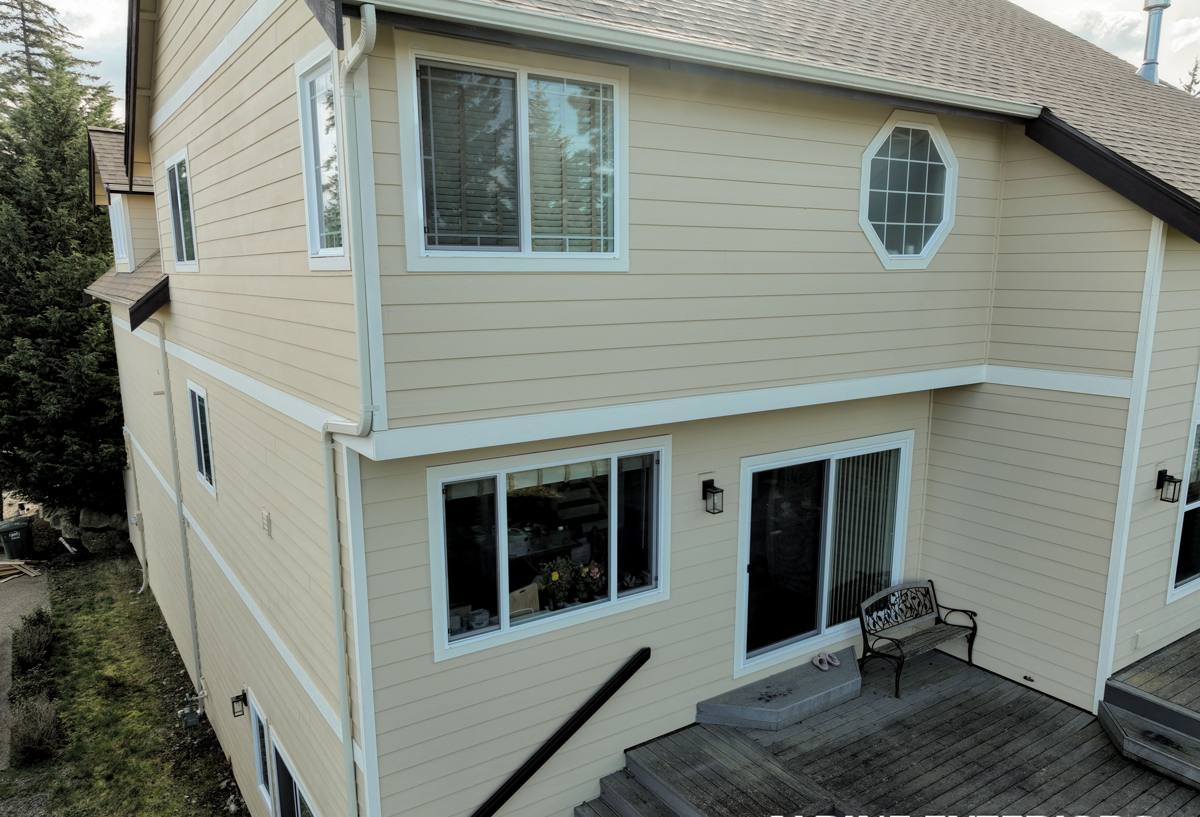
What Actually Wears Down a Deck in Maple Falls
Driving Rain and Runoff From the Foothills
Rain in this part of Whatcom County doesn't just fall — it moves. Water running off the surrounding hillsides and through wooded lots often drains toward and under decks that weren't graded with that runoff in mind, keeping the substructure damp well after a storm has passed. Combined with wind that pushes rain sideways into railings and ledger connections, a deck here can be taking on moisture from above, from the side, and from underneath all at the same time.
A Moss Season That Barely Breaks
Heavy tree cover is part of what makes Maple Falls appealing, but it also means many decks get filtered light at best and deep shade for parts of the day, year-round. Moss and mildew need moisture and shade to establish, and a shaded deck surface holds both far longer than an open one does between rain events. Once moss gets a foothold on a horizontal surface — deck boards, stair treads, railing caps — it holds even more moisture against the material underneath, which accelerates whatever decay process was already starting.
Corrosion From Whatcom County's Marine Air
The salt-tinged air that moves across Whatcom County from the Pacific reaches well inland, and it settles on exposed metal continuously, not just during storms. Fasteners, joist hangers, and railing hardware lose holding strength to corrosion gradually and often invisibly from the top of the deck, long before a homeowner notices anything wrong. Paired with the sustained dampness from rain and shade, hardware in Maple Falls tends to corrode faster than the same hardware would in a drier, more open location.
Cosmetic Wear vs. Structural Problems
Every deck repair call starts with the same question: is this a surface problem or a structural one? Getting that answer right is what determines whether a repair actually fixes something or just covers it up for a season.
| Symptom | Usually Cosmetic | Often Structural |
|---|---|---|
| Gray, weathered wood surface | Yes — normal weathering and moss staining | Only if boards are also soft or splitting through |
| Squeaking or slight bounce underfoot | Sometimes — loose surface fasteners | Often — loosened joists or hangers |
| Railing that flexes or wiggles | Rarely | Usually — loose posts or corroded hardware |
| Soft or spongy decking | No | Yes — rot from trapped moisture below the surface |
| Green or black buildup on boards | Cosmetic if surface-level | Can mask rot if it's been present a long time |
| Gap or movement where deck meets the house | No | Yes — ledger connection needs attention now |
Cosmetic wear can usually wait for routine maintenance. Structural issues — anything touching the ledger board, joist hangers, or support posts — shouldn't be, since those are the elements holding the deck up.
How We Diagnose a Deck Before Recommending Repair
An estimate that's actually useful comes from a real inspection, not a look from the yard. That includes:
- Checking the ledger board connection to the house, the most common serious failure point and the hardest one to see without pulling back trim or skirting
- Probing boards and framing members for soft spots, not just checking them visually — moss and staining can hide early rot rather than cause it
- Inspecting joist hangers, fasteners, and railing hardware for corrosion, especially on older decks built with standard-grade hardware
- Checking support posts and footings for movement, settling, or standing water contact underneath the deck
- Assessing railing attachment and height against current code, particularly on elevated decks where a failure has real consequences
- Looking at drainage and airflow underneath the deck, since poor ventilation there is often what let moisture problems start in the first place
We walk through what we actually find — what needs attention now, what can be monitored, and what's simply cosmetic — before we put together a scope of work.
Repair vs. Replace: How That Decision Actually Gets Made
Homeowners often assume any deck problem calls for a full rebuild, or the opposite — that repair will always be the cheaper, equally good option. Neither assumption holds up consistently. What actually drives the decision:
- How far the substructure damage extends. Rot or corrosion isolated to a few joists, hangers, or a section of decking is usually a straightforward repair. Moisture damage running through most of the framing often isn't worth chasing board by board.
- Age and condition of what's left. A deck near the end of its practical life may only have one or two more repair cycles in it before replacement becomes the more sensible path financially.
- Whether the original build matches current standards. Some older decks in this area weren't framed or fastened with this climate's moisture and corrosion exposure fully in mind, and repairing those in place just delays the same failure showing up again.
- Surface wear versus structural soundness. A structurally solid deck with worn, grayed, or moss-stained surface boards is usually a strong repair candidate — resurfacing over good framing is often the most cost-effective option on the table.
We'll give a straight read on which category your deck actually falls into, including when replacement is genuinely the better call, rather than defaulting to whichever job is bigger.
What a Correct Repair Involves
Matching Materials to What's Already There
Repairing a deck means working with the existing structure and, usually, the existing surface material — wood, composite, or PVC. Matching board profile, fastening pattern, and color or finish as closely as possible keeps a repair from reading as an obvious patch. Discontinued composite or PVC colors and profiles can make an exact match difficult, and we'll say so upfront rather than after the work is done.
Hardware Upgrades, Not Like-for-Like Swaps
When we replace corroded fasteners, hangers, or connectors, we use stainless steel or otherwise corrosion-resistant hardware rated for this kind of sustained moisture exposure, not a plain swap for the same standard-grade hardware that failed the first time. This one decision is often the difference between a repair that lasts and one that needs redoing in a few years.
Fixing the Cause, Not Just the Symptom
A soft board is a symptom. Standing water underneath, poor drainage, a shaded spot that never fully dries, or a failed flashing detail at the ledger is usually the actual cause. Replacing the damaged material without correcting whatever let moisture sit there in the first place tends to produce a repair that fails again in the same spot, often faster the second time.
Structural Work Gets Full Attention
Ledger connections, joist hangers, and support posts carry load, and repairs to them get built to the same standard as new construction — correct fastener grade, correct flashing, attachment sized to the site — not a lesser scope just because it's a repair rather than new construction.
Keeping Moss From Taking the Deck Back
Even a correctly repaired deck needs some routine attention in a climate like this one, especially on shaded lots. Worth keeping to a schedule:
- Sweep or rinse the deck surface regularly to clear needles, leaves, and organic debris before moss and mildew get established in it
- Keep gaps between boards clear so water and airflow can move through the way the design intends, rather than sitting on the surface
- Trim back overhanging branches and brush where it's practical, to give the deck more light and airflow between rain events
- Check railing posts and visible hardware once or twice a year for early corrosion or loosening, especially heading into the wet season
- Address any soft spot or movement right away — that's a structural signal, not a cosmetic one, and it doesn't improve on its own
- Reseal or refinish wood decking on a schedule that matches how much shade and moisture your specific deck actually sees, rather than a generic interval
Why It Matters That We Already Work Maple Falls
A crew that mostly repairs decks in drier, more open parts of the county can still do competent work here, but a Maple Falls repair has variables that show up more often in this part of Whatcom County than elsewhere — sustained shade-driven moss growth, runoff draining toward the deck from surrounding grade, and hardware corrosion that moves faster under near-constant dampness. Working this area regularly means we're not guessing at those conditions or figuring them out on your project. We know which repairs hold up against this specific combination of driving rain, shade, and moss, and which shortcuts just buy a homeowner a second repair a few years sooner than it should have been needed.
That familiarity also shows up in the estimate itself — fewer surprises once work is underway, because the inspection already accounted for how a deck actually wears out in a shaded, wet foothill setting instead of applying the same checklist used on an open, sun-exposed lot.
Get an Honest Look at Your Deck
Whether you're dealing with one specific problem — a soft board, a wobbly railing, hardware that's clearly rusted — or just want a straight read on where your deck actually stands, we're glad to walk the site and explain what we find in plain terms, including when the answer is that it doesn't need much. Reach out below for a free, no-pressure estimate.