 Lynden Siding
 Roof Repair in Custer: What the Climate Actually Demands
Custer sits close enough to the water that homes here take a different kind of weathering than roofs ten miles inland in Lynden proper. The salt-laden air rolling off the Strait of Georgia and Birch Bay works on exposed metal — nail heads, flashing, gutter hangers — faster than it does further from the coast. Add Whatcom County's long wet season, wind-driven rain that gets pushed sideways under shingle tabs and around chimney flashing, and a moss season that can run eight or nine months out of the year under the tree cover common in this area, and you get a roof that ages differently than a roof in a drier climate. A repair approach that works fine in Spokane or Sacramento often falls short here, because it doesn't account for how much of the damage on a Custer roof starts with moisture getting somewhere it shouldn't and staying there.
This page is about roof repair specifically — not full replacement, not general roofing services. If your roof is basically sound but has a leak, a moss problem, damaged flashing, or a handful of failing shingles, this is the service that fixes it without the cost or disruption of tearing the whole thing off.
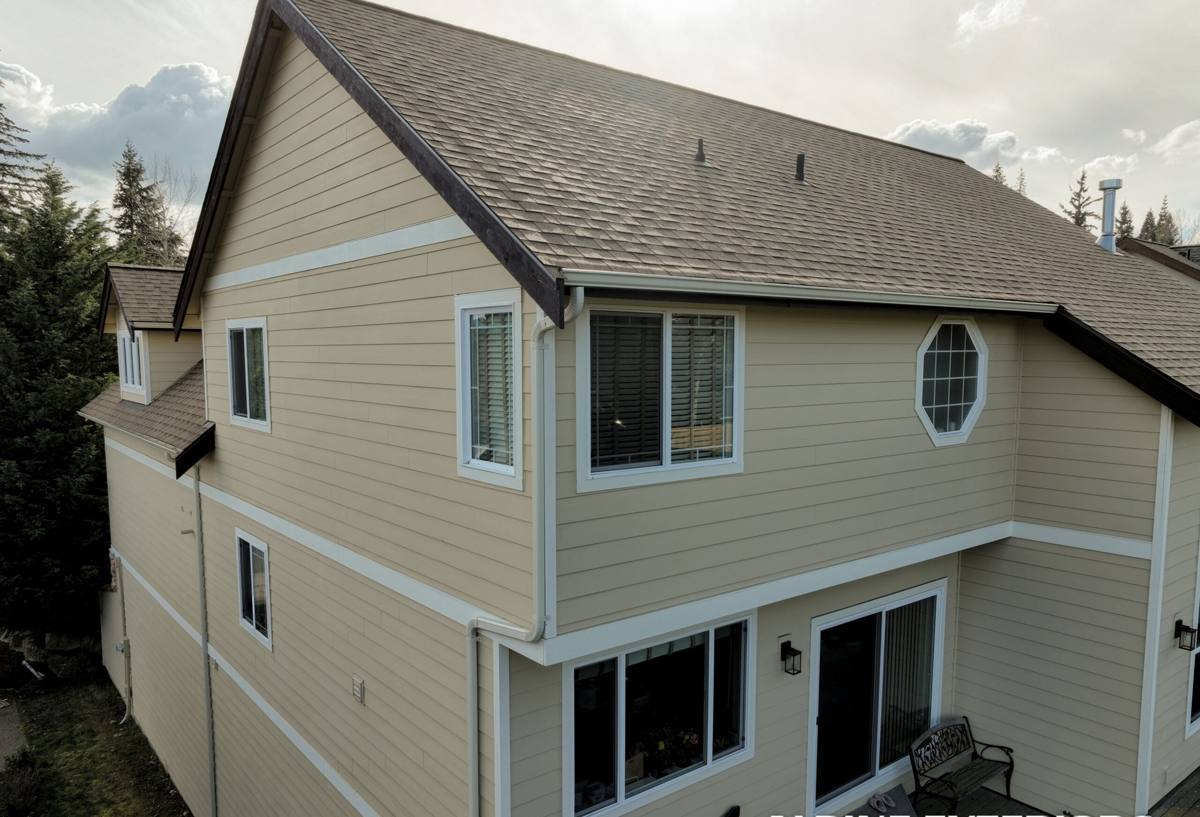
The Roof Repair Issues We See Most in Custer
Moss and Organic Growth
Moss doesn't just sit on top of shingles looking bad — it holds moisture against the roofing material around the clock, and on a shaded, north-facing slope it can work its way under shingle edges and lift them. Once tabs are lifted, wind-driven rain has a path underneath. A lot of the "mystery leaks" we get called out for in this area trace back to moss that's been left to grow for a season or two too long.
Flashing and Fastener Corrosion
Flashing around chimneys, skylights, valleys, and roof-to-wall transitions is where most roof leaks actually start — not in the open field of shingles. Salt air accelerates corrosion on lower-grade or improperly finished metal, and once flashing pinholes or a seam opens up, water finds the path of least resistance into the sheathing below.
Wind-Driven Rain Intrusion
Storms moving through this part of Whatcom County frequently bring rain at an angle rather than straight down. That matters for repair work because a patch that would hold up fine against vertical rain can still leak if it doesn't account for wind pushing water uphill under a shingle edge or through an under-sealed valley.
Granule Loss and UV/Moisture Cycling
Roofs here go through repeated wet-dry cycling more than they go through extreme heat. That cycling, combined with moss and debris holding water against the surface, tends to strip protective granules off asphalt shingles faster in shaded, damp sections of a roof than on sections that dry out between rains.
What a Correct Roof Repair Actually Involves
A repair that's done right isn't just replacing the shingle where the stain shows up on the ceiling. Water travels — it can enter several feet upslope from where it finally shows itself inside the house, running along the underlayment or decking before finding a gap in the ceiling drywall or insulation. A repair that only addresses the visible interior spot without tracing the actual entry point is a repair that comes back.
A proper repair typically includes:
- Tracing the leak to its actual entry point, not just the interior symptom
- Inspecting and, where needed, replacing the underlayment beneath the affected area, not just the surface shingles
- Checking adjacent flashing (chimney, valley, vent boots, wall step-flashing) since failures rarely happen in isolation
- Assessing the decking underneath for soft spots or rot before new material goes down over it
- Matching shingle type, color, and exposure to the existing roof so the repair doesn't stand out or create a new water path at the seam
- Clearing and treating moss in the surrounding area so the same conditions don't cause a repeat failure nearby
Skipping any of these steps is how you end up paying for the same repair twice.
Our Roof Repair Process
- Inspection. We get on the roof (weather permitting) and in the attic where accessible, looking at decking, insulation, and any staining pattern to find the actual source, not just the obvious symptom.
- Honest assessment. We tell you plainly whether this is a repair situation or whether the roof's age and overall condition mean a repair would just be a short-term patch on a bigger problem. If it's the latter, we'll say so instead of billing you for repair after repair.
- Written scope and estimate. You know what's being fixed, what materials are going in, and roughly what it costs before work starts.
- The repair itself. Removal of damaged material, decking repair where needed, correct flashing and underlayment work, and shingle or roofing material matched to what's already on your roof.
- Moss and debris cleanup. Where moss contributed to the problem, we address the surrounding area, not just the failed section, and can talk through longer-term moss control options.
- Final check. We walk the completed area and confirm flashing, seals, and shingle lines are solid before we consider the job done.
Repair or Replace? How We Help You Decide
Not every roof problem in Custer needs a repair, and not every roof needs replacing either. The honest answer depends on a few factors we walk through with every homeowner.
| Factor | Leans Toward Repair | Leans Toward Replacement |
|---|---|---|
| Roof age | Well within expected lifespan for the material | Near or past typical service life for that roofing type |
| Extent of damage | Isolated to one section, flashing point, or leak | Recurring leaks in multiple areas, widespread granule loss |
| Decking condition | Solid, no soft spots beyond the immediate repair area | Rot or soft decking found in multiple locations |
| Moss/algae history | Manageable with cleaning and targeted repair | Long-term unchecked growth has caused widespread lifting |
| Budget goal | Address the immediate problem cost-effectively | Stop recurring repair costs with a longer-term fix |
We're not going to push a full replacement on a roof that just needs honest repair work — and we're not going to keep patching a roof that's telling you it's done. Whatcom County's weather is hard enough on roofs without a contractor adding unnecessary cost on top of it.
Materials and Fasteners: Why Corrosion Resistance Matters Here
Given the salt exposure in the Custer area, the fasteners and flashing we use matter as much as the shingles themselves. Standard galvanized fasteners can corrode faster this close to salt air than they would further inland, which is why we favor corrosion-resistant fastener and flashing options for repair work in this area rather than defaulting to whatever's cheapest at the yard. It's a small line-item difference in cost but a real difference in how long a repair actually holds up.
We also pay attention to how new material transitions into existing roofing — a repair patch that's a slightly different shingle profile or granule color than the surrounding roof isn't just a cosmetic mismatch, it can create a subtle water-shedding gap at the seam. Matching matters both for appearance and for performance.
Signs You Need a Roof Repair Now, Not Later
Roof problems in this climate rarely announce themselves loudly at first. Here's what we'd want you to call about:
- Visible moss growth, especially on shaded or north-facing sections
- Granules collecting in gutters or at downspout outlets
- Curling, cupping, or lifted shingle tabs
- Ceiling stains, even faint ones, especially after wind-driven rain events
- Rusted or visibly corroded flashing around chimneys, vents, or valleys
- Daylight visible through the roof deck from inside the attic
- Shingles missing or displaced after a windstorm
Catching any of these early is almost always cheaper than waiting until they cause interior damage or decking rot.
Why a Crew That Already Works Custer Matters
Roofing crews who work primarily in drier or more inland climates don't always account for the specific ways salt air and sustained moss growth undermine a roof over time. A contractor who regularly works this stretch of Whatcom County — from Lynden out toward Custer and the Birch Bay corridor — has a working sense of which roof orientations moss hits hardest, how far wind-driven rain typically travels up under a shingle edge in a coastal storm, and which fastener and flashing choices actually hold up out here versus which ones look fine on install day and corrode within a few seasons. That local pattern recognition is the difference between a repair that's cosmetically fine for now and one that's actually built for what this area's weather does year after year.
Maintenance Between Repairs
A repair holds up longer when it's not fighting the same conditions that caused the original problem. A few habits make a real difference for Custer homes:
- Keep gutters and valleys clear of needles and debris, especially under evergreen tree cover
- Have moss addressed before it spreads across a full slope, not after
- Trim back overhanging branches that keep sections of the roof shaded and damp
- Have flashing points checked periodically rather than only after a leak shows up inside
- After major windstorms, do a visual check (from the ground is fine) for displaced or missing shingles
If you're seeing signs of trouble on your roof or just want an honest opinion on whether repair or replacement makes sense for your Custer-area home, we're happy to take a look. Fill out the form below for a free, no-pressure estimate.