 Lynden Siding
 Board & Batten in a Salt Air Climate
Birch Bay sits right on the water, and that changes what "good siding" means. A board and batten wall on a sheltered inland lot in Whatcom County deals with rain and moss. A board and batten wall two blocks from the beach in Birch Bay deals with all of that plus salt-laden air, near-constant wind exposure, and driving rain that hits siding at an angle instead of falling straight down. The vertical board and batten profile is a beautiful, historically rooted look for this stretch of coastline, but it only holds up long-term when the material and the installation account for what the water is doing, not just what the wall looks like.
This page is specifically about board and batten siding for Birch Bay homes — what the local conditions demand, what a correct installation actually involves, and why we install this look only in James Hardie fiber cement rather than the vinyl or engineered-wood alternatives that also come in a board and batten style.
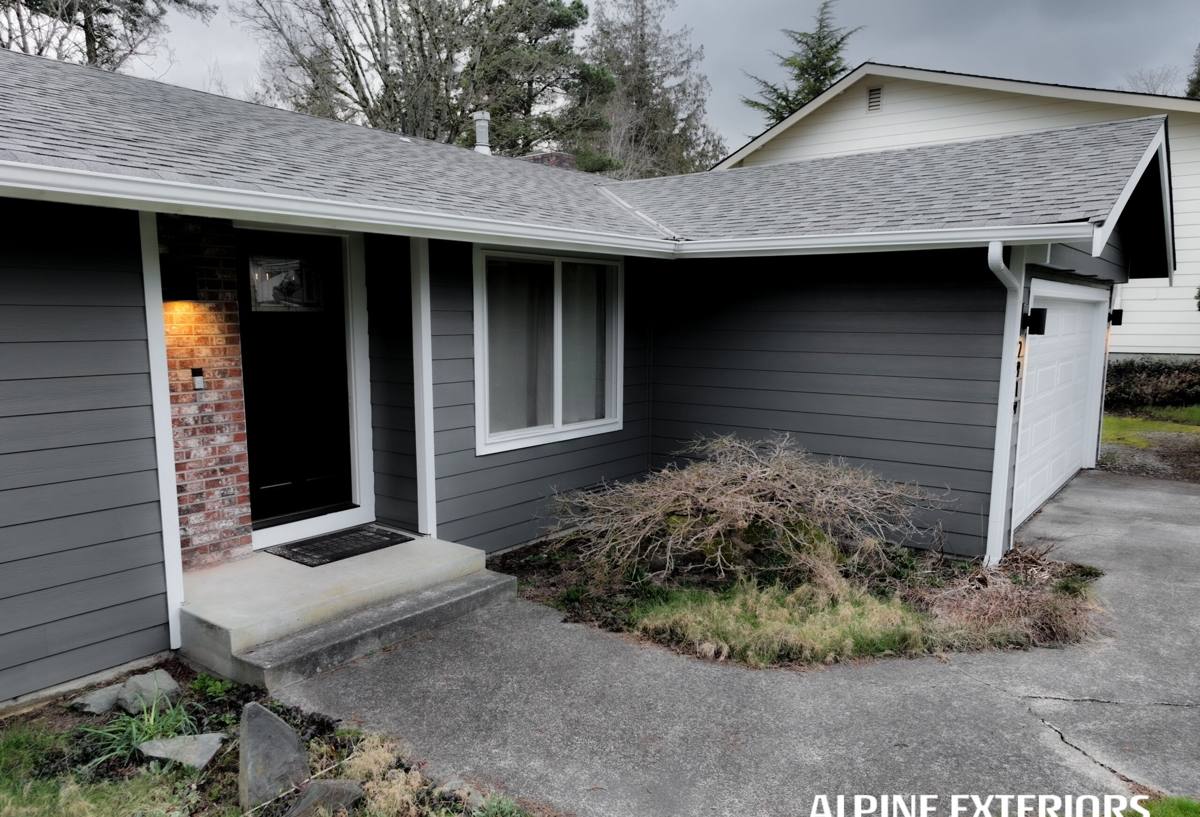
What Board & Batten Siding Actually Is
Board and batten is a vertical siding pattern: wide flat panels or boards installed with narrow strips (battens) covering the seams between them. It reads as clean vertical lines rather than the horizontal shadow lines of lap siding, and it's a strong match for the craftsman, farmhouse, and modern coastal styles common around Birch Bay and the rest of Whatcom County.
In fiber cement, this look is achieved one of two ways:
- Panel and batten system: Large vertical fiber cement panels installed with trim battens over the joints — faster installation, fewer seams, consistent modern look.
- Individual board and batten: Narrower vertical boards with battens over every seam — closer to the traditional look, more seams to detail correctly, more labor.
Both approaches can be done well or done poorly. The style itself isn't the risk — the seams, the fastening pattern, and what's happening behind the siding are what determine whether it lasts on a waterfront lot.
Why Birch Bay's Conditions Are Harder on Siding
Salt Air
Airborne salt from the water accelerates corrosion on fasteners, flashing, and any exposed metal trim. It also degrades cheap paint finishes faster than inland exposure does — chalking, fading, and clear-coating breakdown show up sooner on a Birch Bay wall than on the same product installed a few miles inland.
Driving Rain
Wind off the water pushes rain sideways into walls instead of letting it run straight down and off. That means water finds its way into every seam, joint, and fastener penetration that isn't detailed correctly — and board and batten has more vertical seams than a lap siding wall, which makes seam detailing the single most important part of the job here.
Long Moss Season
Whatcom County's wet, mild winters and shaded lots give moss and algae months to establish themselves on any siding surface that stays damp. Moss holds moisture against the wall, and sustained moisture is what eventually breaks down substrates that aren't built to take it.
None of these conditions are unique to Birch Bay in isolation — but the combination of all three, on an exposed waterfront lot, is more demanding than most inland siding jobs in the county.
What a Correct Installation Involves
The visual result of board and batten siding can look identical from the street whether it was installed correctly or not. The difference shows up in five to ten years, not on day one. A correct installation for a coastal Birch Bay property includes:
- A drainage plane behind the siding — weather-resistive barrier installed correctly, lapped shingle-style so water sheds down and out, not into the wall.
- Furring or a rainscreen gap where conditions call for it, giving any water that gets behind the siding a path to drain and dry instead of sitting against the sheathing.
- Correct fastener spacing and type — corrosion-resistant fasteners matched to the coastal exposure, driven per the manufacturer's schedule, not "close enough."
- Batten seams sealed and back-primed where the product requires it, so the seam — the weakest point in a board and batten wall — isn't left as an open path for wind-driven rain.
- Flashing at every horizontal transition — window heads, roof-to-wall intersections, deck ledgers — details that matter more on a wind-exposed lot than a sheltered one.
- Factory-finished material so the paint or finish layer is baked on under controlled conditions, not brushed on in the field where salt air and moisture can compromise cure quality.
Skip any one of these and the wall can still look right for a few years. On a Birch Bay lot, skipped details tend to show up faster than they would inland.
Board & Batten Material Comparison
| Factor | Vinyl Board & Batten | Engineered Wood (LP-Style) | James Hardie Fiber Cement |
|---|---|---|---|
| Salt air resistance | Plastic doesn't corrode, but seams and fasteners can loosen; color fades faster in coastal sun/salt exposure | Wood-based core is vulnerable if any moisture reaches an exposed edge or unsealed cut | Non-combustible, dimensionally stable, engineered finish holds color in coastal exposure |
| Driving rain / wind-driven water | Relies heavily on lap and seam tolerances; can rattle or work loose over time in high-wind lots | Needs consistent field caulking and touch-up at every cut edge to stay watertight | Rigid panel/board holds its plane; seams and joints can be sealed and flashed to a fixed detail |
| Moss / moisture exposure | Won't rot, but traps moisture behind it if installed tight to the wall without drainage | Vulnerable to swelling and fiber breakdown if moisture sits against it | Won't rot or swell; moss on the surface is a cleaning issue, not a structural one |
| Finish longevity | Color is molded in but fades and chalks; can't be easily refinished to match | Factory primed or coated; repaint interval depends on product and exposure | ColorPlus factory finish is baked-on and warrantied against fading/chipping in normal use |
| Fire exposure | Combustible | Combustible | Non-combustible core |
Why We Only Install James Hardie for This Look
Board and batten in vinyl is a real, budget-conscious option, and it isn't a bad product — it just isn't the product we choose to warranty our work on. Vinyl board and batten depends heavily on installation tolerances staying tight over decades of thermal movement, and in a wind-exposed coastal spot those tolerances get tested harder than in a sheltered inland yard. Engineered wood board and batten looks excellent when new, but it's a wood-fiber product, and wood-fiber products are the category most sensitive to the kind of sustained moisture exposure Birch Bay delivers.
James Hardie fiber cement is what we've standardized on across every home we side, board and batten included, because it's non-combustible, dimensionally stable in temperature and moisture swings, and finished at the factory with a coating engineered to hold up under UV and coastal exposure — not a field-applied paint job that starts degrading the day it's rolled on. Hardie's HZ5 product line in particular is engineered for harsher climate exposure, and their transferable warranty backs the material itself, not just our labor. For a wall that's going to face salt air and driving rain for the next thirty years, that's the standard we're willing to put our name behind.
Our Process for Birch Bay Board & Batten Jobs
- On-site assessment: We look at wind exposure, existing wall condition, moisture staining, and moss growth before we talk product or price.
- System selection: Panel-and-batten or individual board and batten, HZ5 versus standard HZ10 exposure rating, and color, based on how exposed your specific lot is.
- Tear-off and wall prep: Remove existing siding, inspect and repair sheathing, address any moisture damage found before it's covered up again.
- Drainage plane and rainscreen: Weather-resistive barrier and furring installed correctly, not skipped to save labor time.
- Installation: Fastening, seam sealing, and flashing done to manufacturer spec at every transition.
- Final walkthrough: We show you the finished wall, the flashing and trim details, and what maintenance to expect given your specific exposure.
Living With Board & Batten on a Birch Bay Lot
Fiber cement lowers the maintenance burden, but "low maintenance" doesn't mean "no maintenance" — especially this close to the water. A short annual routine keeps a Hardie board and batten wall performing the way it's supposed to:
- Rinse salt residue off the siding once or twice a year with a garden hose, more often on walls that face the water directly.
- Watch shaded and north-facing walls for early moss or algae growth and clean it off before it spreads — a soft wash, not a pressure washer aimed directly at seams.
- Check caulking at window and door trim annually; recaulk before a gap opens up, not after water's already gotten behind it.
- Keep gutters clear so overflow doesn't run down the wall face and concentrate moisture on specific boards or battens.
- Trim back vegetation that shades the wall or holds moisture against it.
- Have any impact damage or loose battens repaired promptly — small gaps are cheap to fix and expensive to ignore.
What Drives the Cost
| Factor | Why It Matters |
|---|---|
| Panel vs. individual board system | Fewer seams with panels generally means less labor than true individual board and batten |
| Wall complexity | Dormers, bump-outs, and multiple roof intersections add flashing and cutting time |
| Tear-off scope | Removing and disposing of existing siding versus building over prepared sheathing |
| Sheathing condition | Rot or moisture damage found underneath the old siding adds repair cost before new siding goes on |
| Exposure rating | HZ5 coastal-rated product costs more than standard HZ10 but is the right call on wind-exposed lots |
| Trim and color | Custom trim details and premium ColorPlus color choices affect material cost |
We give exact numbers after seeing the wall in person — broad ranges without an on-site look aren't useful to you or to us.
Why It Matters That We Already Work in Birch Bay
A crew that's only worked inland Whatcom County jobs can still install siding correctly, but a crew that's already worked Birch Bay's specific exposure has already made the judgment calls this location requires — when a rainscreen gap is worth the extra cost, which walls need the coastal-rated exposure product, and where wind-driven rain actually gets into a wall versus where it looks like a risk but isn't. That local pattern recognition is the difference between a board and batten wall that's built for this coastline and one that's built for siding in general.
If you're weighing board and batten for a Birch Bay home, we're glad to walk the property, look at your current siding condition, and give you a straight assessment — no pressure, no inflated quote games. Reach out for a free estimate through the form below and we'll get a look at your place.