 Lynden Siding
 Storm Damage Roofing in a Border-Region Climate
Aldergrove, BC sits close enough to the Lynden border crossing that a lot of homes here deal with the same weather pattern we see on the Washington side, just with different paperwork when something goes wrong. That weather pattern is the whole reason storm damage roof repair is its own specialty rather than a general handyman fix. Whatcom County and the neighboring Fraser Valley get long stretches of driving rain off the Pacific, wind that funnels hard through the open farmland between Lynden and Aldergrove, and a moss season that can run most of the year in shaded or north-facing sections of a roof. Salt-laden air moving in off the Strait of Georgia and Puget Sound adds a slow corrosive edge to fasteners, flashing, and exposed metal that homeowners further inland don't have to think about.
None of those factors cause a roof to fail on their own. What they do is turn a small, ordinary weak point — a slightly lifted shingle tab, a fastener backing out, a hairline gap in flashing — into an active leak the next time a windstorm or heavy rain event pushes water where it doesn't belong. Storm damage repair done right in this area accounts for that combination, not just the immediate hole or tear.
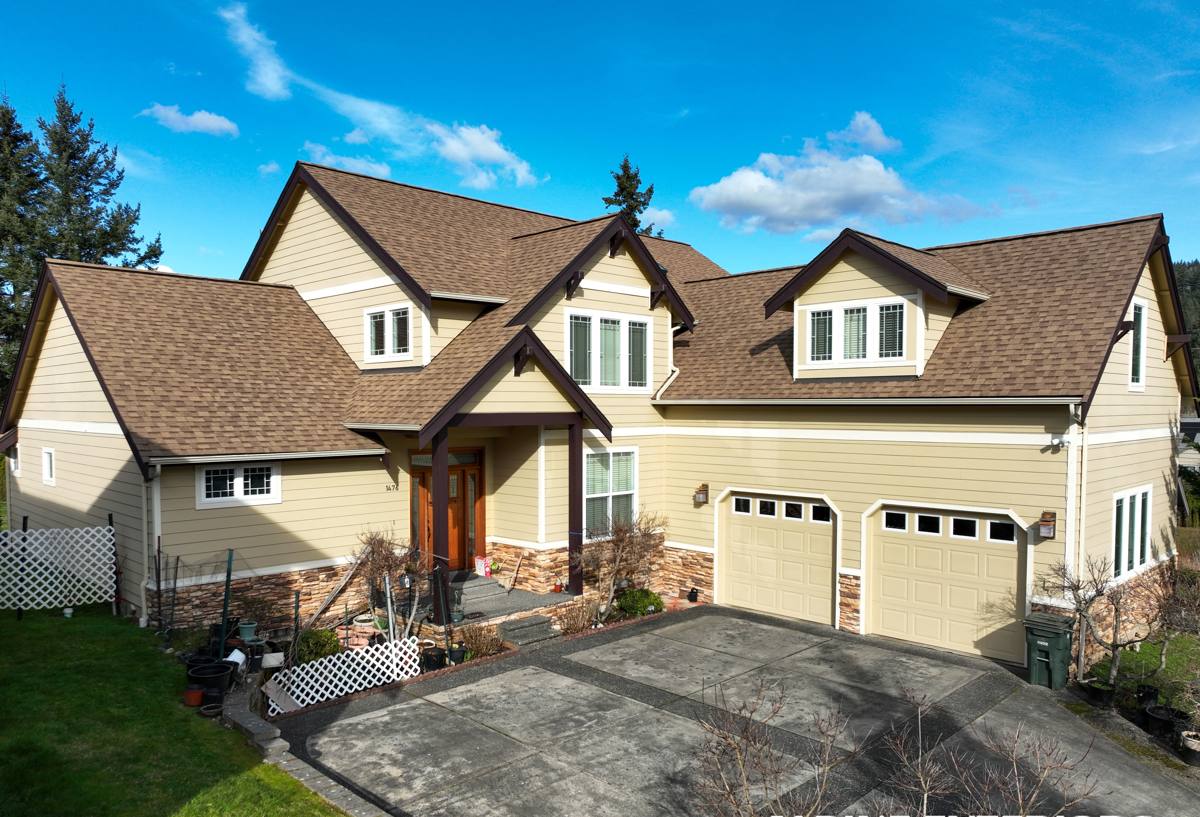
What Storm Damage Actually Looks Like on a Roof
Wind and Wind-Driven Rain
Straight-line wind off a storm system doesn't usually rip a roof apart in one dramatic event. More often it lifts shingle tabs enough to break the seal strip underneath, loosens ridge cap, or works a section of flashing at a chimney or wall intersection just far enough loose that the next rain drives water sideways underneath it. Wind-driven rain is worse than vertical rain because it can push moisture uphill under shingles and past standard laps.
Fallen Limbs and Debris Impact
Firs, cedars, and big leaf maples are common on lots throughout this area, and a windstorm that drops branches is one of the most frequent causes of a service call. Impact damage ranges from a few cracked or punctured shingles to bent flashing or a damaged vent boot, and it's easy to underestimate from the ground.
Moss and Long-Term Moisture Damage
Moss itself is slow-moving, but after a storm it becomes a bigger problem: moss mats hold water against the roof surface, and where wind or debris has already disturbed shingles, that trapped moisture finds the opening much faster. A roof that was marginal before a storm often shows its first real leak afterward, even if the storm didn't directly cause new damage.
Our Storm Damage Repair Process
- Inspection first, repair second. We walk the roof (or use a lift/drone when pitch or access makes that safer) and document every affected area before we touch anything, including damage that isn't causing a visible leak yet.
- Interior check. We look at attic framing, insulation, and ceiling lines near any suspected leak point, since water can travel well away from where it entered.
- Written scope and options. You get a clear breakdown of what's damaged, what's simply worn and unrelated to the storm, and what your realistic repair options are — we don't pad a storm claim with unrelated work.
- Temporary protection when needed. If a section is actively letting water in, we tarp or dry-in that area the same visit rather than leaving it exposed until the full repair is scheduled.
- Repair matched to the existing roof. Shingles, flashing profile, and fastening pattern are matched as closely as possible so the repaired section performs — and looks — consistent with the rest of the roof.
- Final walk-through. We confirm the repair with you before calling the job done, including photos of the completed work for your own records or an insurance file.
Repair or Replace? The Factors We Actually Weigh
Not every storm-damaged roof needs a full replacement, and not every roof that "just needs a patch" is actually a good repair candidate. Here's how we sort that out:
| Factor | Usually points to repair | Usually points to replacement |
|---|---|---|
| Age of roof | Under roughly two-thirds of its expected lifespan | Already near or past typical service life for the material |
| Extent of damage | Isolated to one slope or section | Scattered across multiple slopes or the whole roof |
| Moss/moisture history | Minor, surface-level growth | Long-standing moss mats with soft or spongy decking underneath |
| Shingle match availability | Same or very close product still obtainable | Discontinued style leaves visible mismatch |
| Underlying decking condition | Solid when probed at the repair area | Soft, delaminated, or previously water-damaged |
We'll always tell you honestly which side of that table your roof falls on, even when the honest answer is a smaller job than you expected.
Why a Crew That Already Works Aldergrove, BC Matters
Storm damage work on this side of the line has a few wrinkles that a contractor unfamiliar with the border area can miss. Scheduling around border-crossing logistics for materials and crew, knowing which streets and open-field stretches around Aldergrove take the worst of a windstorm because of exposure rather than roof age, and understanding that BC and Washington jurisdictions handle permitting and inspection differently are all things you learn from doing the work here repeatedly, not from a single job. A crew based in Lynden that regularly serves Aldergrove isn't guessing at any of that — we already know the drive, the weather pattern, and the practical differences in how a repair or claim gets handled depending on which side of the border your home sits on.
That familiarity also means faster response after a storm. When a windstorm rolls through Whatcom County and the Fraser Valley on the same weather system, as they usually do, we're not trying to figure out the area for the first time while your roof is actively leaking.
Working With Your Insurance Claim
Most storm damage repairs involve an insurance claim, and the process works about the same whether your policy is with a US or Canadian insurer: the adjuster needs clear documentation of the damage, a scope of repair, and usually photos from before and after the work. We provide the documentation our end of that requires — detailed photos, a written description of the damage and cause, and an itemized repair scope — but we don't represent your insurer or negotiate your claim for you. If an adjuster has questions about the roofing scope of work specifically, we're glad to speak with them directly.
One honest note: not every issue a homeowner notices after a storm is storm-related. Long-term moss damage or worn-out flashing that finally gave out during a windy, wet week isn't always a covered storm claim, and we'll tell you which is which rather than letting you find that out from the adjuster.
Materials We Use for Lasting Storm Repairs
A storm repair is only as good as the materials and detailing underneath the visible shingle. In a climate with this much driving rain and moss pressure, a few details matter more here than they would in a drier region:
- Self-adhering ice-and-water membrane at valleys, eaves, and around penetrations, which stays sealed even if wind lifts a shingle tab above it.
- Properly lapped step and counter-flashing at walls and chimneys, since flashing failure is one of the most common sources of a "mystery leak" that shows up well after the storm.
- Corrosion-resistant fasteners appropriate for a salt-air environment, so the repair doesn't become the next weak point in a few years.
- Matched shingle products where possible, and an honest conversation about algae-resistant options where moss and algae growth has been a recurring issue on your roof — those products can help slow regrowth but aren't a substitute for periodic cleaning.
We don't push upgrades a storm repair doesn't need. If your existing roofing is a reasonable product in good condition, our job is to repair it to match, not to talk you into a different system.
After the Repair: Keeping the Next Storm From Undoing the Work
A good repair holds up better with a little basic upkeep on your end, especially given how long moss season runs here. A quick post-storm checklist worth keeping:
- Walk the yard after any significant windstorm and look for granules in gutters or downspouts, which often signal shingle wear before a leak does.
- Keep tree limbs trimmed back from the roofline where practical — most impact damage we repair comes from branches that were already close to the roof.
- Have moss cleaned off (not pressure-washed, which can strip granules) before it forms thick mats, particularly on north-facing and shaded slopes.
- Check attic insulation and ventilation periodically — poor ventilation speeds up moss growth and can mask a slow leak for months.
- Have your roof looked at after any storm that dropped debris nearby, even if you don't see an obvious leak yet.
If you're dealing with storm damage on a home in or around Aldergrove, BC, we're happy to take a look and give you a straight, no-pressure estimate — including telling you if what you're looking at is a simple repair rather than anything more. Use the form below to get started.