 Lynden Siding
 Siding Repair for Aldergrove Homes, From a Crew That Already Crosses the Line
Aldergrove sits just north of the Lynden–Aldergrove border crossing, close enough that a lot of the exterior work on that side of the line gets bid by contractors who rarely set foot in the area between jobs. We're not one of those. Working out of Lynden, this crossing is part of our regular route, and Aldergrove homes see the same weather pattern we deal with on our own side of the border — the same marine air, the same wind-driven rain off the Fraser Valley and Whatcom County lowlands, the same long stretch of gray months that keeps moss going most of the year. That matters when the job is a repair rather than a full replacement, because repair work lives or dies on whether the person doing it actually understands why the siding failed in the first place.
This page is about siding repair specifically — not full re-siding — for houses in and around Aldergrove, BC. It covers what the regional climate does to siding over time, what separates a repair that actually solves the problem from one that just patches over it, and how our process works when a homeowner calls us about a damaged section rather than a whole-house project.
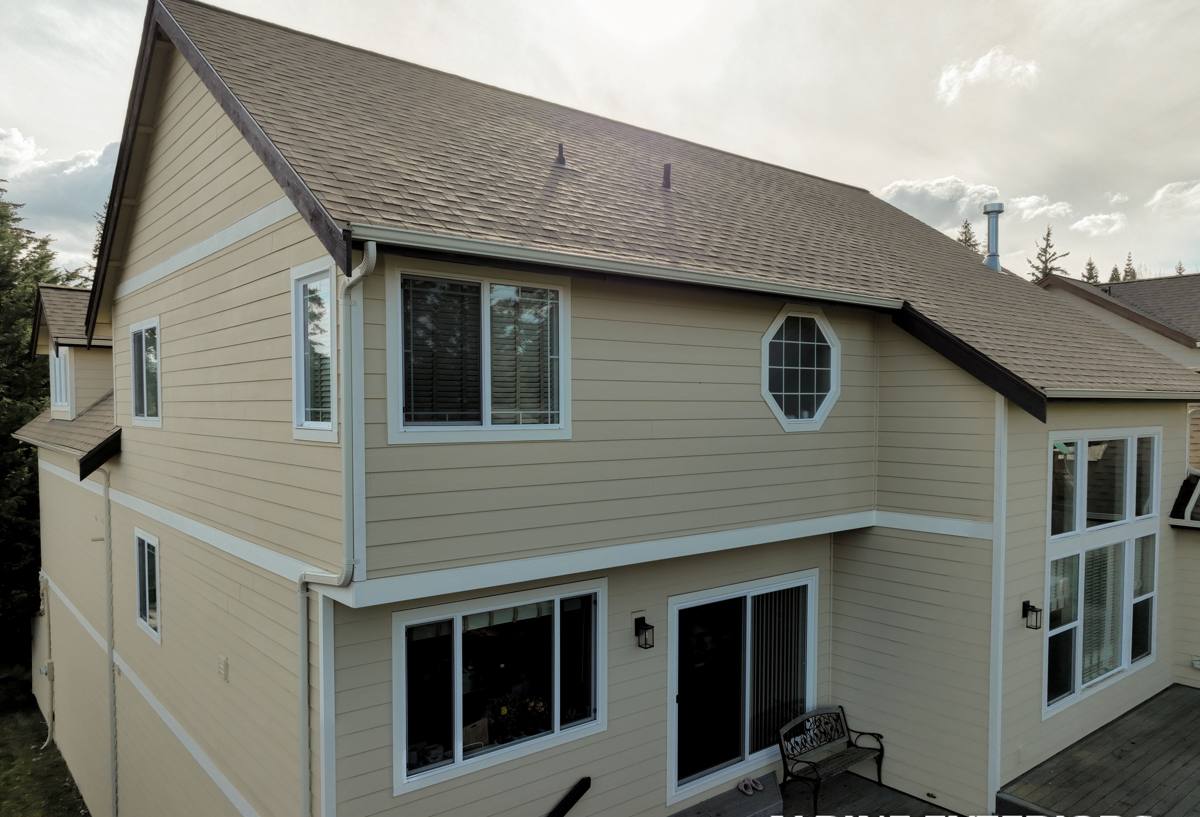
What the Regional Climate Does to Siding Here
Salt Air, Even This Far Inland
Aldergrove and Lynden both sit inland from open saltwater, but marine air still moves through this part of the Fraser Valley and northern Whatcom County lowlands regularly. Over years, that airborne salt accelerates corrosion on exposed fasteners, staples, and any trim that wasn't sealed correctly at installation. On a repair call, corroded fasteners are one of the first things we check, because a section of siding that looks fine on the surface can be barely hanging on underneath if the nails holding it have been quietly rusting for a decade.
Driving Rain That Hits Walls, Not Just Roofs
This region doesn't just get rain — it gets wind-driven rain that comes in at an angle and finds its way behind loose or gapped siding rather than running straight down the face of the wall. That's a different stress than a dry-climate house ever deals with, and it's why so many of the repair calls we get in this area trace back to a water intrusion point, not a cosmetic defect. A cracked or warped board is usually a symptom; the actual problem is often a failure point somewhere upstream — a gap at a window trim, a bad seam, or flashing that was never installed correctly.
A Long Moss Season
Shaded and north-facing walls in this area can stay damp for months at a stretch, and moss and algae take hold anywhere moisture sits against a surface long enough. On wood-based or improperly finished siding, that constant dampness accelerates rot from the surface inward. On correctly installed fiber cement, moss growth is mostly a cosmetic and maintenance issue rather than a structural one — but if the caulking, paint, or factory finish has failed underneath that moss, it stops being cosmetic fast.
Signs Your Siding Needs a Repair Call
Most homeowners don't notice siding problems until they're already advanced, because the early signs are easy to write off as normal weathering. A short list of what actually warrants a closer look:
- Visible cracking, chipping, or warping in one or more boards, especially near corners or seams
- Soft or spongy spots when you press on the siding near the bottom of a wall or below a window
- Paint or factory finish that's peeling, bubbling, or has gone chalky in a localized area
- Persistent moss or algae staining that comes back quickly after cleaning
- Visible gaps, missing caulk, or daylight showing at trim, corner boards, or butt joints
- Water stains or discoloration on interior walls near an exterior corner
- Siding that sounds hollow or feels loose when tapped, suggesting failed fasteners underneath
Any one of these on its own might be minor. Several showing up in the same area of the house, or a soft spot combined with staining, usually means water has already gotten past the surface and the repair needs to address more than the visible board.
What a Correct Siding Repair Actually Involves
Diagnosing the Real Cause, Not Just the Symptom
The most common mistake in siding repair is replacing the damaged board and stopping there. If the reason that board failed was a flashing gap, a caulking failure, or water tracking down from a roof-to-wall transition above it, the replacement board will start failing on the same timeline as the one it replaced. A repair that's actually worth paying for starts with figuring out how water got in, not just where the damage is visible.
Matching Material and Finish
Patching in a mismatched board — different profile, different exposure, or a different finish sheen — is one of the fastest ways to make a repair look worse than the damage it fixed. On factory-finished fiber cement, matching the existing product line and color is what keeps a repair invisible instead of turning into a permanent patch that stands out every time the light hits it. This is one of the practical advantages of working with a single manufacturer's system consistently: matching profiles and colors is straightforward when the original installation used a documented, still-available product line.
Flashing and Water Management
Any repair around a window, door, or wall penetration needs the flashing and water-resistive barrier addressed as part of the job, not treated as someone else's problem. A new piece of siding installed over bad flashing just delays the next failure. This is the part of a repair that's invisible once the job is done, and it's also the part that determines whether the repair actually lasts.
Why We Repair — and Replace — With James Hardie Fiber Cement Only
We install and repair James Hardie fiber cement exclusively. We don't carry vinyl, LP SmartSide, or cedar, and that's a deliberate professional standard rather than a sales position. A few reasons it matters specifically for repair work in this area:
- Moisture behavior: Fiber cement doesn't absorb and swell the way wood-based products can, which matters directly in a region where siding stays damp for long stretches of the year.
- Non-combustible: James Hardie's fiber cement is non-combustible, which is a meaningful, verifiable difference from wood-based or vinyl products regardless of climate.
- Factory finish consistency: ColorPlus factory-applied finish is engineered to hold color and resist the kind of chalking and peeling that field-applied paint struggles with under constant damp-dry cycling.
- Repair compatibility: Because we install this system consistently, matching an existing Hardie installation for a repair is a known, repeatable process rather than a guessing game.
If your home currently has a different siding product and needs repair, we'll say so honestly — a small vinyl or wood repair doesn't always justify pulling in a fiber cement crew, and we'd rather tell you that than push an unnecessary sale. Where fiber cement repair or a partial re-side does make sense, James Hardie is the only system we put on a wall.
Repair or Replace? What Actually Drives That Decision
| Factor | Leans Toward Repair | Leans Toward Replacement |
|---|---|---|
| Extent of damage | Isolated to one or two sections | Spread across multiple walls or elevations |
| Cause of failure | Single identifiable point (impact, one bad flashing detail) | Systemic, e.g. original installation defects throughout |
| Age of existing siding | Newer install, still within expected lifespan | At or past the end of its realistic service life |
| Material match availability | Product line still available for a clean match | Discontinued profile or color, match not realistic |
| Underlying moisture damage | Sheathing and framing behind siding are sound | Rot or water damage found behind the cladding |
We won't know which column your house falls into until we've actually looked at it — this table is a starting point for the conversation, not a substitute for an inspection.
Our Process for an Aldergrove Repair Job
- Inspection: We look at the damaged area and the surrounding siding, checking for moisture behind the cladding and tracing the likely water path, not just the visible crack or gap.
- Honest diagnosis: We tell you what we found, including whether it's a straightforward patch or something that points to a bigger underlying issue.
- Clear estimate: A written scope and price before any work starts — no vague verbal quotes.
- Correct repair: Matching material, proper flashing and sealant detailing, and fastening done to spec, not just a fast patch.
- Cleanup and walkthrough: We show you what was done and why, so the repair isn't a black box.
Why Hiring a Crew That Already Works This Corridor Matters
The Lynden–Aldergrove border crossing puts these two communities closer together in practice than the international line suggests on a map. A crew that treats a border crossing as a routine part of the workweek shows up reliably, understands the regional weather because it's the same weather they work in daily, and isn't pricing in the hassle of a one-off trip into an unfamiliar area. For a repair job specifically — where diagnosing the actual cause matters more than the size of the crew — that local familiarity is worth more than it sounds. We're not learning this climate on your house; we already know what driving rain, salt air, and a long moss season do to siding in this part of the Fraser Valley and Whatcom County lowlands, because we deal with it on both sides of the line.
If you've got a section of damaged, cracked, or water-stained siding on an Aldergrove home, we're glad to take a look and give you a straight answer on whether it needs a repair or something more. Reach out for a free, no-pressure estimate — there's a form below to get started.