 Lynden Siding
 Siding Built for Abbotsford, BC's Border Climate
Abbotsford, BC sits just across the line from Lynden, in the same stretch of Fraser Valley and northern Whatcom County weather that doesn't stop or start at a border crossing. The rain doesn't check which side it's falling on, and neither does the salt-laden marine air or the moss that takes hold on shaded walls for most of the year. A house in Abbotsford deals with the same exterior pressures as one a few miles south in Lynden — which is exactly why we treat siding work here the same way we do on our home side of the line: as a climate problem first, and a product choice second.
We install James Hardie fiber cement siding exclusively, and this page is specifically about what that means for a home in Abbotsford, BC — what the local climate actually does to siding over time, what a correctly installed Hardie system looks like, and how a project runs when the crew doing it already works this area regularly instead of treating it as an occasional out-of-town job.
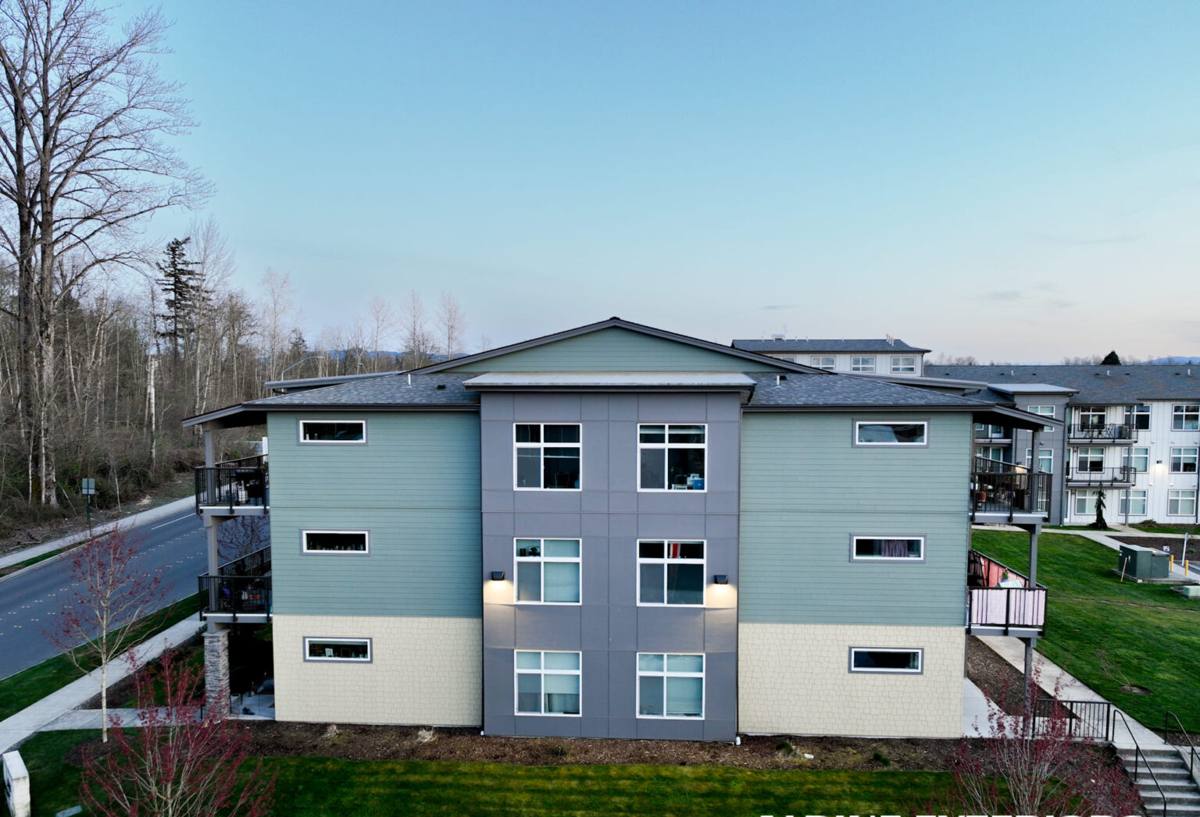
What Salt Air, Driving Rain, and Moss Actually Do Here
Salt Air Off the Strait and Sound
Abbotsford isn't waterfront, but this whole part of the Fraser Valley and lower mainland sits close enough to Georgia Strait and Puget Sound that marine air moves through regularly. Over years, that salt-carrying air accelerates corrosion on fasteners, flashing, and lower-grade trim hardware. It's a slow process, which is exactly why it gets overlooked — nobody notices until rust streaks start showing up below nail heads or trim joints a decade in.
Driving, Wind-Loaded Rain
Rain through the fall and winter months in this region rarely falls straight down. Wind pushes it sideways into wall assemblies, into window and door flashing, and into the joints where trim meets siding. That sideways load is the detail that separates a siding job that holds up for decades from one that starts letting moisture in behind the cladding within a few wet seasons — regardless of how good the material itself is rated to be.
A Moss Season That Barely Breaks
Mild temperatures, tree cover, and near-constant moisture add up to a moss and algae season across this region that can run close to year-round on shaded or north-facing walls. Any siding material that's porous, or that holds moisture against the substrate instead of shedding it, becomes a growth surface over time. Abbotsford's mix of open farmland and tree-lined residential streets means this varies a lot from property to property — a wall facing open field dries out fast after a storm, while one backed up against a tree line often stays damp for days.
Why We Install Only James Hardie Fiber Cement
We narrowed our siding installs down to one system after seeing repeatedly what actually holds up in this exact climate versus what looks good on a spec sheet and starts struggling a few winters into real exposure.
- Non-combustible core: Fiber cement doesn't feed a fire the way wood-based siding can, which matters for both safety and insurance underwriting on either side of the border.
- Factory-applied ColorPlus finish: Baked on in a controlled factory process rather than field-applied, so it holds color and adhesion far longer under sustained moisture and UV exposure than a job-site paint job.
- Climate-engineered HZ product lines: Hardie's HZ5 formulation is built for regions with significant moisture exposure and freeze-thaw cycling, which describes the Abbotsford and Lynden area well.
- Dimensional stability: Fiber cement doesn't swell, cup, or warp the way engineered wood siding can after repeated wetting cycles across a long wet season.
- A strong transferable warranty: Hardie backs the product with one of the more robust warranty structures in the industry, provided the installation follows their published specifications.
We don't install LP SmartSide, vinyl siding, Cemplank, Allura, primed spruce, or cedar. Each has a place in the market and plenty of homeowners are satisfied with them. Our decision is a professional one, not a claim that those products fail — in a climate with this much sustained moisture and salt exposure, we'd rather stand fully behind one system than offer something cheaper that quietly shifts maintenance risk onto the homeowner down the line.
| Product | Common trade-off in this climate |
|---|---|
| Vinyl siding | Can warp or become brittle under sustained UV and temperature swings; panel seams give wind-driven rain an entry point |
| LP SmartSide / engineered wood | Wood-strand core is more moisture-sensitive at cut edges and fastener points than fiber cement |
| Primed spruce or cedar | Requires ongoing paint and moisture maintenance to avoid rot — a real long-term ownership cost beyond the upfront price |
| Other fiber cement brands | May lack a climate-specific HZ-style line or the same depth of factory-finish warranty as James Hardie |
What a Correct Install Looks Like in This Climate
Flashing and Water Management First
Most siding failures we see trace back to water getting behind the cladding, not through it. That means the weather-resistive barrier, window and door flashing, and every wall penetration get careful attention before a single piece of siding goes up. It's the step that's easiest to rush and hardest to inspect once the siding is on, so we treat it as non-negotiable rather than something to speed through.
Fastening, Gaps, and Field Cuts
James Hardie's warranty depends on the installation following their published specifications — correct fastener type and spacing, proper clearances above grade, roofline, and decks, and sealed field cuts. Skipping any of these doesn't show up as a problem on install day; it shows up two or three wet seasons later as staining, swelling at cut edges, or moisture behind the panel.
Trim, Caulking, and the Details That Get Skipped
Given how much moss and algae growth depends on moisture sitting against a surface, the small details — caulking at trim joints, drip caps above windows, proper overlap at panel joints — do a lot of the long-term work. These are also the details that are cheapest to do right the first time and most expensive to fix once they've failed and water has already reached the sheathing.
How the Project Runs for an Abbotsford, BC Home
- Inspection and estimate: We look at current siding condition, signs of trapped moisture or sheathing damage, and how sun, shade, and wind exposure vary across the different walls of the house.
- Tear-off and substrate check: Once old siding comes off, we check the sheathing underneath for rot or soft spots before anything new goes up — covering a damaged substrate just hides a problem that gets worse behind the wall.
- Weather barrier and flashing detail: House wrap, window flashing, and wall penetrations get addressed carefully at this stage, since it's the point in the project where mistakes are least visible and most costly later.
- Installation to manufacturer spec: Fastener spacing, clearances, and field-cutting practices follow James Hardie's published requirements as the baseline, not as an upsell.
- Final walkthrough: We walk the finished job with the homeowner, cover care and maintenance expectations, and confirm everything matches what was estimated.
What Drives Cost on a Project Like This
Every estimate is specific to the house, but a few factors consistently move the number one way or the other. We walk through these directly during the estimate instead of handing over a figure with no explanation behind it.
| Factor | Typical cost impact |
|---|---|
| Total square footage and number of stories | High — the biggest single driver of material and labor |
| Sheathing condition once old siding is removed | Medium to high — hidden moisture damage adds repair work |
| Amount of trim and detail work around windows and rooflines | Medium — more transitions mean more flashing and labor time |
| James Hardie profile chosen (lap, shingle, panel, board and batten) | Low to medium — profile and finish affect material cost |
| Site access and lot conditions | Low to medium — tight lots or difficult staging add time |
A Maintenance Checklist for Salt Air and Moss Country
- Rinse siding at least once a year, focusing on shaded and north-facing walls where moss and algae take hold first
- Check for rust staining below fasteners or trim hardware and have it addressed before it spreads
- Keep gutters clear so overflow doesn't run down the face of the siding repeatedly
- Trim back trees and shrubs that keep a wall shaded and damp longer than the rest of the house
- Look at caulking around windows, doors, and trim joints every couple of years for cracking or gaps
- Have any soft spots, dark staining that returns quickly after cleaning, or musty interior odors near exterior walls looked at promptly rather than waiting for the next wet season
Why a Crew That Already Works This Area Matters
Working both sides of the Lynden–Abbotsford area regularly means we're not guessing at how this climate behaves on a given lot — we're seeing it on job sites through every season. That shapes real decisions on-site: which wall orientations on an Abbotsford property stay wet longest, where extra flashing attention actually pays off, and which install-day details are worth the time so a homeowner isn't dealing with a callback two winters later. Building and permitting requirements differ somewhat between Whatcom County and the Abbotsford side of the border, and a crew that works this area routinely already accounts for that instead of treating it as a surprise mid-project. It also means that if a warranty question or maintenance issue comes up years down the road, it's a call to a crew still working nearby, not one that's moved on.
If your Abbotsford, BC home needs new siding, or you'd like an honest look at what your current siding is telling you about moisture or age, we're glad to come take a look and give you a straightforward, no-pressure estimate. Reach out using the form below to get started.