 Lynden Siding
 Why Blaine's Climate Is Hard on Siding
Blaine sits at the northern edge of Whatcom County, right where the Salish Sea meets the U.S.-Canada border. Homes along Semiahmoo Bay and Drayton Harbor face a different set of conditions than houses twenty minutes inland in Lynden. Salt-laden air moves off the water and settles on exterior surfaces year-round, wind off the Strait drives rain sideways into wall assemblies instead of letting it fall straight down, and the long, wet Pacific Northwest winter feeds moss and algae growth on anything that stays shaded and damp. None of these conditions is unusual on its own. Combined, over years, they're exactly the kind of stress that separates siding installed correctly from siding installed to just get the job done.
Salt air is corrosive to exposed metal fasteners and trim, and it accelerates the breakdown of coatings that aren't formulated to handle it. Driving rain finds every gap in flashing, caulking, or house wrap and pushes water behind the siding rather than letting it run off the face. Moss and algae hold moisture against the wall longer than a dry surface would, which matters most on north-facing elevations and anywhere trees or neighboring structures block sun and airflow. A siding replacement in Blaine has to account for all three at once, not just look good on install day.
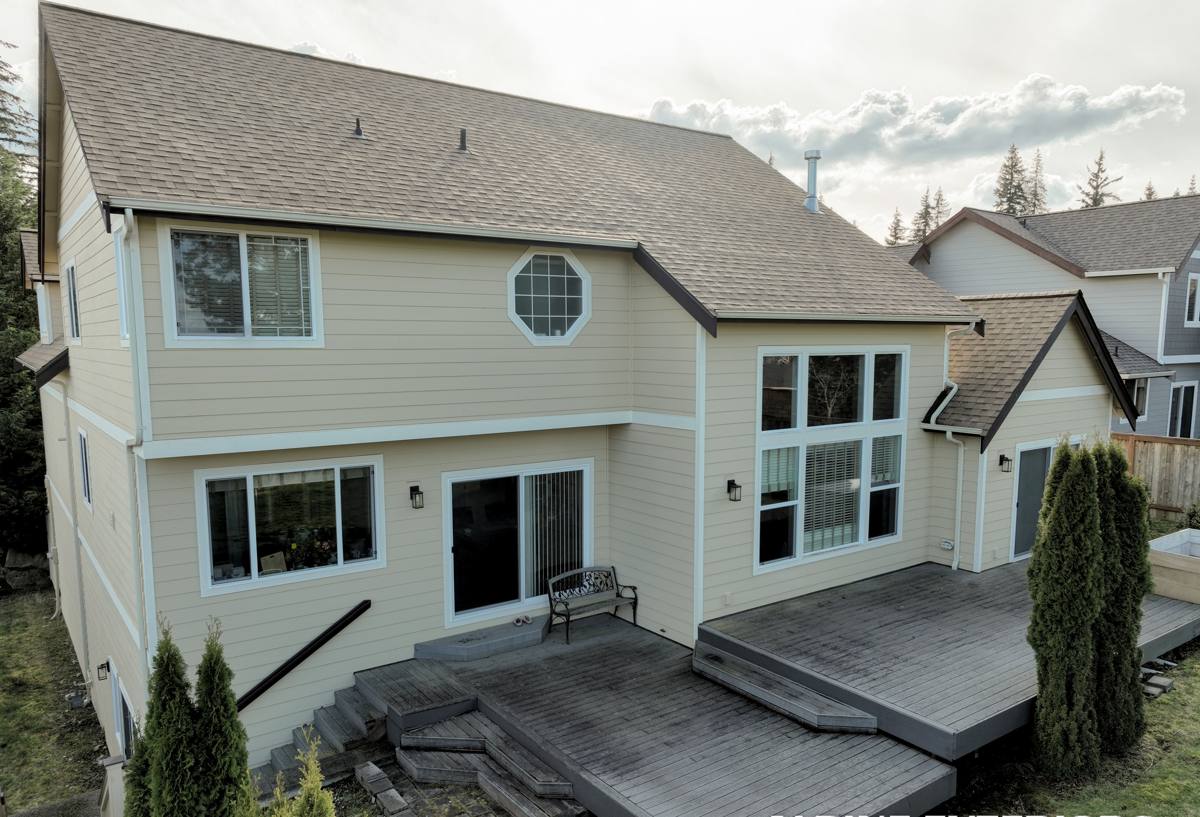
Signs Your Blaine Home's Siding Is Failing
Coastal siding failure is often gradual, which is why it's easy to miss until repairs get expensive. Watch for:
- Soft or spongy spots when you press on siding, especially near the bottom courses and around window and door trim
- Paint that's bubbling, peeling, or chalking faster than it should, particularly on walls that face the water or prevailing wind
- Green or black staining that keeps coming back within a season or two of cleaning
- Visible gaps, warping, or cupping in individual boards or panels
- Rust streaks below nail heads or metal trim
- A musty smell or discoloration on interior walls that back up to exterior siding
Any one of these can be a minor fix. Several at once, or any sign of soft sheathing underneath, usually means the wall assembly itself has been taking on water for a while and a patch won't solve the underlying problem.
Why We Install Only James Hardie Fiber Cement Siding
We made a deliberate decision to stop installing vinyl, LP SmartSide, Cemplank, Allura, primed spruce, and cedar, and to install James Hardie fiber cement exclusively. That's not a marketing position — it's a response to what we've seen hold up in Whatcom County's marine climate and what doesn't.
How Hardie Handles Salt Air and Moisture
Fiber cement is non-combustible and dimensionally stable, meaning it doesn't expand, contract, warp, or rot the way wood-based products can when they take on repeated moisture cycles. It doesn't feed mold or insects. The factory-applied ColorPlus finish is baked on under controlled conditions and formulated to resist fading and chalking from UV and salt exposure far longer than a field-applied paint job on wood or engineered wood products, which matters directly for a coastal town like Blaine where materials are exposed to airborne salt continuously, not just during storms.
The HZ5 Product Line and Northwest Weather
James Hardie engineers its siding by climate zone, and the HZ5 line is built for the wet, temperate Pacific Northwest — including moisture and freeze-thaw performance suited to Whatcom County. That's a meaningful difference from a one-size-fits-all product. It also carries a strong transferable warranty, which matters to homeowners who may sell within the product's lifespan and want that protection to carry forward.
We're not going to tell you vinyl or wood siding is worthless — vinyl is inexpensive and low-maintenance in mild climates, and cedar has real natural appeal. But vinyl can warp and crack in temperature swings and doesn't hold up to impact well, wood-based products require more consistent maintenance to keep water out over time, and none of them match fiber cement's combination of durability, fire resistance, and finish longevity in a salt air, high-rainfall environment. That trade-off is why we standardized on one product instead of offering several.
What a Correct Siding Replacement Involves in Blaine
The siding itself is only part of the system. In a location where wind-driven rain is a regular occurrence, what's underneath and behind the siding matters as much as the material on the face of the wall.
Weather-Resistive Barrier and Flashing Details
A correct install starts with removing the old siding down to the sheathing, checking for hidden rot or water damage, and replacing a weather-resistive barrier that's lapped correctly — upper courses overlapping lower ones so water sheds outward instead of working its way in. Flashing at windows, doors, and any wall penetrations has to be integrated with that barrier in the right order, not just caulked over the top. Caulk fails eventually; properly lapped flashing doesn't depend on caulk to keep water out.
Fastening for Wind-Driven Rain
James Hardie specifies fastener type, spacing, and placement for a reason, and following that spec matters more in a wind-exposed coastal location than it does somewhere sheltered. Under-driven or over-driven nails, wrong fastener spacing, or skipped clearances at the bottom of the wall are common shortcuts that don't show up as problems for a year or two — and then show up as the soft spots and staining described above.
Comparing Siding Materials in a Coastal, Salt-Air Climate
| Material | Salt Air / Moisture Resistance | Maintenance Burden | Typical Lifespan |
|---|---|---|---|
| Vinyl | Low — can warp and become brittle with temperature swings; seams are a moisture entry point | Low, but limited repair options if damaged | 20-30 years, shorter with impact damage |
| LP SmartSide / engineered wood | Moderate — vulnerable at cut edges and joints if moisture gets in | Moderate — finish and caulking need regular upkeep | 20-30 years with consistent maintenance |
| Cedar | Moderate — natural material, but absorbs moisture and is a food source for organisms if not maintained | High — refinishing, sealing, and moisture monitoring | Varies widely with maintenance level |
| James Hardie fiber cement | High — non-combustible, dimensionally stable, factory finish resists salt and UV | Low — periodic rinsing, no refinishing needed for years | Long service life with strong transferable warranty |
Our Siding Replacement Process
We keep the process straightforward so you know what to expect from first visit to final walkthrough.
- On-site assessment of your current siding, sheathing condition, and any trouble areas specific to your home's orientation and exposure
- A written estimate covering material, labor, and any sheathing repair contingencies found once old siding is removed
- Removal of old siding and inspection of the wall assembly before anything new goes up
- Installation of weather-resistive barrier, flashing, and James Hardie fiber cement siding to manufacturer specification
- Final walkthrough so you can see the completed work and ask questions before we consider the job done
Why a Crew That Already Works Blaine Matters
Blaine's building conditions aren't identical to Lynden's, even though both are in Whatcom County. A crew that regularly works this stretch of coastline already accounts for wind exposure on water-facing walls, knows to pay closer attention to flashing details on homes near Semiahmoo Bay and Drayton Harbor, and recognizes moss patterns on shaded, north-facing elevations before they become a moisture problem. That familiarity shows up in the small decisions made on the job — where to add extra flashing attention, which walls need closer inspection for hidden rot, how fastening should adjust for a more wind-exposed elevation — decisions that a crew unfamiliar with coastal Whatcom County conditions might not think to make.
It also matters for permitting and scheduling. Local crews know how weather windows in this part of the county tend to run through the wet season, and plan installation timing accordingly so siding isn't left exposed longer than necessary during a stretch of driving rain.
Living With Hardie Siding in Blaine: Maintenance in Salt Air and Moss Season
One of the practical advantages of fiber cement in this environment is how little upkeep it needs compared to the alternatives — but "low maintenance" doesn't mean "no maintenance." A simple seasonal routine keeps it performing the way it's designed to:
- Rinse siding with a garden hose a couple of times a year to clear off salt residue and airborne grime, more often on walls directly facing the water
- Keep gutters clear so overflow doesn't run down the wall face repeatedly in one spot
- Trim back vegetation and tree limbs that shade siding and keep it damp longer than surrounding areas
- Inspect caulking at trim and penetrations annually and touch up before gaps open further
- Address any moss or algae growth early with a gentle wash rather than letting it establish and hold moisture against the wall
None of this requires refinishing or repainting on any regular schedule, which is a meaningful difference from wood-based siding in a climate this wet.
Get a Free, No-Pressure Estimate
If your Blaine home's siding is showing signs of wear, or you're just trying to plan ahead before the next wet season, we're happy to take a look and give you a straight assessment — no pressure, no sales script. Use the form below to request a free estimate.