 Lynden Siding
 Fiber Cement Siding Built for Kendall's Climate
Kendall sits in a part of Whatcom County that puts real, sustained pressure on the outside of a house. Salt-tinged air drifting in off the water works slowly on anything not built to resist it. Driving rain doesn't fall politely straight down here — it gets pushed sideways and up under laps and trim by wind, testing every seam and joint a siding job has. And the region's long, damp moss season keeps shaded and north-facing walls wet for months at a stretch, which is exactly the kind of condition that separates siding that holds up from siding that doesn't. Fiber cement is the right material for this climate, but only when it's the correct product, installed correctly, on a wall that's been prepped correctly. This page covers what that actually looks like for a Kendall home specifically.
We install James Hardie fiber cement siding exclusively — not as a sales preference, but because after years of working exteriors in this exact climate, it's the product we trust to hold up against what Kendall weather does to a house year after year.
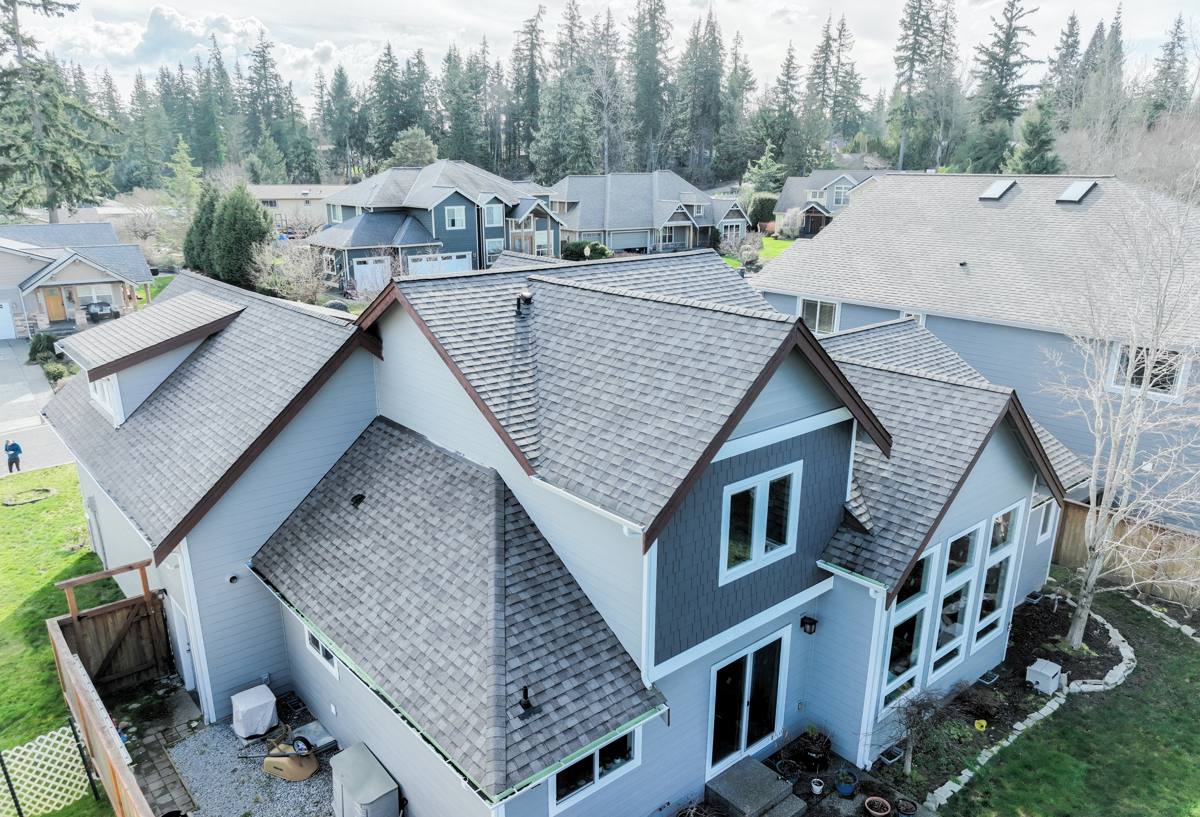
What Kendall Homes Are Actually Up Against
It's worth being specific about what "climate" means for a siding decision here, because it's not one condition but three working together.
Salt Air
Proximity to the water means airborne salt settles on exterior surfaces and accelerates corrosion on unprotected metal fasteners and trim, and it can degrade lower-quality paint and coatings faster than an inland home would ever see. Siding and fastening hardware that aren't rated for this kind of exposure show it within a few years — chalking, fading, or corrosion streaking down from fastener heads.
Driving Rain
Wind-driven rain is a different problem than ordinary rainfall. It gets forced sideways and upward into laps, seams, and trim joints that a system designed for straight-down rain was never built to handle. This is where a lot of siding failures actually start — not on the open wall, but at the transitions: window and door trim, corners, and butt joints.
Moss Season
Whatcom County's wet season runs long, and shaded or north-facing walls can stay damp for extended stretches. Any siding material that holds moisture against itself, or that gives moss and mildew a surface to grip, is going to show organic growth and staining faster here than it would in a drier climate.
None of these three conditions is unusual on its own. What makes Kendall demanding is that a home here typically deals with all three at once, and a siding system has to perform against all of them simultaneously, not just the one that's easiest to design for.
Why We Install Only James Hardie Fiber Cement
There are other fiber cement brands on the market, and there are other siding materials entirely — vinyl, engineered wood, primed wood. We don't install any of them. That's a standard we hold to because of what we've seen play out on real homes in this climate over time, not because of brand loyalty.
Non-Combustible Material
James Hardie siding is a cement-based product, not a wood or wood-composite one, which means it doesn't contribute fuel to a fire the way engineered wood or vinyl products can. That's a meaningful difference in construction material, independent of climate.
The HZ5 Product Line
James Hardie engineers its siding to specific climate zones, and the Pacific Northwest falls under the HZ5 designation — formulated for high-moisture, high-humidity regions like ours. That's not a marketing label; it affects the actual composition of the board so it performs better against sustained damp conditions than a generic, non-zone-engineered product would.
ColorPlus Factory Finish
Rather than relying on field-applied paint, James Hardie's ColorPlus finish is baked on at the factory in a controlled process, which produces a more consistent, more fade- and chip-resistant finish than most site-applied coatings can match — and it comes backed by its own finish warranty, separate from the substrate warranty on the board itself.
Warranty Structure
James Hardie backs its siding with a strong, transferable limited warranty, which matters both while you own the home and if you sell it. A warranty is only as valuable as the product and the installation behind it, but a well-installed Hardie system gives homeowners real, documented coverage rather than a vague promise.
What a Correct Fiber Cement Install Actually Involves
Fiber cement siding is only as good as the wall assembly behind it. A rushed or corner-cut install can undermine even the best board on the market, and in a climate like Kendall's, the mistakes show up faster than they would somewhere drier.
Moisture Management Behind the Siding
A correct install starts with a weather-resistant barrier and a drainage plane behind the siding — a path for any moisture that does get past the surface to drain out rather than sit against the wall sheathing. Skipping or shortcutting this step is one of the most common causes of hidden rot behind siding that looks fine from the street.
Fastening and Clearances
James Hardie specifies exact fastener types, spacing, and penetration depth, along with minimum clearances from grade, roofing, and decks. These aren't arbitrary numbers — they're what keeps the board performing as designed and keeps the manufacturer's warranty intact. Field-cut edges also need to be sealed and primed per specification, since an exposed cut edge is a weak point for moisture intrusion.
Trim, Flashing, and Joints
Given how much of Kendall's weather problem is wind-driven rain finding its way into joints and transitions, correct flashing at windows, doors, and butt joints is not optional detail work — it's the difference between a wall that sheds water and one that eventually traps it. Every horizontal trim piece and joint needs proper flashing and sealant application, not just a bead of caulk applied after the fact.
Panel and Board Selection
James Hardie offers several siding profiles — lap siding, shingle-style panels, and vertical board-and-batten among them — and the right choice depends on the home's architecture and exposure. Style is partly aesthetic, but board profile and thickness also affect how a wall handles wind load and water shedding on more exposed elevations.
Comparing Siding Options for a Kendall Home
| Material | Performance in Salt Air / Driving Rain / Moss | Our Position |
|---|---|---|
| James Hardie Fiber Cement | Climate-engineered (HZ5), factory finish resists fading and moisture, non-combustible | What we install exclusively |
| Vinyl Siding | Can warp or fade under sustained UV and moisture cycling; seams can allow water intrusion over time | Not installed |
| Engineered Wood (e.g. LP SmartSide) | Wood-based core is more moisture-sensitive at cut edges and joints than cement-based board | Not installed |
| Primed Wood / Cedar | Requires ongoing repainting and sealing to resist moss, staining, and moisture absorption in this climate | Not installed |
| Other Fiber Cement Brands | Cement-based like Hardie, but without HZ5 climate-zone engineering or the same factory finish and warranty structure | Not installed |
We're not going to tell you the alternatives are worthless products — vinyl and engineered wood both have a place in the market, and other fiber cement brands are legitimate products in their own right. But standardizing on one system lets us install it the same correct way every time, back it with a warranty we understand completely, and stop chasing the maintenance callbacks that lower-performing materials tend to generate in this specific climate.
Cost Factors Worth Understanding
Two bids for the same Kendall home can come in far apart, and the difference is almost always in scope, not just labor rate.
| Factor | What It Affects |
|---|---|
| Existing siding removal vs. overlay | Whether the wall assembly and sheathing get inspected and repaired before new siding goes on |
| House wrap / drainage plane quality | Long-term moisture protection behind the siding |
| Board profile and trim package | Material cost and the amount of detail work at joints and transitions |
| Flashing and sealant scope | How well the finished wall resists wind-driven rain at windows, doors, and joints |
| Wall complexity and elevation | Labor time, staging, and the amount of cutting and fitting required |
| Paint vs. ColorPlus factory finish | Long-term fade resistance and whether repainting will be needed down the road |
A written estimate that itemizes these factors is worth far more than a single lump-sum number. If a bid doesn't specify house wrap, flashing scope, and finish type, ask before comparing it against anything else.
How Our Process Works
- In-person inspection: We walk the exterior in person, checking existing siding condition, trim, and any signs of moisture damage behind the wall.
- Written estimate: You get an itemized bid covering removal, wall prep, house wrap, board profile, trim, and finish — not a vague single-line price.
- Scheduling around weather: We build reasonable flexibility into the timeline, since wet-season delays are a normal part of exterior work in this region.
- Removal and wall inspection: Old siding comes off and the sheathing underneath gets checked for hidden moisture damage before anything new goes up.
- House wrap and flashing: A proper drainage plane and flashing at every window, door, and joint go in before the first board is hung.
- Hardie installation to spec: Fastening, clearances, and joint treatment follow James Hardie's installation specification, not a shortcut version of it.
- Final walkthrough: We review the finished job with you and do a full site cleanup before calling it done.
Why Hiring a Crew That Already Works in Kendall Matters
A crew that regularly installs siding in and around Kendall has already seen where wind-driven rain finds gaps in a poorly flashed joint, which wall orientations hold moss longest, and how salt air treats an underspecified fastener over a few winters. That knowledge shows up in dozens of small decisions during an install — decisions a crew unfamiliar with this specific stretch of Whatcom County might not think to make.
It also matters after the job is finished. A workmanship warranty is only worth what the company behind it can actually deliver, and a contractor with an ongoing local presence is one you can still reach years later if a question comes up.
A Practical Checklist Before You Choose a Siding Contractor
- Do they install a documented drainage plane and house wrap, not just siding over the existing wall?
- Does the estimate specify board profile, trim package, and finish type — not just "new siding"?
- Is flashing at windows, doors, and joints explicitly called out in the bid?
- Do they carry current WA contractor licensing, liability insurance, and workers' compensation?
- Can they point to real, recent work in or near Kendall?
- Is the manufacturer warranty registration handled as part of the job, and is it transferable if you sell the home?
Signs Your Current Siding May Be Failing
Siding problems in this climate usually build slowly, and catching them early can mean a repair instead of a full replacement.
- Persistent moss, algae streaking, or dark staining that returns soon after cleaning
- Soft spots, bubbling, or visible warping, especially on shaded or north-facing walls
- Paint that's peeling, chalking heavily, or fading unevenly across the wall
- Gaps opening up at trim, corners, or butt joints
- Rust streaking below fastener heads or trim edges
- Rising utility bills that may point to moisture or air infiltration behind the siding
If any of that sounds familiar, it's worth getting the wall looked at before another wet season adds to the damage.
If you'd like an honest, no-pressure look at your Kendall home's siding and a written estimate to compare against anything else you've received, we're glad to come take a look. Use the form below to request a free estimate.