 Lynden Siding
 Why Ferndale Siding Takes More Punishment Than It Should
Ferndale sits close enough to the water that homes here deal with a combination most inland Whatcom County towns don't: salt-laden air moving in off Bellingham Bay and the Strait, near-constant winter rain driven sideways by coastal wind, and a moss and algae season that can run most of the year on north- and west-facing walls. None of that is dramatic on its own. The problem is that it never really stops, and siding damage in this climate is almost always cumulative — small failures that go unnoticed for a year or two, then show up as rot, staining, or a section that's suddenly soft under a thumb.
Salt air is corrosive to exposed metal fasteners and flashing long before most homeowners notice a visual change in the siding itself. Driving rain doesn't just wet the surface — it gets pushed into laps, seams, and butt joints that were fine in a calm rain but fail under wind-loaded moisture. And moss doesn't just look bad; it holds water against the siding surface for weeks at a time, which is exactly the condition that breaks down caulking, primer, and, on the wrong materials, the substrate underneath.
A siding repair in Ferndale isn't the same job as a siding repair in a dry inland climate. It has to account for all three of these stressors at once, or the "fix" just fails again in a season or two.
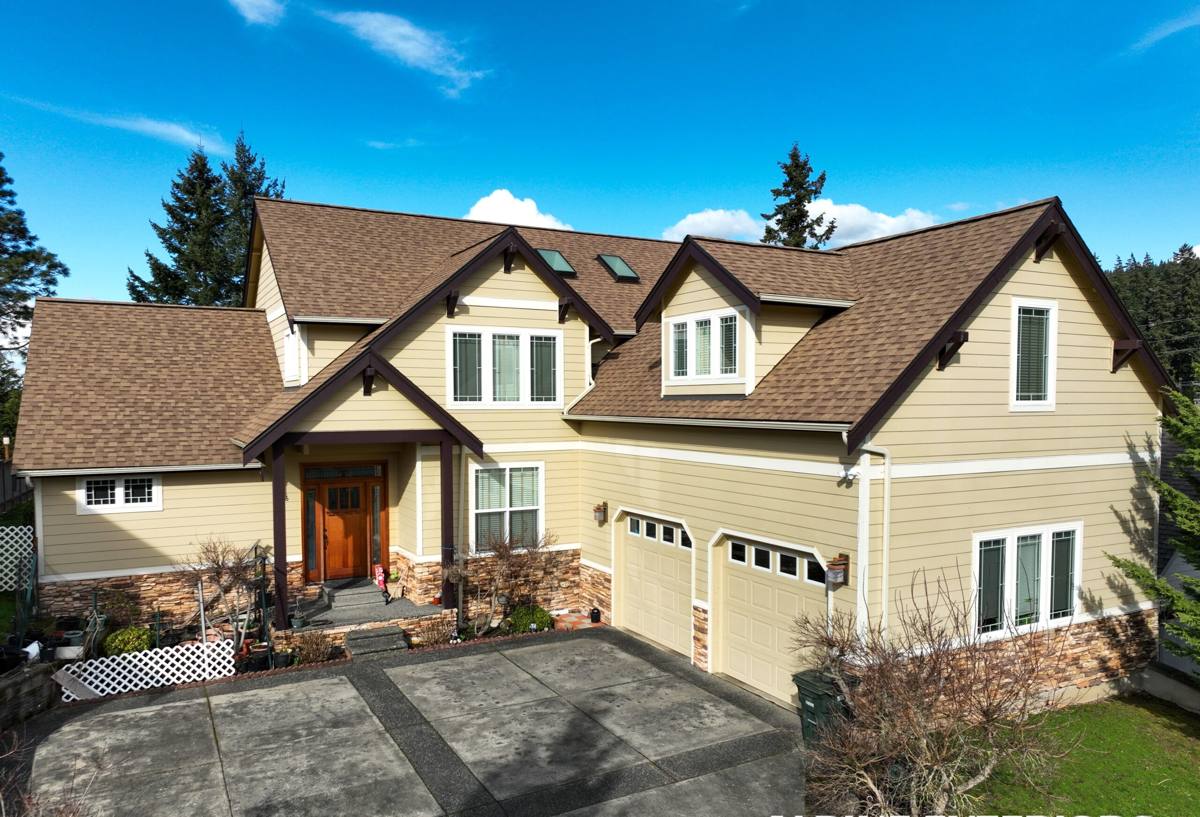
Common Signs a Ferndale Home Needs Siding Repair
Most siding repair calls we get start with one visible symptom, but the real damage is often broader once we get a panel open. Here's what typically triggers the first call:
- Soft, spongy, or crumbling spots when you press on the siding, especially near the bottom edge or around windows
- Dark streaking or persistent moss and algae growth that keeps coming back after cleaning
- Visible gaps, warping, or buckling at seams and butt joints
- Paint that's peeling, bubbling, or failing faster than the rest of the house
- Cracked or chipped panels, often from impact or long-term freeze-thaw stress
- Rust staining bleeding down from fasteners or flashing
- Soft trim boards or corner boards near ground level or under gutters without proper drainage
- A musty smell or interior staining on a wall that backs up to damaged exterior siding
Any one of these is worth a look. Several at once, especially on the same wall, usually means moisture has been getting behind the siding for a while.
What a Correct Siding Repair Actually Involves
It starts with finding the water, not just the damage
Patching over a soft spot without figuring out how water got in is the single most common shortcut in siding repair, and it's why so many "repaired" walls fail again within a couple of years. A correct repair starts by tracing the actual path — a failed seal at a window, a piece of flashing that was never installed, a butt joint that wasn't back-caulked, or grade and gutter issues pushing water up against the base of the wall.
Then it addresses what's underneath
If water has been sitting behind the siding, there's a good chance the house wrap, sheathing, or framing underneath has taken damage too. A repair that replaces the visible siding but ignores a compromised weather barrier or soft sheathing isn't a repair — it's a temporary cover-up. We check what's behind the siding before we close anything back up.
And it finishes with materials and details that match the climate
In a climate with this much rain and salt exposure, the details matter as much as the material: proper flashing above windows and horizontal trim, correctly lapped house wrap, stainless or coated fasteners where corrosion risk is higher, and caulking only where it belongs — siding shouldn't rely on caulk to do a flashing detail's job.
Repair or Replace? How We Actually Decide
Not every problem needs a full re-side, and not every problem should be patched. The honest answer depends on how contained the damage is and what's causing it.
| Factor | Leans Toward Repair | Leans Toward Replacement |
|---|---|---|
| Extent of damage | Isolated to one or two sections | Spread across multiple walls or repeats after past repairs |
| Underlying cause | Single identifiable source (one bad seal, one impact spot) | Systemic issue — poor original installation, missing flashing throughout |
| Sheathing condition | Dry and sound once opened up | Soft, delaminating, or water-stained in multiple spots |
| Existing material | Still structurally sound elsewhere, reasonably current | Failing product type, or nearing the end of its realistic service life |
| Age and history | Newer install with an isolated defect | Older siding with a pattern of recurring problems |
We'll tell you plainly which category your house falls into. If a targeted repair genuinely solves the problem, that's what we'll recommend — there's no reason to sell a full re-side when it isn't needed. But if we find the damage is a symptom of a bigger moisture or installation problem, we'll explain exactly what we found and why patching it would just delay the same failure.
Our Process for a Ferndale Siding Repair Call
- Inspection. We look at the damaged area and the surrounding wall, including what's happening at grade, gutters, and any nearby windows or penetrations that could be feeding water in.
- Diagnosis. Before any material comes off, we identify the likely water path and check how far the damage extends by opening up the affected section.
- Straight answer. We tell you what we found, whether it's a contained repair or something bigger, and what each option involves — no upselling, no downplaying.
- Correct repair. Damaged material, and any compromised sheathing or house wrap behind it, gets replaced. Flashing and drainage details get corrected, not just recaulked.
- Match and finish. We match material, reveal, and finish as closely as the situation allows so the repair blends in rather than standing out as a patch job.
Why We Use James Hardie for Repairs, Not Just New Installs
When a repair calls for new siding material — whether it's a few boards or a full section of wall — we use James Hardie fiber cement, the same as we do for full installations. We don't install LP SmartSide, vinyl, Cemplank, Allura, primed spruce, or cedar, and that standard applies to repair work too, for the same reasons it applies to a new install: those products carry moisture and maintenance trade-offs that don't hold up as well against a climate like Ferndale's over the long run.
Fiber cement is non-combustible and dimensionally stable, meaning it doesn't swell, cup, or warp with repeated wet-dry cycling the way some wood-based and engineered wood products can. Hardie's factory-applied ColorPlus finish is baked on under controlled conditions, which gives it better resistance to the fading and peeling that field-applied paint struggles with under constant coastal moisture. And Hardie's HZ5 product line is specifically engineered for wetter, harsher climates — which is exactly the profile of a home a few miles from saltwater with a long moss season.
Practically, that also means repairs blend in better. If your existing siding is James Hardie, we can match reveal, texture, and often color far more closely than we could patching in a different material. If your existing siding is something else and it's failing in a way that keeps generating repair calls, we'll say so honestly and let you decide whether a phased or full switch to Hardie makes sense for that wall.
What Happens If Damage Gets Ignored
Siding damage in a wet coastal climate doesn't stay the same size. A small soft spot near a window sill, left alone through one more wet season, often turns into rotted sheathing, and sometimes framing, by the time it's addressed. Moss left to grow unchecked holds moisture against the wall continuously, which accelerates whatever damage is already starting underneath. And any point where water is getting behind the siding is also a point where it can reach insulation and interior wall cavities — which is a considerably more expensive repair than the siding itself.
The reason we push for an inspection sooner rather than later isn't to manufacture urgency. It's that in this climate, the cost difference between "repair now" and "repair after another winter" is usually real and usually significant.
Why a Crew That Already Works Ferndale Matters
Siding repair is diagnostic work as much as it's carpentry. A crew that regularly works homes in Ferndale and the surrounding coastal Whatcom County area has already seen how salt air affects fasteners and flashing over time, how moss behaves on shaded north walls near the water, and which failure patterns show up again and again in this specific combination of wind, rain, and salt exposure. That familiarity shortens the diagnosis, because we're not guessing at conditions we've never dealt with — we're recognizing a pattern.
It also means we can speak plainly about what's realistic for a house in this location. A repair approach that works fine in a drier, more sheltered part of the county isn't automatically the right call three miles from the water, and we won't recommend it just because it's simpler.
Get an Honest Look at Your Siding
If you're seeing soft spots, persistent moss, staining, or damage anywhere on your Ferndale home's siding, it's worth having it looked at before another wet season adds to the problem. We'll give you a straightforward assessment, an honest repair-versus-replace opinion, and a free, no-pressure estimate — use the form below to get started.