 Lynden Siding
 Siding Built for What Everson's Weather Actually Does to a House
Everson sits inland along the Nooksack River in Whatcom County, and homeowners here sometimes assume that being a few miles off the water means their siding gets an easier ride than a house on the coast. It doesn't, not really. The same marine air that moves across the county still reaches Everson, the same wind-driven rain still falls sideways into wall assemblies here as it does closer to Bellingham Bay, and the mild, damp climate that fuels moss growth doesn't stop at any particular distance from the shoreline. What changes house to house isn't whether the climate is a factor — it's whether the siding on the wall was engineered and installed to handle it.
We install James Hardie fiber cement siding exclusively, and on this page we're narrowing in on one thing: what a correct James Hardie installation looks like specifically for Everson homes, why that matters more here than in a drier climate, and what our process looks like from first estimate to finished wall.
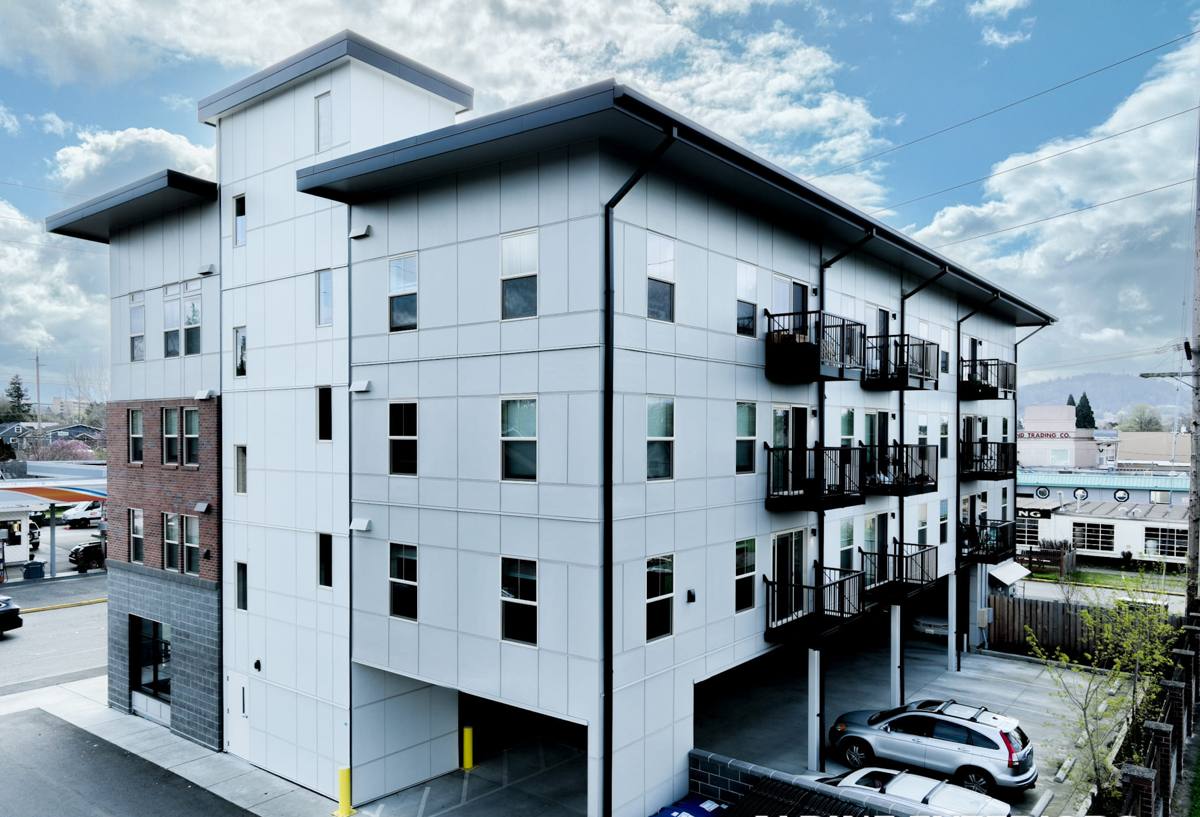
What Everson's Climate Asks of a Siding System
Salt Air, Even This Far Inland
Salt-tinged air off the Sound travels further into Whatcom County than most people expect, and it doesn't need direct waterfront exposure to do its work. Salt accelerates the breakdown of lower-quality finishes and speeds up corrosion on fasteners, flashing, and trim hardware. Over ten or fifteen years, that steady low-level exposure is often what separates a wall that still looks tight from one that's showing chalking, streaking, and loose trim.
Driving Rain That Doesn't Fall Straight Down
Rain in this part of Washington rarely arrives as a simple vertical shower. Wind pushes it sideways into lap joints, under trim boards, and into any seam where the water management detailing isn't right. That's a harder test than an annual rainfall number suggests, and it's a test that punishes sloppy flashing and caulking work far more than it punishes the siding material itself.
A Moss Season That Runs Most of the Year
Mild temperatures and consistent moisture mean moss and mildew have a long growing season across Whatcom County, and shaded, tree-lined lots — common around Everson — see it worst. Organic growth on a siding surface holds moisture against the wall behind it, and that trapped moisture is where a lot of long-term rot and finish problems actually start, regardless of what the siding is made of.
Why James Hardie Fiber Cement Is What We Put on Everson Homes
We used to offer a broader range of siding products. We stopped because of a pattern we kept seeing on service calls and tear-offs in exactly this climate: organic and petroleum-based sidings depend on an intact surface coating and consistent maintenance to keep moisture out, and in a place where wet weather is the default rather than the exception, that maintenance burden adds up fast. James Hardie fiber cement is a cured blend of cement, sand, and cellulose fiber — inorganic, non-combustible, and dimensionally stable in a way that wood-based and vinyl products aren't. It doesn't solve every problem by itself, but it gives an installation crew a material that behaves predictably in this climate instead of fighting it.
The HZ5 Product Line
James Hardie engineers different board formulations for different climate zones, and we install the HZ5 line, built specifically for regions with freeze-thaw cycles and sustained moisture exposure. That's a meaningfully better fit for a Whatcom County winter than a board engineered primarily for hot, dry markets, and it's one of the concrete reasons we standardized on this manufacturer rather than fiber cement as a generic category.
What a Correct James Hardie Installation Actually Involves
Fiber cement's real-world performance depends heavily on installation quality. A good board installed out of spec will still fail early, and that's worth being upfront about rather than pretending the material does all the work on its own.
- Correct clearances from grade, roofline, decks, and patios, so splash-back and standing moisture can't sit against the board edge
- Manufacturer-specified fastener type, spacing, and depth — overdriven or wrong-gauge fasteners crack boards and compromise the water-resistive barrier behind them
- Properly lapped and flashed joints at every horizontal and vertical seam, window head, and roof-to-wall transition
- Correctly sealed field cuts — any edge cut on site needs to be sealed per manufacturer spec, not left raw
- A functioning water-resistive barrier and rainscreen gap behind the siding, so any moisture that does get past the cladding has somewhere to drain and dry
- Factory-finished ColorPlus boards installed with touch-up only at cut edges, rather than a full field-painted finish that depends on jobsite weather conditions to cure properly
Skipping any one of these doesn't usually cause an obvious problem in year one. It shows up in year five or ten, as a stained joint, a soft spot at a butt seam, or trim that's pulling away from the wall — the kind of damage that's expensive to trace back to an installation shortcut once the siding has been up for a while.
Matching the Right Hardie Product to Your Home
James Hardie makes several distinct siding profiles, and the right one for a given house depends on its style, the look you want, and in some cases how exposed a particular wall or gable is.
| Product | Best Fit | Notes for This Climate |
|---|---|---|
| HardiePlank lap siding | Traditional and craftsman-style homes, the most common choice in this area | Horizontal laps need consistent overlap and fastening to shed wind-driven rain |
| HardiePanel vertical siding | Gables, modern-style homes, accent walls | Fewer horizontal seams, but vertical joints need careful flashing and caulk maintenance |
| HardieShingle | Craftsman and cottage-style detailing, accent gables | Shadow-line profile sheds water well but has more individual seams to detail correctly |
| HardieTrim boards | Window and door surrounds, fascia, corner boards | Same fiber cement durability as the field siding, so trim and field age together |
What Drives the Cost of a Hardie Siding Job in Everson
Every house is different, so we're not going to put a number on this page that doesn't mean anything until we've actually looked at your home. What we can do is walk through the factors that move the price up or down, so an estimate makes sense when you get one.
| Factor | Why It Matters |
|---|---|
| Full re-side vs. new construction | Tear-off, disposal, and repair of any damaged sheathing found underneath add cost that new construction doesn't have |
| House size and wall complexity | More corners, gables, and dormers mean more cuts, more flashing details, and more labor per square foot of coverage |
| Product mix | A house using plank, panel, shingle accents, and trim together costs more than a single-profile install, but often looks more custom |
| Underlying moisture or rot damage | Damage found after tear-off has to be repaired before new siding goes on, and that scope isn't always visible until the old material is off |
| Color and finish selection | Factory ColorPlus finish and certain color families carry different material costs than standard options |
| Access and site conditions | Steep lots, mature landscaping close to the walls, and limited staging space all affect labor time |
Our Process, From First Call to Finished Wall
- Walkthrough and estimate. We look at your existing siding, wall condition, and any problem areas, and put together a written estimate with no pressure to sign that day.
- Product and color selection. We help you choose the right Hardie profile, texture, and ColorPlus color for your home's style and exposure.
- Permitting. We handle the paperwork required for exterior work in Whatcom County so you don't have to track it down yourself.
- Tear-off and inspection. Once old siding comes off, we inspect the sheathing and framing underneath and flag any repairs needed before new siding goes on.
- Water-resistive barrier and flashing. This layer goes in before a single piece of Hardie board, because it's the part that actually keeps water out over the long run.
- Installation to manufacturer spec. Clearances, fastening, joint lapping, and sealed cuts, done to James Hardie's published installation requirements, not shortcuts.
- Final walkthrough. We go over the finished job with you before we consider it done.
Why a Crew That Already Works in Everson Matters
Siding installation quality depends on judgment calls that a written spec sheet can't fully cover — how much clearance to leave on a particular grade slope, how to detail a transition where a deck meets the wall, how a specific wall orientation is likely to take wind-driven rain over a full winter. A crew that's already worked on homes in this part of Whatcom County has seen those judgment calls play out over years, not just in a training manual. That matters more here than it would in a milder, drier climate, because the margin for error on flashing and water management details is smaller when the weather is actively working against a bad detail every week of the year.
There's also a practical side to hiring local: a contractor based nearby is easier to reach if a question comes up after the job, is familiar with the permitting process for this area, and has a real reputation in the community that isn't going anywhere after the final invoice.
A Practical Checklist Before You Hire Anyone
- Confirm the contractor is licensed and bonded to work in Washington State
- Ask specifically what siding product and product line they install, and why
- Ask how they detail clearances, flashing, and joint sealing — not just what brand of board they use
- Get the estimate in writing, with the product line, color, and scope of work spelled out
- Ask whether they pull the required permits or expect you to
- Ask how they handle sheathing or framing damage discovered after tear-off
- Ask about warranty coverage on both the material and the labor
Let's Talk About Your Home
Every wall on a house takes weather a little differently, and the right way to find out what your Everson home actually needs is to have someone look at it in person rather than guess from a general climate description. If you're weighing a re-side or planning ahead for one, we're happy to walk the property with you and put together a free, no-pressure estimate.