 Lynden Siding
 Building New in Deming Means Building for the Rain
Deming sits along the Nooksack River corridor in Whatcom County, tucked against the foothills that funnel marine air and storm systems straight off the water and up the valley. If you're framing a new home out here, you're not just picking windows for looks — you're choosing and installing them to survive a climate that stays wet, humid, and shaded for a good chunk of the year. Driving rain off the Sound, a long moss-and-mildew season under tree cover, and salt-tinged marine air moving inland all put steady pressure on window assemblies that weren't detailed correctly the first time.
New construction is actually the best possible moment to get this right. Unlike a retrofit, where you're working around existing siding and trim, a new build lets us integrate the window flange, the weather-resistive barrier, and the flashing into one continuous water-management system before the walls are ever closed up. Do that correctly and the window becomes one of the most weathertight parts of the house. Do it wrong, and it's the first place moisture finds its way into the framing — often years before anyone notices, hidden behind drywall and siding.
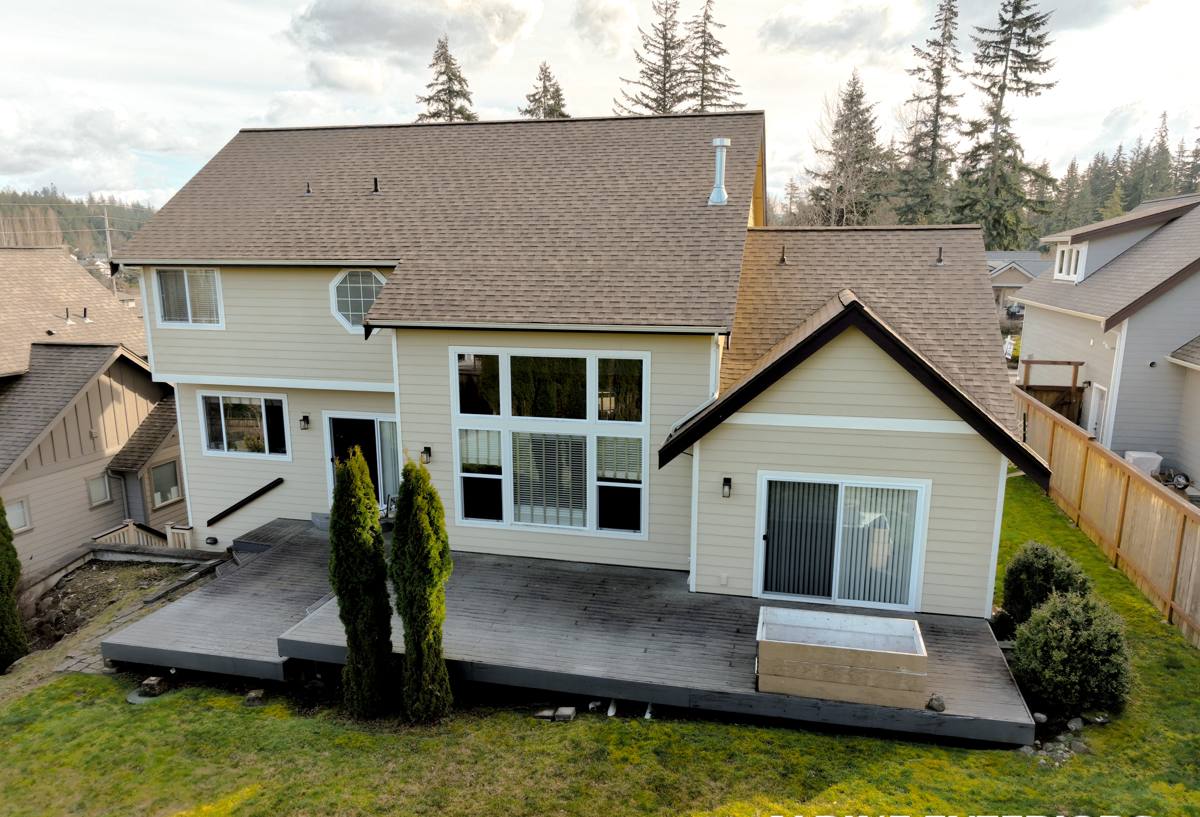
Why New-Construction Windows Are a Different Job Than Replacements
New-construction windows use a nailing flange around the perimeter of the frame, which gets fastened directly to the sheathing and integrated with the house wrap before siding goes on. That's a fundamentally different installation than a replacement or "pocket" window, which fits into an existing opening with no flange access. Trying to treat a new-construction opening like a replacement job — or vice versa — is one of the more common errors we see corrected on newer Whatcom County homes.
What Correct Flange Installation Involves
- Sill pan flashing installed first, sloped to drain outward, before the window ever goes in the opening
- Window set plumb, level, and square, with shims at the correct load points so the frame doesn't rack once it's fastened
- Flange fastened per the manufacturer's schedule — skipping fasteners or over-driving them is a warranty issue waiting to happen
- Flashing tape run in the correct shingle-lap sequence: sill, then jambs, then head, so water is always directed outward and down, never trapped behind a lapped seam
- House wrap integrated over the head flashing last, maintaining the drainage plane all the way up the wall
Every one of those steps matters more in a climate like Deming's than it would in a dry-summer region, because the assembly gets tested by real weather within months of the house being closed in, not years.
Choosing a Frame Material for This Climate
There's no single "best" window material — there's a best fit for how the house is built, how it's oriented, and what maintenance the homeowner is willing to do. In a marine climate with long wet stretches and shaded, moss-prone conditions, we weigh moisture behavior and long-term maintenance heavily.
| Frame Material | Moisture Behavior | Maintenance | Typical Fit |
|---|---|---|---|
| Vinyl | Won't rot; expands/contracts with temperature swings | Low — occasional cleaning | Cost-conscious builds, rental properties, most new construction |
| Fiberglass | Very stable dimensionally, excellent moisture resistance | Low | Larger openings, higher-end new builds, energy-focused projects |
| Wood-clad | Interior wood needs a dry, conditioned space; exterior clad handles rain well | Moderate — interior finish upkeep | Homes prioritizing interior wood aesthetic |
| Aluminum | Prone to condensation without thermal breaks; conducts cold | Low, but performance-limited here | We generally steer builds away from it in this climate unless thermally broken |
We'll walk through this with you based on your builder's plans, your budget, and how much sun exposure the elevations actually get — a north-facing wall under fir trees behaves very differently than a south-facing wall in the same house.
Glass Packages Matter as Much as the Frame
In a region with this much cloud cover and moisture, the glass package does real work beyond just insulating. Low-E coatings reduce heat loss through the glass and help control condensation on the interior pane during cold, damp mornings — a common complaint in homes built with builder-grade single Low-E glass in shaded valley locations like Deming. Double-pane with argon fill is standard on most new builds we do out here; triple-pane gets considered on north-facing rooms or homes aiming for tighter energy performance, but it adds cost and weight that isn't always justified.
Whatever glass package you choose, the spacer system between the panes matters for long-term seal integrity. Warm-edge spacers resist seal failure better over the decades of temperature and humidity cycling this climate puts an assembly through than older aluminum spacer designs.
Our Installation Process on New Builds
- Coordinate with the general contractor on framing tolerances and rough opening sizes before windows are ordered, so nothing gets forced into an out-of-square opening on install day
- Inspect sheathing and house wrap for damage or gaps before any window goes in
- Install sill pan flashing at every opening, sloped to shed water outward
- Set, level, and fasten each window per manufacturer spec
- Flash in the correct sequence — jambs, then head — with compatible tape and sealants
- Integrate the surrounding house wrap and verify the drainage plane is continuous before siding crews start
- Photograph and document flashing details at each opening for the builder's and homeowner's records
That last step matters more than people expect. Once siding goes on, nobody can see the flashing again for the life of the house. Having a documented record of how each opening was detailed is worth having if a warranty question ever comes up.
Mistakes We Commonly Correct on Newer Homes
Some of the call-backs we get on newer Whatcom County construction trace back to the same handful of shortcuts:
- Sill pans skipped entirely, relying on caulk alone to keep water out — caulk fails; flashing shouldn't depend on it as the only line of defense
- Flashing tape applied out of sequence, so water gets directed behind a lower course instead of over it
- Windows fastened before they were properly shimmed, leaving frames slightly racked — this stresses seals and can cause operable sashes to bind within a year or two
- House wrap cut too tight around the flange with no lap, leaving a gap for wind-driven rain to find
None of these are visible from inside the finished house. They show up later as moisture staining, soft trim, or a sash that won't close right — usually well after the original installer has moved on to the next job.
What New-Construction Windows Cost to Get Right
Pricing depends heavily on frame material, glass package, size, and how many openings the plan calls for. Rather than quote a flat number that won't hold up across different house plans, here's what actually drives the cost on a Deming build:
| Cost Factor | Why It Matters |
|---|---|
| Frame material | Vinyl is typically the most budget-friendly; fiberglass and wood-clad run higher |
| Opening size and count | More openings and larger spans mean more flashing detail work, not just more glass |
| Glass package | Triple-pane and specialty coatings add cost over standard double-pane Low-E |
| Site access and timing | Coordinating install around other trades on a tight framing schedule affects labor time |
| Custom shapes or sizes | Non-standard openings require special-order units, which extend lead time and cost |
We'll give you a real number once we know the plan set, not a ballpark that changes once the framing is actually up.
A Checklist Before You Order Windows for Your Deming Build
- Confirm rough opening sizes against the actual window schedule, not just the architectural plans
- Decide on frame material based on maintenance tolerance, not just price per unit
- Choose a glass package suited to each elevation's sun exposure, not one spec for the whole house
- Ask your window contractor how they handle sill pan flashing — this is the single detail most worth asking about
- Get flashing documented in writing or photos before siding closes it in for good
Why It Helps to Hire a Crew That Already Works This Area
Whatcom County's building conditions aren't uniform — a lot down near Lynden proper behaves differently than a wooded, river-adjacent lot in Deming with more shade, more standing moisture, and a longer moss season on any north-facing surface. A crew that's installed windows across this specific stretch of the county already knows how local framing crews tend to build, what inspectors here are looking for, and where water actually wants to go on a lot like yours. That local pattern recognition is hard to replace with a generic install checklist, and it's the difference between a window that performs for thirty years and one that starts giving you trouble in five.
If you're framing a new home in Deming and want windows installed the way this climate actually requires — sill pans, correct flashing sequence, and a frame choice that fits your house — we're happy to walk the plan set with you and put together a straightforward, no-pressure estimate. Reach out through the form below to get started.