 Lynden Siding
 Why Ferndale Siding Takes a Different Kind of Beating
Ferndale sits close enough to the water and open farmland that homes here deal with a combination of exposures most siding products were never really engineered for. You've got salt-laden air drifting in off the bay, wind-driven rain that doesn't just fall straight down but gets pushed sideways into wall assemblies, and a gray, wet stretch of the year long enough that moss and algae get a real foothold on anything that stays damp. Any one of those factors on its own is manageable. Together, over years, they expose the weak points in a siding system fast.
We install siding across Whatcom County, and Ferndale properties consistently show the same pattern: siding that looked fine going in starts telling on itself around year eight to twelve, usually at the same handful of predictable spots — bottom courses near grade, window and door trim joints, and north- or west-facing walls that never get a chance to fully dry out between storms. This page is about what a siding installation actually needs to hold up under those specific conditions, not a generic rundown of siding in general.
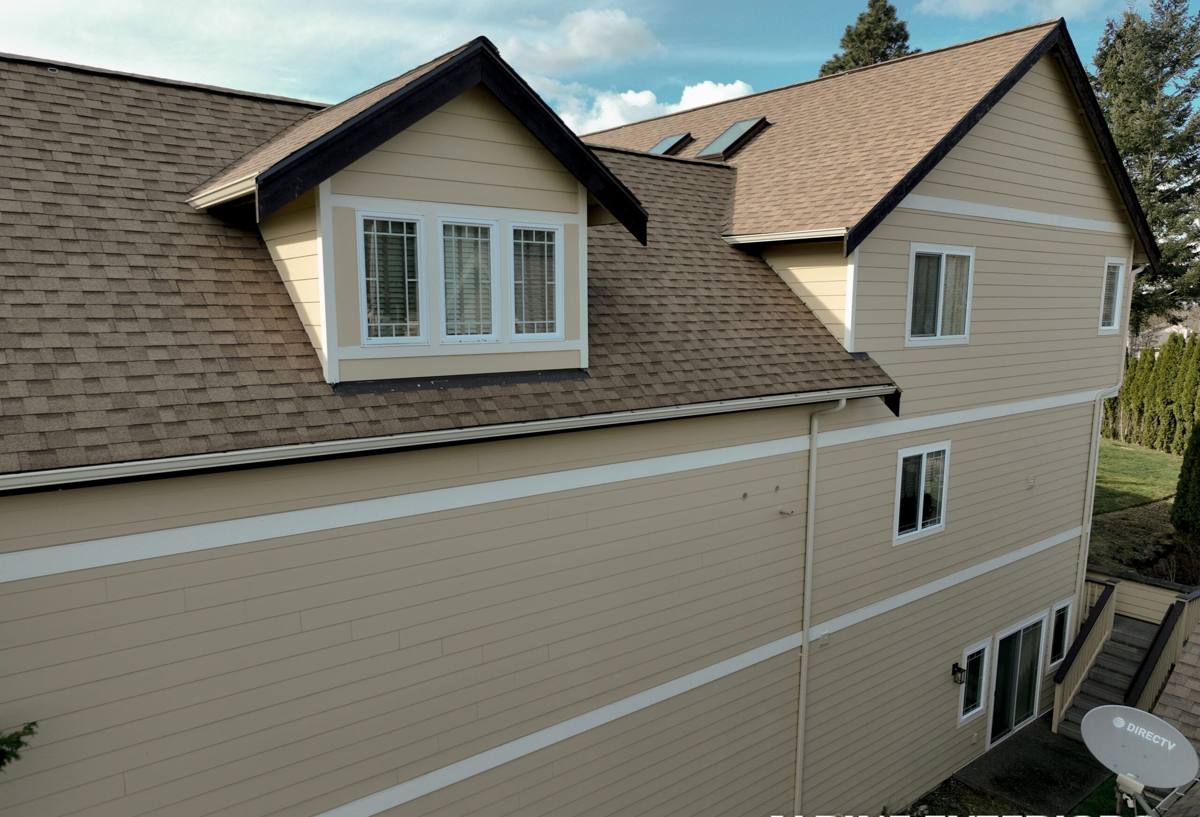
What Ferndale's Climate Actually Does to a Wall
Salt Air
Airborne salt is corrosive to exposed metal fasteners, flashing, and hardware, and it accelerates the breakdown of finishes that weren't formulated to handle it. On a home a few miles inland this is a minor factor. On homes with a more direct exposure toward the water, it's a real design consideration — the fasteners, flashing metal, and paint or factory finish all need to be chosen with that in mind, not just picked off the shelf.
Driving Rain
Whatcom County storms frequently come with real wind behind them, which means rain doesn't just run down a wall — it gets forced sideways and upward into laps, seams, and penetrations. A siding system that's watertight against straight-down rain can still leak under driving rain if the laps, flashing, and water-resistive barrier underneath weren't detailed for that condition. This is one of the most common places we find deferred problems on older Ferndale homes: the siding itself looks intact, but water has been getting behind it at a poorly lapped joint for years.
Extended Moss and Algae Season
Between the rain and the region's long stretches of overcast, moist weather, anything on a Ferndale exterior that stays damp for extended periods becomes a candidate for moss, algae, and mildew growth — not just on roofs, but on siding, especially on shaded north walls and under eaves with limited sun exposure. Porous or absorptive materials hold that moisture longer and give organic growth more to work with. Siding that sheds water quickly and dries fast between rain events simply doesn't grow moss the way slower-drying materials do.
What a Correct Siding Job Involves Here
A siding installation that's actually built for Ferndale's exposure isn't just about the panel you put on the wall — it's a system, and every layer matters.
- Water-resistive barrier: A correctly lapped, sealed weather barrier behind the siding, installed shingle-style so every layer drains outward and down, not into the wall.
- Flashing at every penetration: Windows, doors, hose bibs, vents, and any other wall penetration need proper flashing that directs water back out, not into the sheathing.
- Rainscreen or drainage gap where appropriate: A ventilated gap behind the siding lets any moisture that does get past the outer layer drain and dry instead of sitting against the sheathing.
- Correct fastening: Fastener type, length, and placement matter — under-driven or over-driven fasteners, or the wrong fastener for the substrate, are a common source of premature failure.
- Proper clearance at grade: Siding installed too close to soil, decking, or hardscape wicks moisture and stays wet longer, which is exactly what invites rot and moss growth.
- Tight, correctly lapped joints: Every horizontal and vertical joint has to be lapped and sealed in a way that sheds wind-driven rain, not just gravity-fed rain.
Skip or rush any one of these steps and the siding itself becomes almost irrelevant — water will find the gap in the system before it ever has to test the durability of the panel.
Why We Only Install James Hardie Fiber Cement
We standardized on James Hardie fiber cement siding for every home we work on, including Ferndale, and it comes down to how the material actually performs against the specific conditions described above.
Fiber cement is non-combustible, dimensionally stable, and doesn't absorb and hold moisture the way wood-based or wood-adjacent products can — which matters directly in a climate with this much sustained dampness. Hardie's HZ product lines are engineered for specific climate zones, so the product specified for a Pacific Northwest install is built around the moisture and weathering conditions we actually get here, not a one-size-fits-all formulation. The factory-applied ColorPlus finish is baked on under controlled conditions and backed by its own finish warranty, which means the color layer holds up to UV and moisture exposure more consistently than field-applied paint, and it gives us a hard, smooth surface that doesn't offer organic growth the same foothold that a more porous or fibrous surface would.
We don't install LP SmartSide, vinyl, Cemplank, Allura, primed spruce, or cedar. That's not a knock on every homeowner who has one of those products on their home — plenty perform fine in the right conditions with the right maintenance. It's that we've made a professional decision to build our installation practice, our flashing details, and our warranty around one material system that we can stand behind fully, rather than splitting our expertise across several. In an exposure environment like Ferndale's, we'd rather install one product exceptionally well than several products adequately.
Our Installation Process
- On-site assessment: We walk the exterior, check current siding condition, look at grading and drainage around the foundation, and identify any areas with existing moisture damage that need to be addressed before new siding goes on.
- Removal and sheathing inspection: Old siding comes off and we inspect the sheathing underneath for rot, soft spots, or prior water intrusion — this is often the first time hidden damage becomes visible, and it needs to be fixed, not covered over.
- Weather barrier and flashing installation: A new water-resistive barrier goes on correctly lapped, with flashing detailed at every window, door, and penetration.
- Hardie panel or plank installation: Panels are fastened per manufacturer specification, with attention to fastener spacing, clearance at grade, and correct joint lapping for wind-driven rain.
- Trim, caulking, and touch-up: Trim is installed and sealed at transitions, and any factory-finish touch-up is done with Hardie's matched touch-up product.
- Final walkthrough: We review the completed job with the homeowner and go over basic care so the siding performs the way it's designed to.
Cost Factors for a Ferndale Siding Project
Every home is different, but the same handful of factors tend to drive cost up or down on a Ferndale project specifically:
| Factor | Why It Matters Here |
|---|---|
| Home size and wall complexity | More corners, gables, and dormers mean more cutting, flashing, and labor time |
| Existing sheathing condition | Hidden rot from past water intrusion adds repair scope before siding can go on |
| Product line and profile | Lap width, texture, and color affect material cost within the Hardie lineup |
| Trim and detail work | Custom trim around windows, doors, and transitions adds labor |
| Site exposure | Homes with more direct wind or salt exposure may need additional flashing detail or fastener spec |
| Access and site conditions | Tight lots, landscaping, or multi-story walls affect staging and labor time |
We give a firm, itemized estimate after walking the property — not a phone quote — because these factors vary too much house to house to price accurately any other way.
Signs Your Ferndale Home's Siding Needs Attention
- Soft or spongy spots when you press on the siding, especially near the bottom courses or under windows
- Persistent moss, algae, or dark streaking that comes back shortly after cleaning
- Visible cracking, buckling, or separation at seams and joints
- Peeling or bubbling paint, or a chalky finish that rubs off on your hand
- Warping or waviness across a wall section
- Rising utility bills that suggest the wall assembly isn't insulating or sealing the way it should
Any one of these on its own might be minor. Several together, especially on a wall facing prevailing wind and rain, usually means water has been getting behind the siding for a while.
Why a Crew That Already Works Ferndale Matters
Siding installation isn't just about following a manufacturer's install guide — it's about knowing how that guide needs to be applied to a specific exposure. A crew that's worked Whatcom County homes knows which walls in a given orientation are going to see the worst of the driving rain, which grade conditions lead to moisture problems at the bottom courses, and how much drainage detail is actually warranted versus overbuilt. That judgment comes from doing the work here repeatedly, not from a general contracting background applied to a new region. It also means faster, more accurate estimates, because we're not guessing at how local conditions will affect the job — we already know.
Ready to Talk About Your Home?
If your Ferndale home's siding is showing its age, or you're planning ahead before a problem shows up, we're happy to take a look and give you a straight, no-pressure assessment. Fill out the form below for a free estimate — we'll walk the property, answer your questions, and give you a clear picture of what the job actually involves.