 Lynden Siding
 Composite Decking in Deming: Building for This Climate, Not Around It
Deming sits inland from the coast, tucked into the foothill country along the Nooksack River corridor in Whatcom County, but it isn't spared from the weather that defines exterior work across this part of Washington. Marine air still moves through the valley, rainfall is frequent and often wind-driven rather than falling straight down, and the tree cover that makes this area what it is also means shaded, slow-drying surfaces for a good chunk of the year. A deck built without that in mind — wrong board choice, sloppy ledger flashing, no airflow underneath — tends to show problems years before it should.
Lynden Siding Installer works siding, roofing, windows, and decks across this stretch of Whatcom County, and decks get treated with the same standard as everything else we build: the parts nobody sees have to be right, because those are the parts that fail first. This page covers composite decking specifically for Deming homes — what the climate actually does to a deck here, what a correct build involves, and how we run the job from first look to final walkthrough.
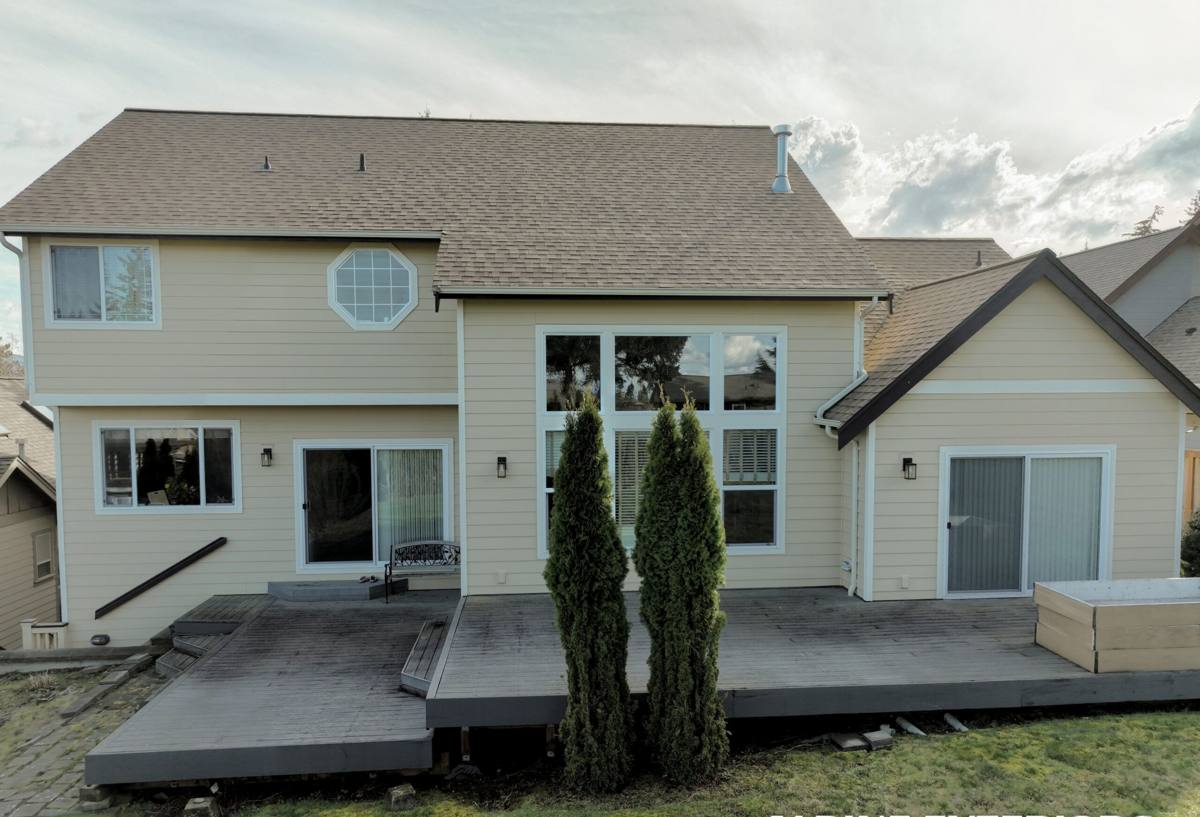
What Deming's Climate Actually Does to a Deck
Moss and Slow-Drying Surfaces
A deck under mature trees or on the shaded side of a house can hold moisture for days after a storm has passed. On any surface that's even a little porous, that turns into moss and algae growth over a season or two — and on a horizontal walking surface, that's not just cosmetic. Moss holds water against the board, and a board that stays wet longer breaks down faster, whatever it's made of.
Wind-Driven Rain at the Ledger Connection
The single most common source of hidden deck damage isn't the decking boards at all — it's the ledger board, the framing member that bolts the deck to the house. Rain that hits a wall at an angle instead of straight down works its way behind poorly flashed ledger connections, and once water gets between the ledger and the house framing, it can rot structural wood for years before anyone notices from the surface. This is the detail that separates a deck that's structurally sound at year twenty from one that needs emergency framing repair at year eight.
Freeze-Thaw and Seasonal Movement
Whatcom County doesn't see extreme winters most years, but Deming's inland, higher-elevation position means it gets a few more cold snaps than waterfront towns closer to the Sound. Moisture that's soaked into a board or fastener connection and then freezes expands, and repeated freeze-thaw cycling is what turns a small crack or a loose connection into a real structural issue over time.
UV and Moisture Cycling on Fasteners and Hardware
Everything holding a deck together — joist hangers, structural screws, post bases — sits through the same wet-then-dry cycle as the decking above it, plus direct sun exposure on top of that. Hardware that isn't rated for sustained exposure corrodes faster here than it would in a drier climate, and corroded hardware is a structural problem, not a cosmetic one.
Composite vs. Wood Decking: What Actually Holds Up in Deming
Both materials can work here if they're installed correctly, but they ask for different levels of ongoing maintenance and behave differently in sustained moisture. Here's the honest comparison, not the sales pitch:
| Factor | Wood Decking | Composite Decking |
|---|---|---|
| Moisture absorption | Absorbs and releases moisture readily; needs sealing to slow it down | Capped composite resists absorption; core doesn't swell or rot |
| Moss and mildew | Porous surface holds growth; needs regular cleaning and treatment | Sheds moisture better; still needs occasional cleaning in shaded areas |
| Maintenance | Annual sealing/staining recommended in this climate | Periodic washing; no sealing or staining required |
| Splintering/cupping | Common as boards weather and dry unevenly | Doesn't splinter; resists cupping when installed with proper gapping |
| Upfront cost | Generally lower | Generally higher |
| Long-term cost | Higher over time with sealing, staining, and board replacement | Lower ongoing cost; longer typical service life |
| Typical service life here | 10-15 years before major refinishing or replacement | 25-30+ years with proper substructure and ventilation |
Composite isn't automatically the right call for every homeowner — some people like the look and feel of real wood enough to accept the upkeep. But for a Deming property with shade, tree cover, and a long wet season working against it, composite's resistance to moisture absorption is a real, practical advantage, not just a marketing point.
What a Correct Composite Deck Build Actually Involves
The decking boards are maybe a third of what determines whether a deck lasts. The rest is substructure work that's invisible once the project is finished:
- Ledger board flashing that sheds water away from the house rather than trapping it against the rim joist
- Joist tape or a moisture barrier over every framing member the decking will sit on
- Corrosion-resistant structural hardware — hangers, screws, and post bases rated for sustained wet exposure
- Proper board spacing and airflow underneath so the structure and the underside of the decking can actually dry out between rain events
- Hidden fastener systems where the product allows, so there are fewer exposed penetration points for water to work into
- Correctly framed and coded stairs, railings, and guard posts, especially on any elevated deck
- Ground clearance and drainage grading underneath the deck so water doesn't pool against posts and footings
Skip any one of these and the composite boards on top can look fine for years while the structure underneath is quietly failing. We build the substructure the same way regardless of which composite product a homeowner chooses, because that part of the job doesn't change — only the visible boards do.
Choosing a Composite Board for a Deming Home
Not all composite decking is the same product wearing different colors. There are real differences in how the boards are made:
Capped Composite
A wood-plastic composite core with a protective polymer cap bonded around it. The cap is what resists staining, fading, and moisture absorption — an uncapped composite board wears very differently over time because the core is more directly exposed. Most quality composite decking sold today is capped for exactly this reason.
PVC / Cellular PVC
Fully synthetic, no wood content at all. Generally the most moisture-resistant option and lighter in weight, which can matter on elevated decks. Tends to cost more than wood-composite blends and has a slightly different look and feel underfoot that some homeowners prefer and others don't.
Color and Heat Considerations
Darker composite boards absorb more heat in direct sun, which matters more on an open, south-facing deck than on a shaded one under tree cover — a common layout in Deming. We'll talk through color options relative to how much sun your specific deck actually gets before you commit to one.
We'll walk you through the real trade-offs between products based on your budget, how much sun and shade your deck sees, and how long you plan to stay in the house — not just push whichever line has the best margin.
How a Composite Decking Project Runs, Start to Finish
- On-site assessment — we look at the existing deck or build site, house framing at the ledger connection, drainage and grade underneath, and sun/shade exposure across the deck footprint.
- Design and material selection — board layout, railing style, stair placement, and composite product selection based on your budget and how the deck will actually be used.
- Demo, if replacing an existing deck — removal of old decking and inspection of the framing underneath for rot or damage before anything new goes on top.
- Framing and substructure — ledger flashing, joist layout, joist tape, and hardware installation, built to hold up under sustained moisture, not just pass a quick inspection.
- Decking installation — boards installed with correct spacing and fastening for the specific product, including any picture-framing or trim detail.
- Railings, stairs, and code compliance — guard height, baluster spacing, and stair geometry built to current code, not whatever was standard when an old deck was originally built.
- Final walkthrough — we go over the finished deck with you, including basic care and what to expect from the material over time.
Cost Factors: What Actually Moves the Price
We're not going to quote a number without seeing the site, but these are the honest factors that move a composite decking project up or down in cost:
| Factor | Why It Matters |
|---|---|
| Deck size and shape | Square footage and how many angles/cuts the layout requires |
| Height and access | Elevated decks need more substructure, railings, and often stairs |
| Composite product tier | Entry-level composite vs. premium capped composite or PVC |
| Existing structure condition | Whether framing can be reused or needs to be rebuilt due to rot or age |
| Railing and trim details | Basic railing vs. custom styles, picture-framing, or accent trim |
| Site access | How easily materials and equipment can reach the build area |
Two decks that look similar in square footage can land in very different price ranges once the framing condition and access are factored in. We'll break down where your project's cost is actually coming from rather than handing you a single number with no explanation.
Signs an Existing Deck Needs Attention
- Soft, spongy, or bouncy spots when walking across the deck
- Visible gaps, staining, or discoloration at the ledger board where the deck meets the house
- Moss or algae buildup that returns quickly after cleaning
- Rust streaking around fasteners or visible hardware corrosion
- Wobbly or loose railings and posts
- Boards that are cupping, splintering, or separating at the seams
- Water pooling underneath the deck instead of draining away
Any of these is worth a real inspection rather than a guess. A ledger connection problem in particular is a structural issue, not a cosmetic one, and it's not something to leave alone through another wet season.
Why a Local Whatcom County Crew Matters for a Deming Deck
A crew that builds decks across this county through every season develops a feel for how moss, driving rain, and shade actually play out on real properties, not just how a composite product performs on a manufacturer's data sheet. That shows up in the decisions that don't make it into a sales conversation: how much ledger flashing a given house actually needs, which board layout will dry fastest on a shaded lot like many in Deming, and which hardware is worth the extra cost because it's what actually survives out here. It also means someone who already understands the difference between an open, sun-exposed deck and one tucked under tree cover, and doesn't build both the same way.
Beyond Decking: The Rest of the Exterior
Decking is one part of what we do — we also handle siding, roofing, and window installation, and on a lot of homes those systems connect directly to deck work. A ledger board sits right against the siding and wall assembly, so if there's moisture damage at that connection, it's worth having someone look at both the deck framing and the wall behind it at the same time, rather than treating them as two separate problems handled by two different contractors down the road.
If you're thinking about a new composite deck or need an honest look at an existing one in Deming, we're happy to come take a look. There's no pressure and no obligation — just a straightforward estimate and a clear explanation of what your deck actually needs. Use the form below to get started.