 Lynden Siding
 Building a Deck That Actually Holds Up in Aldergrove
Aldergrove sits in a part of the Fraser Valley that gets the full Pacific Northwest treatment — long stretches of driving rain in the fall and winter, a moss season that can run half the year on shaded or north-facing structures, and a damp, salt-tinged air pattern that moves in off the Salish Sea and settles into the valley. A deck built with generic, one-size-fits-all methods will show its age within a few seasons here: soft boards, rusted fasteners, slippery moss buildup, and rot creeping in at the spots where the deck meets the house. A deck built for this specific climate looks and performs differently five, ten, and twenty years down the road.
We're based just south of the line in Whatcom County and have built and repaired decks on both sides of the border for years. That means we already understand what Aldergrove homes are up against before we ever step on site — the ground conditions, the drainage patterns, the way moisture works its way into wood and hardware over a wet winter. This page focuses specifically on custom deck work for Aldergrove properties, not a generic rundown of deck options.
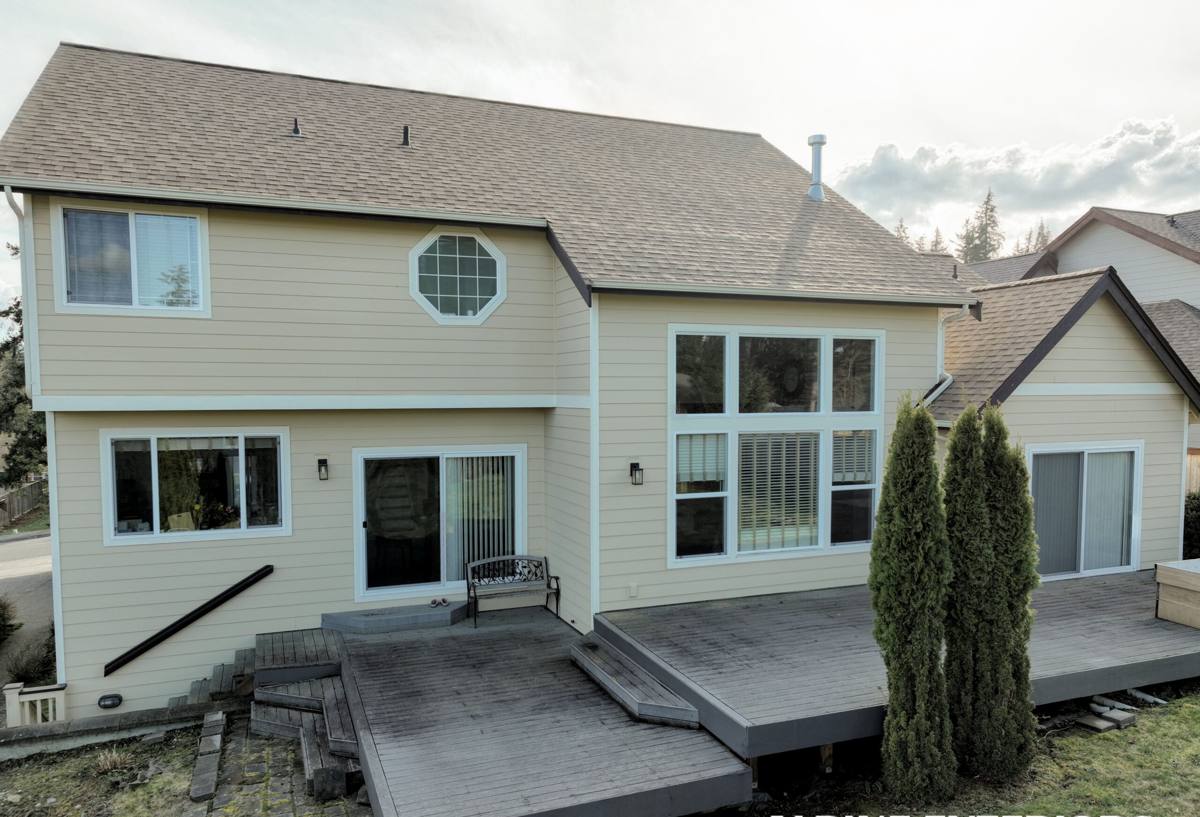
What Local Homes Actually Need From a Deck
Every deck has to handle load, but in this climate the bigger long-term threat isn't weight — it's water and organic growth. A well-built Aldergrove deck needs to manage three things well:
- Drainage — water needs a clear path off the deck surface and away from the house foundation, not a place to pool.
- Airflow underneath — a deck built too low or too tight to the ground traps moisture under the boards and accelerates rot and moss growth on the underside.
- Corrosion resistance — fasteners, brackets, and hangers that aren't rated for this level of ongoing moisture exposure will rust, stain the decking, and eventually fail structurally.
Shaded lots with mature trees — common on quieter residential streets in this area — see heavier moss and algae buildup than open, sun-exposed yards. That's not a reason to avoid a deck project, but it does change some of the material and structural decisions we'd make on your specific lot.
Decking Material Options for This Climate
There's no single "best" decking material — there's a best material for your budget, your sun exposure, and how much upkeep you actually want to do. Here's how the common options stack up for a property like yours:
| Material | Upfront Cost | Maintenance Needed | Moisture / Moss Resistance |
|---|---|---|---|
| Pressure-treated wood | Lowest | Annual cleaning and re-staining/sealing | Moderate — needs upkeep to stay ahead of rot |
| Cedar | Moderate | Regular sealing to hold color and resist moisture | Good natural resistance, still needs care |
| Capped composite | Higher | Occasional washing, no staining/sealing | Strong — resists rot, but surface moss/algae still needs washing |
| PVC decking | Highest | Occasional washing | Excellent — fully synthetic, no wood to rot |
Wood decking isn't a bad choice — it's a real, honest option with a lower upfront cost — but it only performs well here if the homeowner is committed to the maintenance schedule. Composite and PVC cost more up front but trade ongoing labor for material cost, which is worth discussing honestly based on how you actually want to spend your weekends. We'll walk through the tradeoffs for your specific project rather than push one product line.
A Note on "Deck Boards Only" Upgrades
Some homeowners want to know if they can just swap old wood boards for composite on an existing frame. Sometimes that works — but only if the existing framing, joist spacing, and ledger connection are sound and rated for the new material's weight and fastening pattern. We check the substructure first; putting new boards on a frame that's already been compromised by years of moisture just hides the real problem for a season or two.
Structural Details That Actually Matter
The visible decking gets all the attention, but the parts you don't see are what determine whether a deck lasts 10 years or 30 in this climate.
Ledger Board and Flashing
Where the deck attaches to the house is the single most common failure point we see on rebuilds. Proper flashing — installed correctly, in the right layered order, with the house's water-resistive barrier — keeps rain from working its way behind the siding and into the wall framing. A deck that's been lag-bolted to the house without correct flashing is a slow leak waiting to happen, and it's often invisible until there's real damage.
Joist Protection and Fasteners
We use joist tape or an equivalent moisture barrier on the tops of framing lumber and corrosion-rated, structural-grade fasteners and hangers throughout. In a climate with this much sustained dampness and salt-influenced air, standard hardware corrodes faster than most homeowners expect — and corroded hardware is a structural issue, not a cosmetic one.
Footings and Frost
Footings need to be sized and set to the correct depth for local frost conditions and soil type. Undersized or shallow footings can shift over time with freeze-thaw cycles and seasonal ground saturation, which shows up later as a deck that feels bouncy, uneven, or pulls away from the house.
Railings, Stairs, and Finishing Details
Railings and stair components take a lot of direct weather exposure and a lot of hand contact, so material choice matters as much here as it does for decking. Powder-coated aluminum and composite railing systems hold up well against the wet season without the yearly refinishing that painted wood requires. Whatever system you choose, we build to proper height, baluster spacing, and load requirements — not just to what looks right, since railings are a safety component, not a decorative one.
Stair stringers and any structural post that sits close to grade get particular attention, since ground-level wood is the first place moisture and rot take hold on any deck.
Moss, Algae, and Long-Term Maintenance
Moss doesn't just make a deck look neglected — on wood decking, it holds moisture against the board surface and speeds up rot underneath it. On any material, a moss-covered surface gets slick and genuinely dangerous in wet weather. A few habits keep it manageable:
- Sweep debris and organic buildup off the deck surface regularly, especially under overhanging trees.
- Keep gutters and downspouts near the deck clear so water isn't dumping directly onto or under it.
- Wash the deck surface at least once a year with a cleaner suited to your decking material — pressure washing wood too aggressively can damage the surface.
- Check fasteners and connections periodically for rust staining, which is an early warning sign worth addressing before it becomes structural.
We design and build with drainage and airflow in mind specifically to reduce how much of this maintenance burden falls on you long-term — but no deck in this climate is entirely maintenance-free.
Our Process for Aldergrove Deck Projects
We keep the process straightforward and honest from the first conversation:
- Site visit and assessment — we look at your lot's grade, sun exposure, existing structure (if any), and how water currently moves around the area.
- Design and material discussion — we talk through decking material, layout, railing style, and any structural considerations specific to your property, with honest tradeoffs on cost and maintenance.
- Permitting — deck projects typically require a permit; we handle the paperwork and coordinate inspections as part of the job.
- Build — footings, framing, flashing, decking, and railings, in that order, with attention to the structural details that don't show up in a walkthrough.
- Final walkthrough — we go over the finished deck with you, including basic care guidance for whatever material you chose.
Why a Crew That Already Works in Aldergrove Matters
A deck contractor who mostly works dry-climate jobs will make different default assumptions — about flashing, fastener grade, footing depth, and drainage — than one who works this specific stretch of the Pacific Northwest regularly. We're not guessing at what driving rain and a long moss season do to a structure over time; we see it on rebuilds and repair calls every year. That local, repeat exposure to this exact climate is what separates a deck that needs major work in five years from one that's still solid in twenty.
If you're planning a new deck or replacing a tired one in Aldergrove, we're happy to take a look and give you a straightforward, no-pressure estimate — just fill out the form below to get started.