 Lynden Siding
 Composite Decking Built for Everson's Climate
Everson sits inland in the Nooksack River valley, a good stretch back from the salt water that pounds towns like Blaine or Birch Bay, but that distance doesn't buy the town much of a break. Weather systems move through Whatcom County off the Salish Sea and carry salt-tinged, moisture-heavy air well past the coastline, and Everson still gets driving rain, low cloud cover, and a moss season that runs long enough to feel like it never fully lets go. A deck sits outside in all of it, with no roof or wall to take the brunt, which is exactly why decking material and build quality matter more here than most homeowners expect until they're dealing with a soft board or a corroded fastener a few years in.
This page is specifically about composite decking for Everson properties — what the local climate actually does to a deck, what a correctly built composite deck involves, and how our process works when we build one here. It's not a generic composite decking overview; it's what we'd tell a homeowner sitting across the table from us in this part of the county.
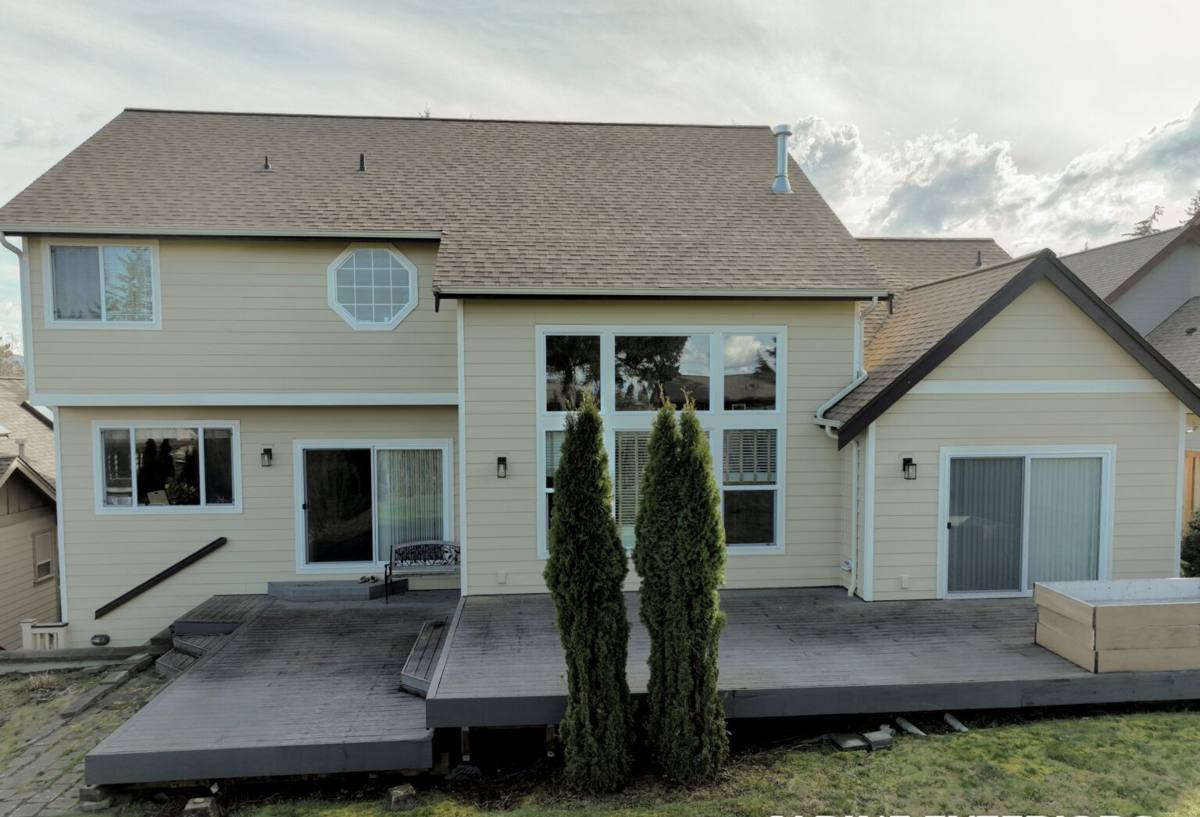
What Everson's Climate Does to a Deck Surface
Moisture-Heavy Air, Even This Far Inland
Everson doesn't take direct salt spray the way a waterfront property does, but the marine-influenced air that moves through the Nooksack valley still carries enough moisture and salt residue to matter over years of exposure. On a deck, that shows up less as visible corrosion on day one and more as a slow accumulation — fastener heads that start to weep rust stains, hardware that stiffens, and a surface that never quite dries out completely between rain events.
Driving Rain and Standing Water
Rain in this part of Whatcom County tends to come in sustained, wind-driven stretches rather than quick passing showers, and a deck without correct board gapping or substructure drainage will hold water in the seams and against the framing long after the rain stops. That's a bigger issue for decking than for siding, because a deck surface is horizontal — it can't shed water by gravity the way a wall does, so drainage has to be built into the design rather than assumed.
A Long Moss and Mildew Season
Shaded decks, decks under tree cover, and anything on the north side of a house stay damp for extended stretches in Everson, and that's exactly the condition moss and mildew need to take hold. Once moss establishes itself on a deck surface, it's not just unsightly — it holds moisture against the board and makes the surface slick and unsafe underfoot, which is a real concern on stairs and around railings.
Why Composite Makes Sense for This Climate
Composite decking pairs wood fiber with plastic, and on capped boards, that plastic forms a protective shell around the entire board rather than just coating the surface. That construction matters directly in Everson's conditions: a capped composite board doesn't absorb moisture the way raw wood does, doesn't need annual sealing or staining, and resists the surface staining and fading that constant damp and UV exposure cause over time. It's not a maintenance-free material — nothing outside truly is — but it shifts the upkeep from a seasonal chore to an occasional wash.
Not all composite is built the same, and the difference matters more here than in a drier climate:
| Composite Type | Moisture Resistance | Moss & Staining Resistance | Long-Term Upkeep |
|---|---|---|---|
| Capped composite (cap on all sides) | Excellent — moisture can't reach the wood-fiber core | Strong; smoother, less porous surface | Occasional washing |
| Capped composite (top and sides only) | Good — exposed board ends and cut edges need attention | Good on most product lines | Occasional washing, sealed cut ends |
| Uncapped composite | Moderate — wood fiber can absorb moisture at any exposed surface | Fair; more prone to buildup over time | Periodic cleaning, more frequent inspection |
For most Everson homes, a fully capped composite board is the right default. Where a homeowner wants a different look or budget fits differently, we'll walk through the honest trade-offs rather than defaulting to the highest-margin option.
What a Correctly Built Composite Deck Involves
The composite boards get the attention, but in this climate, what's underneath and holding it together determines whether the deck actually lasts. A build done right here includes:
- Pressure-treated framing lumber rated for ground contact where applicable, sized correctly for the span and expected load
- Corrosion-resistant fasteners and hardware throughout — standard hardware starts showing rust bleed within a few seasons in this air, even set back from the water
- Hidden fastener systems on the composite surface itself, where the product line supports it, keeping exposed metal off the walking surface
- Correct board spacing for drainage and thermal movement, so composite can expand and contract with temperature without buckling or gapping wrong
- Properly flashed ledger board connection where the deck ties into the house — one of the most common places water gets into framing on a poorly built deck
- Joist spacing matched to the specific composite product's span rating, since composite generally needs tighter joist spacing than dimensional lumber decking
- Sealed or capped cut ends on any board where the factory cap gets cut through during installation
- Grading and airflow underneath the deck so moisture doesn't sit against the framing between storms
A deck missing any of those still looks fine when it's finished. The problems — a soft joist, a loosening railing post, fastener staining bleeding into the boards — tend to show up a couple of wet seasons later, once it's a repair instead of a detail.
Design Considerations for Everson Properties
Beyond material and framing, a few site-specific questions come up on most Everson decks. Shade and tree cover affect which composite color and finish will resist moss best, since a heavily shaded deck needs a different moss-resistance priority than one that gets consistent sun. Proximity to the river valley's low-lying, damp ground can affect how much clearance and airflow the substructure needs underneath. And how the deck ties into existing grading and drainage around the house matters just as much as the deck itself — a deck built well on top of poor site drainage will still have moisture problems, just delayed a season or two.
How Our Process Works
We start with a site visit — looking at existing structure condition if it's a replacement, grade and drainage around the deck footprint, sun and shade exposure through the day, and how the space connects to the house. From there we go through composite product options that fit the budget and how the deck will actually get used, whether that's a small platform off a kitchen door or a larger deck built for entertaining.
Permitting for decks in Everson and the rest of Whatcom County generally follows standard setback, structural, and in some cases elevation requirements depending on the site, and we handle that as part of the job. Once permitted, we build the substructure and framing first, sized and fastened for what the site actually needs, then install the composite decking, railing, and any stairs or trim. We finish with a walkthrough covering exactly what the composite product you chose needs going forward — which is minimal, but not nothing.
What to Have Ready Before an Estimate
- A rough idea of size and location — attached to the house, freestanding, or replacing an existing structure
- Any known issues with the current deck if this is a replacement (soft spots, railing movement, drainage problems)
- A general sense of budget range, so we can steer product recommendations toward what actually fits
- How the space will be used day to day — that shapes railing style, stair placement, and layout more than most homeowners expect
What Your Composite Deck Still Needs From You
Composite cuts the maintenance burden significantly compared to wood, but it isn't zero-maintenance. A short list worth keeping in mind:
- Rinse or wash the surface periodically to clear pollen, organic debris, and the residue that settles out of damp Whatcom County air
- Keep the gaps between boards clear of leaves and debris so water and airflow can move through as designed
- Check railing hardware and fasteners once a year, particularly heading into the wet season, for early corrosion or loosening
- Trim back overhanging branches or plants holding moisture against the deck or blocking sun and airflow
- Address any soft framing, standing water, or drainage issues underneath right away — that's structural, not cosmetic, and it doesn't wait
Why It Matters That We Already Work Everson
A crew that mostly builds decks in a drier region can still assemble one competently, but an Everson job carries specifics that don't come up everywhere — moisture-heavy air moving up the Nooksack valley from the coast, sustained wind-driven rain rather than short showers, and a moss season long enough to test any decking material that isn't suited to it. Working this part of Whatcom County regularly means we already know which composite lines actually hold up to those conditions and which framing and fastener details are worth the extra attention rather than an unnecessary upsell.
That familiarity shows up in the judgment calls homeowners don't usually see — how to orient a deck for the shade a particular lot actually gets, or being straightforward about what a deck here realistically needs to last versus what's just an extra line item on an invoice.
Get a Straight Answer About Your Deck
Whether you're replacing a tired deck, building new, or want an honest read on what composite decking would take on your Everson property, we're happy to walk the site with you and lay out the options plainly. Reach out below for a free, no-pressure estimate.