 Lynden Siding
 Siding Installation for Blaine Homes: Why the Process Matters as Much as the Material
Blaine sits at the edge of Whatcom County, close enough to the water that salt air, driving rain, and a long moss season shape almost every exterior decision a homeowner makes here. Picking a good siding product is only half the equation. How that product goes onto the wall — the flashing details, the fastener spacing, the sequencing of the weather barrier — determines whether it performs the way the manufacturer intended or starts letting moisture in behind the cladding within a few wet seasons. We're based in Lynden, and Blaine is regular territory for our crew, not an occasional stop between jobs elsewhere in the county.
This page is specifically about siding installation for Blaine homes: what the local climate demands, what a correct job actually involves step by step, and why the installation process itself is where most siding failures actually start. We install James Hardie fiber cement exclusively. That's a professional standard we hold to, not a sales pitch, and it shapes every recommendation below.
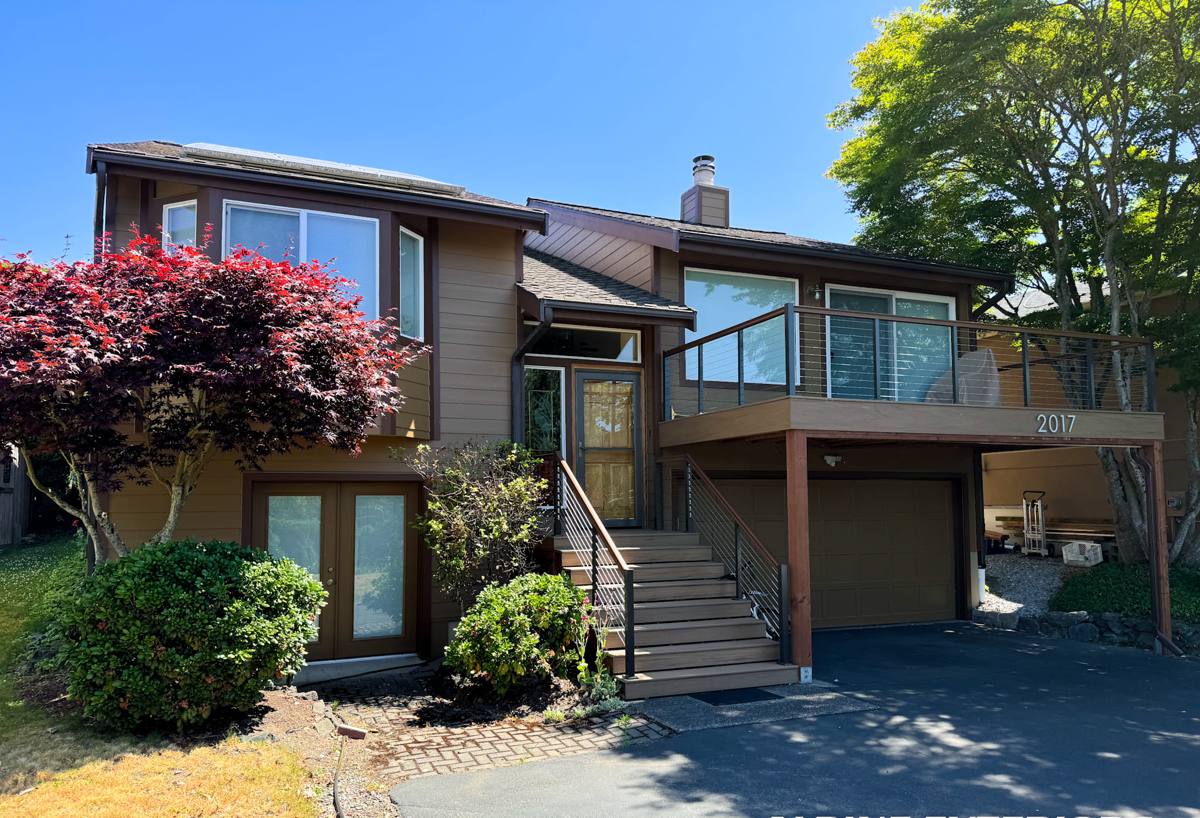
What Blaine's Climate Requires From a Siding Installation
Salt Air Off the Water
Homes anywhere near Semiahmoo Bay or Drayton Harbor take on a steady dose of salt-laden air, and that air is hard on fasteners, flashing, and any exposed metal trim over time. An installation that uses the wrong fastener grade, or leaves cut edges and metal connections under-protected, gives corrosion a head start it wouldn't get twenty miles inland. Fastener and flashing material selection matters more in Blaine than in most of the rest of the county.
Driving Rain, Not Just Rain
Storms coming off the water rarely fall straight down. Wind pushes rain sideways into siding joints, window flashing, and the transitions where a roof meets a wall — the exact places where a rushed installation leaves gaps. A siding product rated for wet climates on paper still fails if the crew installing it didn't seal and flash those transitions correctly, because the water finds the installation's mistakes, not the material's.
A Long Moss Season
Mild, damp conditions keep moss and mildew active on shaded and north-facing walls for much of the year in Blaine, and tree-covered lots see it worst. Installation choices affect this directly — proper clearance above grade and rooflines, correct panel gapping, and a weather barrier that lets a wall dry rather than trapping moisture against the sheathing all reduce how much of a foothold moss and mildew get.
What a Correctly Installed Siding Job Actually Includes
"Correct installation" isn't a marketing phrase — it's a specific, checkable sequence of steps. Skipping or rushing any one of them is usually invisible the day the job finishes and expensive two or three winters later.
Tear-Off and Substrate Inspection
Old siding has to come off before anyone can see what's actually happening at the sheathing. We check for rot, soft spots, and hidden moisture damage before anything new goes up. Covering a compromised substrate with fresh siding doesn't fix the problem — it just hides it behind a new wall for a few more years.
Weather-Resistive Barrier and Flashing
This is the layer that does the real work of keeping water out of the wall assembly, and it's also the layer that's impossible to inspect once the siding is up. House wrap has to be lapped correctly, window and door openings need proper flashing, and every penetration — vents, hose bibs, light fixtures — needs to be sealed as part of the system, not patched around afterward.
Fastening and Clearances to Manufacturer Spec
James Hardie's warranty is conditional on installation following their published specifications: fastener type and spacing, minimum clearance above grade, roofline, and other siding, and proper handling of factory-cut versus field-cut edges. We treat that spec as the baseline for every job, not as an upgrade option.
Trim, Joints, and Caulking
Butt joints, corner boards, and trim transitions are where a lot of water intrusion actually starts if they're rushed. Correct joint treatment — proper backer material, the right sealant for a fiber cement product, and attention to how panels are staggered — keeps those seams from becoming entry points over the life of the siding.
Why We Install Only James Hardie Fiber Cement
We narrowed our siding offering to one system after seeing, on jobs across this part of the county, what actually holds up in sustained coastal exposure versus what performs well on a spec sheet and struggles a few winters into real use.
- Non-combustible core: Fiber cement doesn't feed a fire the way wood-based siding products can.
- Factory-applied ColorPlus finish: Baked on under controlled conditions rather than field-applied, holding color and adhesion longer under salt air and UV exposure.
- Climate-engineered HZ5 formulation: Built for regions with significant moisture and freeze-thaw cycling — a good match for Blaine's coastal conditions.
- Dimensional stability: Fiber cement doesn't swell, cup, or warp the way engineered wood siding can after repeated wetting cycles.
- A strong transferable warranty: Backed provided the installation follows Hardie's published specifications — which is exactly why the installation process matters as much as the product choice.
We don't install LP SmartSide, vinyl siding, Cemplank, Allura, primed spruce, or cedar. Each has its place in the broader market. Our position is specific to this climate: we'd rather install one system correctly, every time, than offer a lower-cost alternative that shifts maintenance risk onto the homeowner down the road.
| Product | Installation-related trade-off in Blaine's climate |
|---|---|
| Vinyl siding | Panel seams and expansion gaps give wind-driven rain more entry points; can warp under sustained UV and salt-air exposure |
| LP SmartSide / engineered wood | Wood-strand core is more sensitive at cut edges and fastener points, making correct field-sealing more critical and less forgiving of shortcuts |
| Primed spruce or cedar | Needs ongoing paint and moisture maintenance after installation to avoid rot; salt air shortens the repaint cycle |
| Other fiber cement brands | May lack a climate-specific HZ formulation or the same factory-finish warranty depth as James Hardie |
Our Installation Process, Step by Step
- Inspection and estimate: We look at current siding condition, sheathing exposure once removed, and how sun and wind exposure vary across the home's walls before pricing the job.
- Tear-off: Old siding comes off and the substrate gets a full inspection before anything new is planned around it.
- Substrate repair: Any rot or soft sheathing gets addressed before the weather barrier goes on — this step isn't optional or skipped to save time.
- Weather barrier and flashing: House wrap, window flashing, and penetration seals go in as a complete system, with extra attention on water-facing walls.
- Installation to spec: Panels go up with correct fastener spacing and clearances, following James Hardie's published installation requirements.
- Trim and joint finishing: Corner boards, butt joints, and caulking get finished with materials rated for fiber cement.
- Final walkthrough: We walk the completed job with the homeowner and cover maintenance expectations specific to a coastal property.
Installation Mistakes That Shorten a Siding Job's Life in Blaine's Climate
Most premature siding failures we see trace back to the installation, not the material. A homeowner evaluating a bid — from us or anyone else — should watch for these:
- House wrap installed without proper lapping, leaving gaps at seams
- Window and door flashing skipped or done out of the correct sequence
- Siding installed with too little clearance above grade, roofline, or decking
- Fasteners driven too tight or too loose, or the wrong fastener type used for the substrate
- Butt joints and corners caulked with a sealant not rated for fiber cement
- New siding installed directly over damaged or unrepaired sheathing
- No documented adherence to the manufacturer's published installation spec
What Affects the Cost of a Blaine Siding Installation
Every estimate is specific to the house, but a few factors consistently move the number: total square footage and number of stories, how much trim and detail work surrounds windows and rooflines, the condition of the sheathing once old siding comes off, how exposed the home is to wind and water, and which James Hardie product line and color fit the house. We walk through these factors directly during the estimate rather than handing over a flat per-square-foot number with no explanation.
| Cost factor | Why it matters |
|---|---|
| Home size and stories | More square footage and taller walls mean more material, labor, and access equipment |
| Trim and detail complexity | Homes with more windows, dormers, and architectural trim take more time to flash and finish correctly |
| Sheathing condition | Rot or moisture damage found during tear-off adds repair work before new siding can go on |
| Wind and water exposure | Homes closer to open water often need more careful flashing attention on exposed walls |
| Product line and color | James Hardie offers multiple plank profiles, textures, and ColorPlus options at different price points |
Why Hiring a Crew That Already Works in Blaine Matters
An installation crew that works this part of Whatcom County regularly makes different decisions than one seeing a coastal property for the first time — which walls stay wet longest given the wind off the water, where extra flashing attention actually earns its keep, and which shortcuts that might pass unnoticed inland will show up fast on a home this close to the coast. It also means that if a warranty or maintenance question comes up years later, it's a call to a crew still working in the area, not one that's moved on.
If your Blaine home needs new siding, or you'd like our team to look at the current installation before deciding whether replacement is really necessary, we're glad to come take a look. Reach out using the form below for a straightforward, no-pressure estimate.