 Lynden Siding
 Blaine's Climate Asks More of Siding Than Most Homes Get
Blaine sits at the northern edge of Whatcom County, wrapped by Drayton Harbor, Semiahmoo Bay, and the open water of the Strait of Georgia. That location is a big part of why homes here weather differently than homes even a few miles inland in Lynden. Marine air carries salt, wind off the water drives rain sideways into wall assemblies, and the combination of shade, moisture, and mild temperatures keeps moss and algae active for most of the year. None of that is unusual for a Pacific Northwest coastal town — but it does mean siding that performs fine in a drier or more sheltered spot can fail early here.
Fiber cement siding, installed correctly, is one of the few exterior claddings that holds up to that combination of salt exposure, wind-driven rain, and constant damp without becoming a maintenance project every couple of years. This page covers what Blaine's climate actually does to siding, what a correct fiber cement installation looks like in this environment, and why we install James Hardie products exclusively rather than offering a menu of cheaper alternatives.
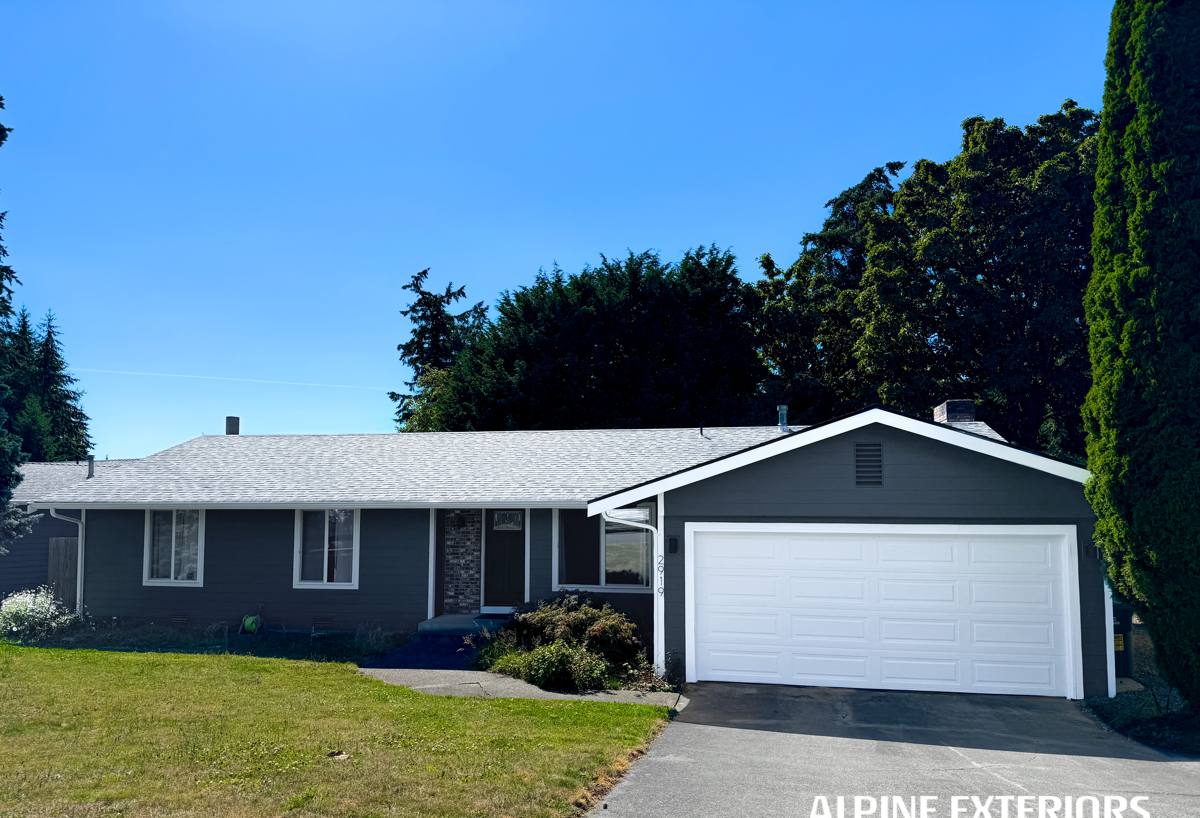
What Salt Air and Driving Rain Actually Do to a House
Salt Air
Airborne salt from the Strait and the harbor settles on every exterior surface, including fasteners, flashing, and trim. Over time it accelerates corrosion in anything not rated for coastal exposure — this is why fastener choice and flashing material matter as much as the siding panel itself in a town like Blaine.
Driving Rain
Wind off the water doesn't just add volume to a storm, it changes the angle rain hits the wall. Rain that would run harmlessly down a sheltered wall gets forced sideways and upward into laps, seams, and penetrations. Siding systems that rely on tight caulk joints instead of proper drainage planes tend to show water intrusion first at these pressure points.
Moss and Algae Season
Northern Whatcom County's mild, wet winters and shaded, damp shoulder seasons give moss and algae a long window to establish on north-facing walls, under eaves, and anywhere airflow is limited. Siding that stays damp longer — because it absorbs moisture or dries slowly — feeds that growth instead of resisting it.
Why We Install Only James Hardie Fiber Cement
We don't offer vinyl, LP SmartSide, Cemplank, Allura, primed spruce, or cedar as options on Blaine homes. That's not a marketing position — it's a standard we hold because we've seen what each of those materials does over time in this exact climate, and because we don't want to be back at a homeowner's door in five years explaining why the siding we installed is failing.
- Non-combustible core: Hardie's fiber cement composition doesn't feed a fire the way wood-based or wood-fiber composite sidings can, which matters more with wildfire smoke seasons becoming a regular late-summer occurrence in the Northwest.
- Climate-engineered HZ product lines: Hardie manufactures different formulations for different regions. HZ5 is engineered for cold, wet climates like Whatcom County — it resists moisture absorption and freeze-thaw stress better than a one-size-fits-all product.
- ColorPlus factory finish: The color is baked on at the factory under controlled conditions, not brushed on at the jobsite. That finish resists fading and holds up to UV and salt air far longer than field-applied paint.
- Warranty structure: Hardie backs its siding with a strong, transferable warranty — a real consideration for resale in a coastal market where buyers ask pointed questions about exterior condition.
We're not going to tell you competing products are junk — vinyl is inexpensive and low-maintenance in the right setting, LP SmartSide has real fans among builders. But when we weigh moisture behavior, salt air durability, and long-term maintenance burden against what a Blaine home actually faces, fiber cement — and specifically Hardie's climate-engineered line — is the only material we're willing to warranty our labor against.
How Coastal-Exposure Siding Materials Compare
| Material | Salt Air Durability | Moisture Behavior | Maintenance | Typical Lifespan |
|---|---|---|---|---|
| Vinyl | Can become brittle and discolor faster near salt spray | Doesn't absorb water, but panels can warp with heat/wind stress | Low, but limited repair options if damaged | 20–30 years |
| Cedar / primed spruce | Vulnerable without diligent upkeep | Absorbs moisture; prone to rot and moss if not sealed regularly | High — repainting/staining on a recurring cycle | 15–25 years with upkeep |
| LP SmartSide | Moderate; edge sealing is critical near salt exposure | Engineered wood strand core; sensitive to unsealed cuts and edges | Moderate — edge and joint inspection needed | 25–30 years |
| James Hardie fiber cement (HZ5) | Strong; formulated for wet, coastal Pacific Northwest climates | Low absorption, dimensionally stable when wet or dry | Low — periodic washing, no repainting | 30–50 years installed to spec |
What a Correct Fiber Cement Installation Involves in Blaine
Fiber cement siding is only as good as the assembly behind it. In a high-exposure town like Blaine, the details most homeowners never see are the ones that determine whether the siding lasts three decades or leaks behind the walls in five years.
- Weather-resistive barrier and drainage plane: A properly lapped and sealed house wrap, with a drainage gap where wind-driven rain and condensation can escape rather than sit against the sheathing.
- Flashing at every penetration: Windows, doors, hose bibs, vents, and deck ledgers all need corrosion-resistant flashing detailed to shed water outward, not just caulked and hoped for.
- Correct fastener spec: Hot-dipped galvanized or stainless fasteners, driven to Hardie's specified depth and pattern — not just any nail gun setting, because salt-air corrosion punishes the wrong fastener choice fast.
- Proper clearances: Minimum gaps between siding and grade, roofing, decks, and patios so moisture doesn't wick into the bottom edge of the panels.
- Joint and butt seam treatment: Sealed or shiplap-detailed per manufacturer spec, sized for expansion, and positioned to shed rather than collect water at horizontal laps.
- Field-cut edge sealing: Any cut edge gets sealed before installation — an easy step to skip and one of the most common causes of premature failure at trim and corners.
None of this is exotic. It's just easy to skip when a crew is moving fast or hasn't installed Hardie in a wet coastal environment before. It's the difference between a job that looks right at closeout and one that actually performs for 30-plus years.
Our Process, From Estimate to Finished Siding
We start with an on-site walkthrough — checking the current siding, sheathing condition where it's exposed, trim, and flashing at windows and rooflines, since Blaine's exposure means we sometimes find moisture damage that isn't obvious from the street. From there we walk you through Hardie's plank, shingle, and panel options along with HZ5 suitability for your specific exposure, whether the home faces open water and wind or sits in a more sheltered spot.
Once you approve a scope, we handle removal of the old siding, repair of any damaged sheathing or framing we find underneath, a correctly detailed house wrap and flashing package, and the Hardie installation itself to manufacturer spec — not a shortcut version of it. We pull the required permits and keep you updated as the job moves, and we walk the finished exterior with you before we call it done.
Ongoing Maintenance: What Blaine Homeowners Should Actually Do
Fiber cement is low-maintenance, not no-maintenance. In a salt-air, high-moss environment, a little seasonal attention keeps a correctly installed system performing for decades.
- Rinse siding with a garden hose (not a pressure washer aimed directly at seams) once or twice a year to clear salt residue and organic buildup.
- Keep gutters clear so overflow doesn't run down the face of the siding and feed moss growth.
- Trim back vegetation and tree cover that keeps north- and shade-facing walls damp longer than the rest of the house.
- Inspect caulking at trim, window, and door joints annually and have gaps re-sealed before they become entry points for water.
- Watch for any soft spots, staining, or dark streaking at the base of walls near grade — early signs of a drainage or clearance issue, not a siding failure.
What Fiber Cement Siding Costs to Install in Blaine
Every home is different, but the factors that move the price are consistent. We'll always give you an itemized number after seeing the house — the ranges below are just to help you understand what drives cost up or down.
| Cost Factor | Why It Matters |
|---|---|
| House size and wall complexity | More square footage, dormers, and corners mean more material and labor hours |
| Existing siding removal | Tear-off and disposal of old wood, vinyl, or composite siding adds labor |
| Sheathing or framing repair | Coastal moisture damage found once old siding is off can add scope |
| Product line and profile | HZ5 formulation, plank width, and shingle vs. lap style affect material cost |
| Color and finish | Factory ColorPlus finishes vary in price by color and sheen |
| Trim and accessory scope | Corner boards, fascia, and soffit work bundled into the siding job |
Why Hiring a Crew That Already Works Blaine Matters
A crew that installs siding across a range of inland and coastal towns without adjusting for exposure will treat a Blaine home the same as a job in a sheltered inland neighborhood — same flashing details, same fastener spec, same assumptions about how fast a wall dries out. That approach doesn't hold up here. A crew that regularly works this stretch of Whatcom County knows which walls take the worst of the wind and salt, builds in the drainage and flashing detail that Blaine's exposure actually requires, and isn't guessing about how HZ5 performs once winter sets in.
If you're weighing a siding replacement or new construction siding for a home in Blaine, we're glad to walk the exterior with you, look at what your specific exposure requires, and put together a straightforward, no-pressure estimate. There's no cost and no obligation — just a clear look at what correct fiber cement siding would take for your home. Use the form below to get started.