 Lynden Siding
 Why Birch Bay Siding Wears Differently
Birch Bay sits right on the water, and that changes what "normal wear" looks like on a house. Homes a few miles inland in Whatcom County deal with the standard Pacific Northwest mix of rain and shade. Homes in Birch Bay deal with that same rain plus something inland homes mostly don't: salt-laden air moving off the water, driving straight into exposed walls during winter storms. Salt air accelerates the breakdown of paint films, corrodes fasteners and trim, and works its way into any seam or crack faster than it would a few miles east. Add a moss season that runs long on shaded and north-facing walls, and you get siding that can look tired years before its rated lifespan is up — not because the product failed, but because it was never matched to this exposure in the first place.
We install siding across Whatcom County, and Birch Bay jobs get planned differently from the start because of that combination: salt exposure, wind-driven rain, and moss. A replacement done right here has to account for all three, not just the ones a generic install checklist covers.
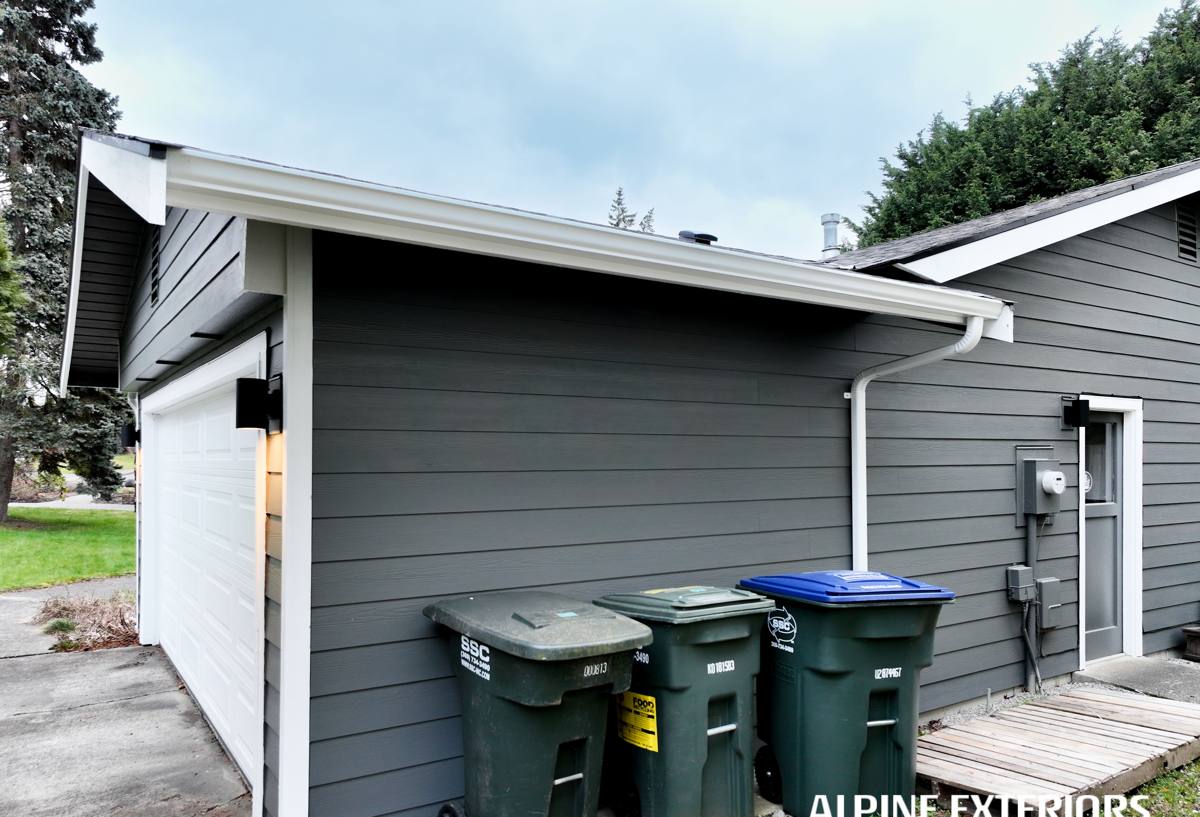
Signs a Birch Bay Home Needs Siding Replacement, Not Another Repair
Coastal exposure doesn't always show itself as obvious damage. Sometimes it's subtle — a soft spot near the bottom of a wall, paint that won't hold no matter how often it's redone, trim that's rusting at the nail heads. Here's what tells us a wall section (or the whole house) is past the point of patching:
- Soft, spongy, or crumbling siding near the bottom edges, corners, or below windows — usually a sign moisture has been getting behind the material for a while
- Paint that fails within a year or two of repainting, especially on walls that face the water or catch prevailing wind
- Visible rust streaks running down from nail heads or trim fasteners
- Persistent moss or black-green staining that comes back within a season of cleaning, especially on shaded or north-facing walls
- Warping, cupping, or separated seams — common on wood and engineered wood products that have absorbed repeated moisture cycles
- Visible gaps at trim, corners, or window edges where caulking has dried out and pulled away
- An interior wall or ceiling near an exterior wall that shows staining, which often means the siding failure is no longer just cosmetic
What a Correct Siding Replacement Actually Involves
Full tear-off and a real look at what's underneath
A siding replacement that's worth doing starts with taking the old material all the way off, not just capping over it. That's the only way to actually see the sheathing, framing, and any rot or moisture damage that's been hiding behind failing siding — which is common on Birch Bay homes that have taken years of driving rain against certain walls. Any soft or damaged sheathing gets addressed before anything new goes up. Covering over a problem with new siding just hides it for a few more years.
Weather-resistive barrier and flashing done right
The siding itself is the visible layer, but the water-resistive barrier and flashing details underneath are what actually keep a coastal home dry. Every window, door, and penetration needs flashing that sheds water outward and down, lapped correctly so wind-driven rain can't work its way behind the assembly. This is the part of the job that doesn't show up in a driveway photo but is the difference between siding that lasts and siding that fails from the inside out.
Fastening built for wind exposure
Homes closer to open water take more direct wind load than homes tucked inland. Fastener spacing and type matter more here — under-fastened siding can work loose over time in a way that's rarely a problem a few miles inland. We follow manufacturer fastening specs for the exposure category the home is actually in, not a generic pattern.
Why We Install Only James Hardie Fiber Cement
We made a decision a while back to stop installing several common siding products — vinyl, LP SmartSide, primed wood, cedar, and other fiber cement brands — and install James Hardie exclusively. That's not a marketing position; it's a response to what we kept seeing on coastal and near-coastal homes specifically.
Vinyl softens and can distort with sustained heat and UV, and its seams and J-channels give salt-laden wind-driven rain more opportunities to find a way behind the cladding. Engineered wood products like LP SmartSide perform well in many climates but rely on an intact factory coating to keep moisture out — any breach in that coating, which is more likely where salt air accelerates wear, exposes the wood substrate underneath. Primed wood and cedar require an ongoing maintenance commitment — regular repainting or staining — that most homeowners underestimate, and coastal exposure shortens the interval between those maintenance cycles.
James Hardie fiber cement is non-combustible, doesn't rot, and its ColorPlus factory-applied finish is baked on in a controlled environment rather than field-applied, which gives it better long-term adhesion and color retention than a job-site paint job — a real advantage on walls that take direct salt spray. It's also backed by a strong transferable warranty, which matters for homes that may change hands down the road. That combination is why it's the only product we put on homes, in Birch Bay or anywhere else we work.
Matching the Product to the Exposure
James Hardie makes several siding profiles and, more importantly for this area, engineers its products by climate zone (HZ5, HZ10) to account for regional moisture and temperature conditions. For a water-facing or wind-exposed home in Birch Bay, we look at wall-by-wall exposure — not just the house as a whole — when deciding on profile and detailing.
| Factor | Why it matters in Birch Bay |
|---|---|
| Lap siding vs. panel systems | Lap profiles shed water well on most walls; panel systems with battens can perform better on walls with heavy direct wind-driven rain |
| ColorPlus factory finish | Baked-on finish holds up to salt exposure and UV far longer than a field-applied paint coat, reducing repaint cycles |
| Trim and fastener material | Corrosion-resistant fasteners and trim details matter more near open water than a few miles inland |
| Caulking and sealant joints | Fewer, better-detailed joints reduce the number of places wind-driven rain can intrude |
Moss, Algae, and the Long Wet Season
Birch Bay's combination of shade, moisture, and a long damp stretch of the year gives moss and algae plenty of time to establish on siding, trim, and roof lines. Moss holds moisture against the surface it's growing on, which is a problem for any siding material but especially for ones that can absorb water. James Hardie fiber cement doesn't provide the organic material moss and algae feed on the way wood-based products can, and its factory finish resists staining better over time. It's not moss-proof — nothing fully is in this climate — but it doesn't create the same long-term maintenance spiral that wood and engineered wood products can on shaded, north-facing walls near water.
We also pay attention to how a home's landscaping and orientation affect airflow and drying time on shaded walls, since that's often a bigger factor in moss return than the siding material alone.
Our Process for a Birch Bay Replacement
- On-site assessment of every wall, with particular attention to water-facing and wind-exposed sides
- Written estimate covering tear-off, sheathing repair allowances, product line, color, and trim
- Full tear-off and inspection of sheathing and framing before anything new is installed
- Weather-resistive barrier and flashing installed at every window, door, and penetration
- James Hardie siding installed to manufacturer fastening specs for the home's actual wind exposure
- Final walkthrough covering caulking, trim, and touch-up before we consider the job done
Why Hiring a Crew That Already Works Birch Bay Matters
Siding installation isn't one-size-fits-all, and a crew that mostly works inland neighborhoods doesn't always think about fastening schedules, flashing detail, or moss-prone wall orientation the way a crew that regularly works Whatcom County's coastal communities does. We've seen what happens on this stretch of coastline when siding is installed to a generic spec instead of the actual exposure the home faces — and it usually shows up as a callback a few years sooner than it should.
Working this area regularly also means we're familiar with the permitting expectations in Whatcom County and can plan a job around this region's weather windows, so tear-off and dry-in happen when the forecast actually cooperates rather than leaving a home open to the weather longer than necessary.
What Affects the Cost of a Birch Bay Siding Replacement
Every home is different, so we don't quote pricing without seeing the house, but these are the factors that most often move a project's cost up or down:
| Factor | How it affects cost |
|---|---|
| Amount of sheathing or framing repair needed | Hidden moisture damage found during tear-off is the most common source of change orders |
| Home size and wall complexity | More corners, dormers, and trim detail add labor time |
| Siding profile and finish selection | Panel systems and premium ColorPlus finishes vary in material cost |
| Current siding removal difficulty | Multiple layers of old siding or extensive fastening add tear-off time |
| Access and site conditions | Waterfront lots, slopes, or limited equipment access can affect labor and staging |
We'd rather walk a home and give a real number than guess at one here — broad ranges without seeing the actual wall conditions tend to be more misleading than helpful.
If your Birch Bay home's siding is past patching, or you just want an honest read on how much life is left in what's there, we're happy to take a look. The estimate is free, there's no pressure, and you'll get a straight answer about what your home actually needs — just fill out the form below.