 Lynden Siding
 Why Metal Roofing Makes Sense for Abbotsford Homes
Abbotsford sits in the Fraser Valley, and if you've owned a home here for more than a season or two, you already know what the roof puts up with. Rain that doesn't just fall but drives sideways off the valley winds. Air carrying enough moisture and salt off the coast to work into anything with a seam or a fastener. And a moss season that, realistically, runs most of the year in the shaded and north-facing sections of a roof. Asphalt shingles can be made to work here, but they're fighting the climate the whole time. Metal roofing, installed correctly, works with it instead.
We install metal roofing for homeowners in Abbotsford and the surrounding communities along the Lynden-Abbotsford corridor, and the reason we push it as an option in this specific area isn't brand loyalty — it's that the material's strengths line up almost exactly with what this climate demands: shedding water fast, resisting moss colonization, and holding up to decades of wet-dry-wet cycling without the granule loss and mat degradation that eventually catches up with asphalt.
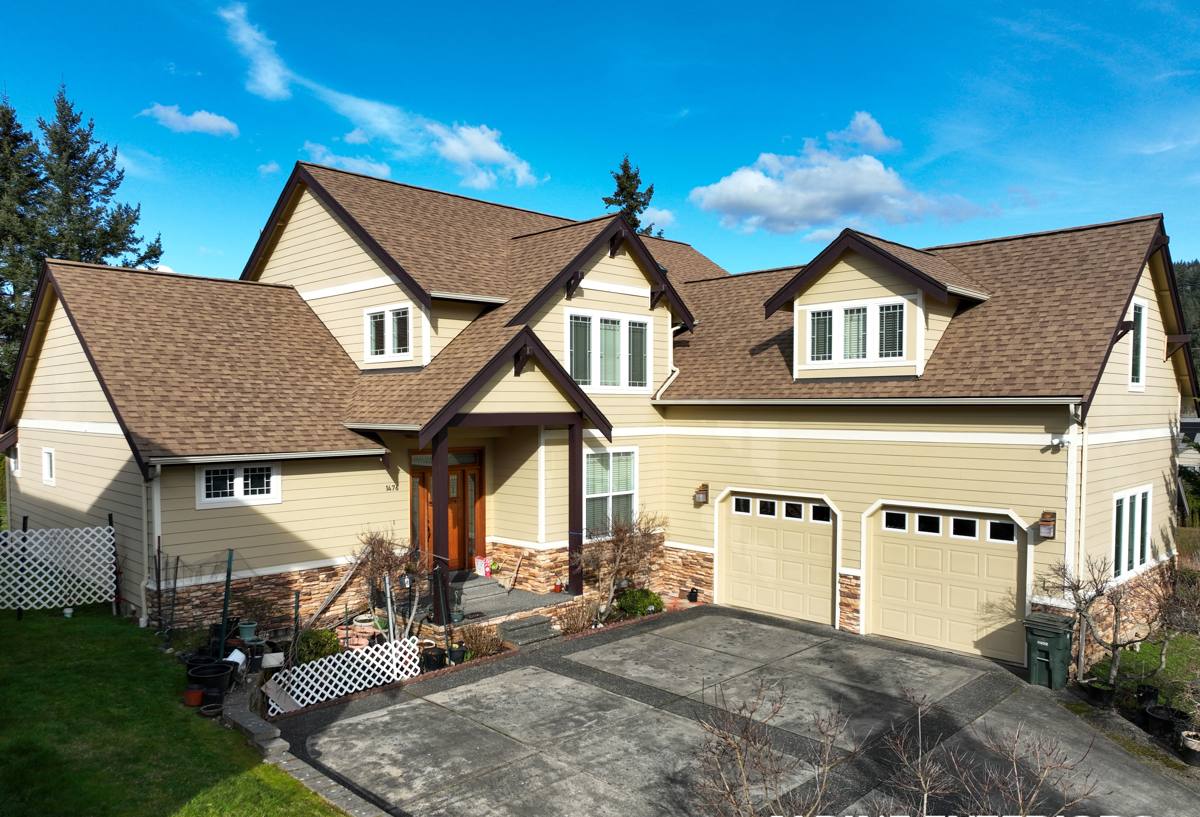
What Driving Rain and Moss Season Actually Do to a Roof
It helps to be specific about the failure modes we see, because they explain every decision that goes into a correct metal roof install here.
Wind-driven rain
Rain that comes in at an angle doesn't behave like rain falling straight down. It gets pushed up under shingle tabs, into exposed fastener heads, and along any horizontal seam that isn't properly lapped. On a standard shingle roof, this is one of the more common causes of slow leaks that show up as ceiling stains months after the storm that caused them.
Moss and organic growth
Moss doesn't just sit on a roof — it holds moisture against the surface, works its rhizoids into shingle granules and mat, and lifts edges as it grows. On shaded slopes, north-facing sections, and anywhere debris collects, moss can take hold within a couple of years of a new asphalt install. Removing it later often does more damage than the moss itself, because scraping pulls granules and roughens the surface, accelerating the next round of growth.
Salt-influenced air and metal fatigue
Salt in the air accelerates corrosion on any exposed metal — flashing, fasteners, vents — that isn't rated for it. This is one of the areas where a lot of roofs get shortchanged: the field material might be fine, but cheap flashing or exposed carbon-steel fasteners fail years before the rest of the system, and that's usually where the leak starts.
How a Correctly Installed Metal Roof Handles This Climate
A metal roof earns its reputation for durability only if it's installed to account for the conditions it'll actually face. There's a real difference between a metal roof that's built for this valley and one that was installed the same way it would be in a dry climate.
Underlayment and ice/water protection
We use a synthetic underlayment rated for high-moisture climates across the full deck, with self-adhering ice-and-water membrane at eaves, valleys, and any low-slope transition — the areas where wind-driven rain is most likely to get pushed backward under the panels.
Fastening and sealants matched to the coast
Fasteners and flashing need to be corrosion-resistant, not just paint-matched to the panel color. We spec fastener systems and sealants rated for coastal and marine-influenced exposure rather than the cheaper interior-climate hardware that shows rust streaks within a few years.
Panel seams and laps
How panels overlap and how seams are sealed or mechanically locked matters more here than in a drier region. Standing seam systems with mechanically locked seams handle driving rain better than exposed-fastener panels because there's no exposed penetration for water to find under wind pressure.
Ventilation
A roof deck that can't breathe traps moisture underneath the metal, which leads to condensation, deck rot, and mold — regardless of how good the roofing material is. Proper ridge and soffit ventilation is part of every install, not an upsell.
Choosing the Right Metal Roofing System
"Metal roofing" covers a range of products, and the right one depends on your roof's slope, your budget, and how much you want the roof to visually read as "metal" versus blend in with a more traditional look.
| System | How It Sheds Water | Best For | Trade-offs |
|---|---|---|---|
| Standing seam | Mechanically locked raised seams, no exposed fasteners on the field | Steeper slopes, coastal-exposed homes, long-term low maintenance | Higher upfront cost, requires experienced crew for correct seaming |
| Exposed-fastener panel | Fasteners with rubber washers driven through the panel face | Budget-conscious projects, outbuildings, lower-exposure roofs | Washers degrade over time and need periodic inspection/replacement |
| Metal shingle/shake profile | Interlocking panels styled to mimic shingle or shake | Homeowners who want a traditional look with metal durability | More seams per square foot than standing seam; installation quality matters more |
For most homes in Abbotsford with any real exposure to driving rain — especially on lower-slope sections or valleys where water concentrates — we lean toward standing seam. It's not the right call for every budget or every roof, and we'll tell you honestly if an exposed-fastener system is a reasonable fit for your situation rather than upselling a system your roof doesn't need.
Our Installation Process
The steps themselves aren't unusual for the trade, but the sequencing and attention to detail at each stage are where climate-appropriate installs are won or lost.
- On-site assessment. We look at slope, existing deck condition, ventilation, valleys, and any chronic problem areas — moss buildup, past leak history, shaded sections.
- Deck evaluation and repair. Any soft, rotted, or moisture-damaged decking gets replaced before anything goes down over it. Installing over a compromised deck just hides a problem, it doesn't fix it.
- Underlayment and ice/water membrane. Full synthetic underlayment with membrane reinforcement at eaves, valleys, and penetrations.
- Flashing at all penetrations and transitions. Vents, chimneys, skylights, and wall intersections get corrosion-rated flashing, correctly lapped — this is the single most common source of leaks on any roof, metal or otherwise.
- Panel installation. Panels are run, seamed, and fastened to spec, with attention to how each course laps the one below it against prevailing wind and rain direction.
- Ventilation tie-in. Ridge and soffit ventilation is confirmed functional and properly integrated with the new roofing.
- Final walkthrough. We go over the finished roof with you, including what routine maintenance to expect and what's covered under warranty.
Maintenance in a Moss-Heavy Climate
A metal roof needs far less maintenance than asphalt, but "far less" isn't "none" — especially in a valley where moss and organic debris are a year-round factor.
- Clear gutters and valleys of leaves and debris at least twice a year, more often near mature trees
- Rinse or gently brush off moss growth before it establishes a foothold, rather than waiting until it's thick enough to hold water
- Check flashing and sealant at penetrations annually, since these age faster than the panel field
- Trim overhanging branches to reduce shade and debris buildup on north-facing slopes
- Watch for any fastener or washer degradation on exposed-fastener systems, and address it before it becomes a leak
Because metal doesn't have the porous surface that granulated shingles do, moss has a much harder time getting a grip in the first place — but the roof still lives outside in a wet climate, so periodic attention keeps it performing the way it should for decades.
What Drives the Cost
Metal roofing costs more upfront than asphalt, and the honest answer to "what will this cost" depends on several factors specific to your roof and this region.
| Factor | Why It Matters Here |
|---|---|
| Panel system chosen | Standing seam runs higher than exposed-fastener panel due to material and labor for seaming |
| Roof complexity | Valleys, dormers, and penetrations all need additional flashing work — more common on older Fraser Valley homes with varied rooflines |
| Deck condition | Moisture-damaged decking found during tear-off adds repair cost but prevents a problem being sealed under the new roof |
| Hardware spec | Corrosion-rated fasteners and flashing cost more than standard hardware but are not optional in this climate |
| Ventilation upgrades | Homes with inadequate existing ventilation may need ridge or soffit work added to the scope |
We'll walk your roof, give you a real number based on your actual conditions, and explain what's driving the cost — not a rough per-square estimate that ignores the parts of your roof that actually need attention.
Why It Matters to Hire a Crew That Already Works This Area
Roofing crews that mostly work drier inland climates tend to install to a generic spec — because that's what holds up where they usually work. A roof built to a dry-climate standard, even with quality materials, can underperform here simply because the flashing detail, fastener spec, or ventilation plan wasn't built with Fraser Valley conditions in mind.
We work this corridor regularly, which means we're not guessing at how a given roofline will handle wind-driven rain, or which slopes on a typical local home tend to hold moss longest. That familiarity shows up in the small decisions — where extra membrane goes, how a valley gets flashed, how ventilation is balanced — that don't show up on a spec sheet but determine whether a roof performs for twenty years or needs attention in five.
Get an Honest Look at Your Roof
If you're weighing metal roofing for a home in Abbotsford or the surrounding area, we're happy to come take a look, walk you through what your specific roof needs, and give you a straightforward estimate — no pressure, no generic pricing. Fill out the form below and we'll set up a time.