 Lynden Siding
 Roofing Built for Abbotsford's Weather, Not Just Any Weather
Abbotsford sits in the Fraser Valley, close enough to the Salish Sea and the Fraser River corridor that homes here deal with a specific mix of punishment: salt-tinged marine air, long stretches of driving rain off the Pacific systems, and a moss season that can run from October well into April. None of that is unusual for the region, but it adds up differently on a roof than it does on siding or trim. Shingles here don't just get wet — they stay wet, cycle through freeze-thaw more than people expect for a "mild" climate, and host moss and algae growth that most manufacturers never designed their granule coatings to fully resist.
A roof that's correctly installed for Abbotsford's climate looks almost identical to one installed anywhere else — same shingle, same general layout. The difference is in details most homeowners never see: how the underlayment is lapped, how much attic ventilation is actually present, how the valleys and flashings are detailed, and whether the crew understood that this roof needs to shed water fast and dry out fast between storms. Get those details wrong and you don't see the failure for two or three years — by which point it's a deck repair, not a shingle repair.
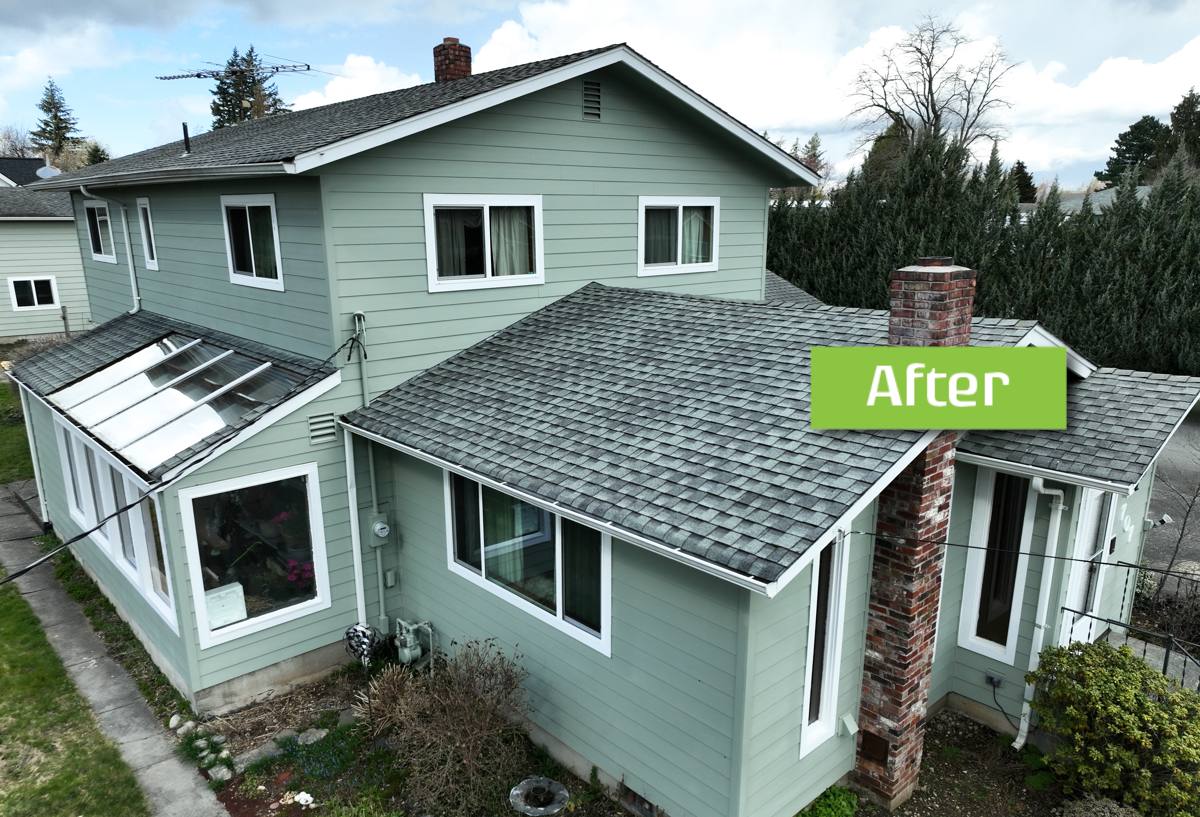
What Driving Rain and Moss Actually Do to a Shingle Roof
Driving Rain
Wind-driven rain doesn't fall straight down — it gets pushed sideways and upward under shingle tabs, through poorly sealed nail penetrations, and into any gap where flashing wasn't lapped correctly. On a well-built roof this is a non-issue because every layer is designed to shed water downhill even when it's coming in at an angle. On a roof with shortcuts — under-lapped underlayment, reused flashing, missed step-flashing at a wall intersection — driving rain is exactly the condition that finds the weak point.
Moss and Algae
Moss needs shade, moisture, and organic debris to get established, and a lot of Abbotsford properties — especially those with mature trees or north-facing slopes — offer all three for months at a time. Moss itself isn't just cosmetic: as it grows, it lifts shingle tabs, holds water against the granule surface, and works its root structure into seams. Left long enough, it accelerates granule loss and shortens the roof's effective life well below its rated years.
What a Correct Asphalt Shingle Roof Job Involves
There's a real difference between a roof that's "on" and a roof that's correctly installed. For this climate, a proper job includes:
- Full tear-off to the deck on re-roofs — layering over old shingles traps moisture and hides deck damage
- Deck inspection and repair of any soft, delaminated, or water-damaged sheathing before anything new goes down
- Ice-and-water membrane at eaves, valleys, and roof penetrations, sized for the actual exposure of the roof
- Synthetic underlayment lapped correctly, shingle-fashion, so every seam sheds water downhill
- New flashing at all walls, chimneys, skylights, and penetrations — flashing is a common corner cut, and it's usually the first thing that fails
- Balanced intake and exhaust ventilation so the attic can actually dry out between wet spells
- Correct nailing pattern and nail placement — high-nailing or under-nailing is invisible until wind gets under a tab
- Proper starter strip and drip edge at eaves and rakes, not just shingles cut down and reused as starters
Every one of those steps is standard practice — none of it is exotic. The issue is that most of it is invisible once the roof is finished, which is exactly why it gets skipped by crews working fast and cheap.
Choosing a Shingle for This Climate
Not every asphalt shingle line handles a wet, moss-prone climate the same way. The biggest practical decision is architectural (laminate) versus 3-tab, and the second is whether to pay for algae-resistant granules.
| Factor | 3-Tab Shingles | Architectural (Laminate) Shingles |
|---|---|---|
| Wind resistance | Lower rated, more tab lift risk in driving rain/wind | Higher rated, heavier construction resists lifting |
| Moss/algae resistance | Available with treated granules, but thinner profile wears faster | Typically available with algae-resistant granules and thicker wear layer |
| Expected lifespan (local conditions) | Shorter end of manufacturer range | Longer end of manufacturer range with correct ventilation |
| Upfront cost | Lower | Moderate |
We install both, but for Abbotsford's mix of moisture and moss exposure, we generally steer homeowners toward architectural shingles with algae-resistant granules unless budget makes that impractical — the extra cost tends to buy back years of service life in this specific climate. We're not chasing a particular brand name here; the deciding factors are wind rating, algae-resistant granule treatment, and a warranty structure that actually covers this region's conditions, not marketing claims.
A Note on "Cool Roof" and Reflective Granules
Some shingle lines now offer reflective or "cool roof" granule technology aimed at reducing attic heat gain. It's a reasonable feature but a secondary one here — Abbotsford's climate makes moisture management and moss resistance the priority, with reflectivity as a nice-to-have rather than the deciding factor.
Ventilation: The Part Most Roofs Get Wrong
An asphalt shingle roof doesn't fail in isolation — it fails alongside whatever's happening in the attic underneath it. Poor ventilation traps warm, moist air against the underside of the deck, which speeds up shingle aging from below and creates the exact damp, shaded conditions moss and algae thrive in from above. Balanced ventilation — intake at the soffits, exhaust at or near the ridge — lets that moisture escape instead of cycling back into the roof assembly.
This matters more in the Fraser Valley than in drier climates because there are simply more wet, low-sun days for moisture to sit and do damage. If your current roof shows moss concentrated in certain areas, uneven aging across slopes, or a musty attic smell, ventilation is often the underlying cause rather than the shingle itself.
Our Process
- On-site inspection — we look at the existing roof, deck condition where visible, attic ventilation, and any problem areas you've noticed (leaks, moss, granule loss in gutters)
- Written estimate — a clear scope covering tear-off, deck repair allowance, underlayment, flashing, shingle selection, and ventilation, so there's no guessing what's included
- Scheduling around weather — asphalt shingle installation needs a dry deck and reasonable temperatures; we plan around the forecast rather than rushing a job into rain
- Tear-off and deck prep — full removal, deck inspection, and repair of any damaged sheathing before new materials go down
- Installation — underlayment, ice-and-water membrane, flashing, shingles, and ventilation components installed to manufacturer spec
- Cleanup and walkthrough — magnetic sweep for nails, debris removal, and a final walkthrough so you know exactly what was done
Working Across the Border: What It Means for Scheduling
Abbotsford sits just across the international border from our home base in Lynden, and we treat cross-border jobs as a normal part of our service area rather than a special case. In practice that means building a little extra buffer into scheduling for border crossings and material deliveries, and coordinating permitting and inspection requirements as your municipality requires. We're upfront during the estimate about timelines so a cross-border job doesn't come with surprise delays.
Keeping a New Roof Performing: A Homeowner Checklist
Even a correctly installed roof benefits from basic seasonal attention in this climate:
- Clear gutters and downspouts before the fall rains start, so water isn't backing up under the eaves
- Trim back tree limbs that shade sections of the roof — less shade means less moss
- Have moss treated or gently removed before it establishes a thick mat, rather than after
- Check the attic once a year for signs of moisture, staining, or poor airflow
- Watch for granules collecting in gutters, which can signal a shingle nearing the end of its wear layer
- Have flashing around chimneys and skylights checked periodically — it's a common early failure point
Why Local Experience Matters
A shingle roof installed to spec in a dry inland climate and one installed to spec for Whatcom County and the Fraser Valley aren't the same job, even though the materials might look identical on a shelf. The difference is in underlayment choices, ventilation sizing, flashing detail, and shingle selection tuned to salt air, driving rain, and a moss season that doesn't really end for half the year. A crew that already works Abbotsford and the surrounding area has already made those judgment calls on other roofs and knows which shortcuts cause callbacks two winters later.
If you're weighing a repair against a full replacement, or just want an honest read on what your current roof needs, we're glad to take a look. Reach out for a free, no-pressure estimate using the form below.