 Lynden Siding
 Building Decks for Bellingham's Marine Climate
Bellingham sits close enough to the water that its weather behaves differently than towns further inland in Whatcom County. Salt-tinged air off the bay, long stretches of driving rain, and a moss season that can run most of the year all put real stress on an outdoor structure. A deck built to a generic spec sheet might look fine the day it's finished and still start showing problems within a couple of seasons — soft spots near the house, green film building up on the boards, hardware starting to streak with rust. A deck built for this specific climate holds up differently, because the material choices, fastener choices, and structural details were picked with this weather in mind from the start.
We're based in Lynden and already do siding and exterior work throughout Whatcom County, including Bellingham. That means we're not learning this climate on your project — we're applying what we already know from years of exterior work in the same air, the same rain patterns, and the same moss pressure.
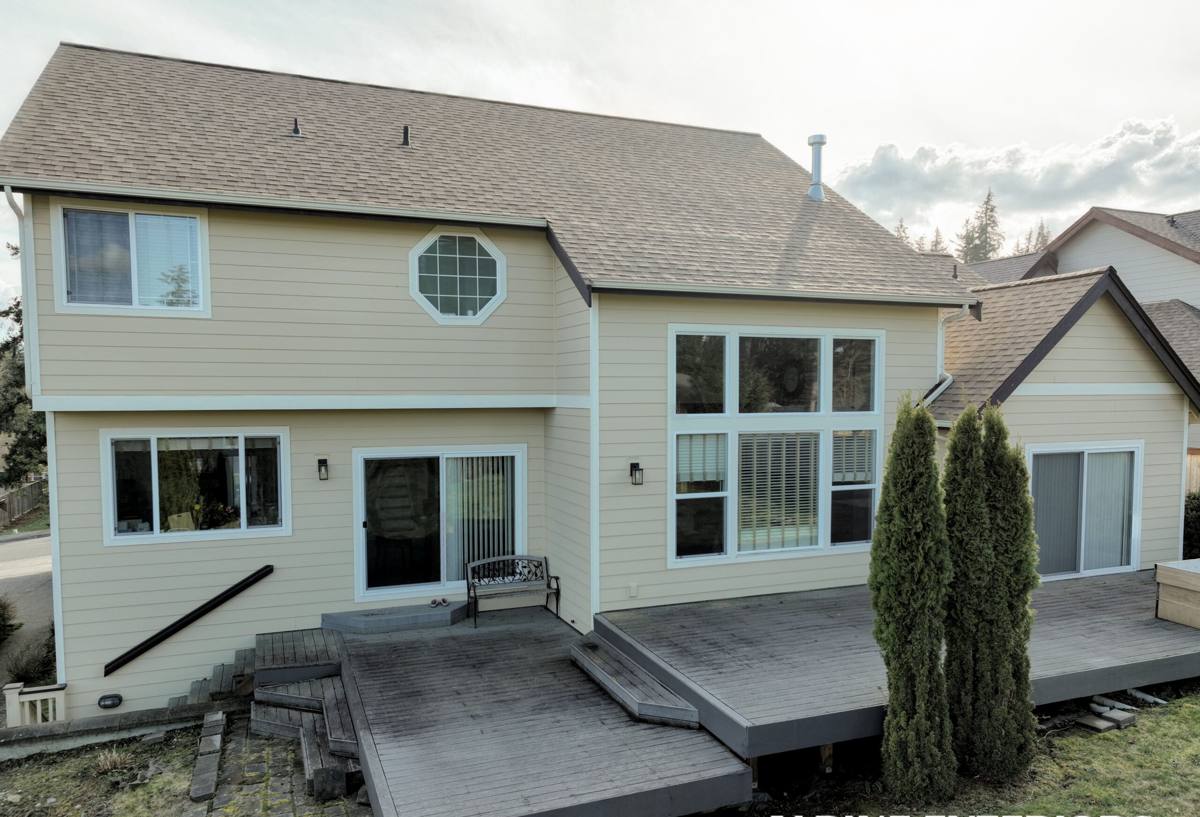
What Bellingham's Weather Does to a Deck Over Time
Salt Air and Corrosion
Proximity to the bay means a low but steady level of salt in the air, especially closer to the water and on exposed, west-facing decks. Salt air accelerates corrosion in fasteners, brackets, and any exposed metal hardware. On a deck, that's not cosmetic — corroding structural screws or joist hangers lose holding strength over time, and you usually can't see it happening until the damage is well underway.
Driving Rain and Water Intrusion
Wind-driven rain off the water doesn't fall straight down — it gets pushed sideways and up under railings, against ledger boards, and into any gap that isn't properly flashed or sealed. The single most common point of failure we see on older decks in this region is the ledger board connection where the deck meets the house. If that flashing detail is wrong, water works its way behind the siding and into the rim joist, and by the time it's visible, there's often already rot.
A Long Moss Season
Shade, moisture, and mild temperatures are exactly what moss wants, and Bellingham has all three for a large part of the year. Moss on a deck surface isn't just an appearance issue — it holds moisture against the wood or composite surface, and on stairs and walkways it becomes a real slip hazard. Decks built with poor airflow underneath, tight board spacing, or shaded, low-slope layouts tend to grow moss faster than ones built with drainage and air movement in mind.
Choosing the Right Decking Material for This Climate
There's no single "best" decking material for every situation — it depends on your budget, how much upkeep you want to do, and how exposed the deck is to sun, shade, and moisture. Here's an honest breakdown of how the common options perform in this specific climate.
| Material | Moisture & Moss Behavior | Maintenance | Typical Lifespan |
|---|---|---|---|
| Pressure-treated wood | Absorbs moisture, needs good airflow to resist moss and mildew | Annual cleaning, periodic staining/sealing | 15–25 years with upkeep |
| Cedar | Naturally moisture- and insect-resistant, but still needs sealing to hold its color and resist moss in shaded areas | Regular sealing, cleaning | 20–25 years with upkeep |
| Composite decking | Doesn't absorb water or rot, but can still grow surface moss/algae in shaded, damp spots without cleaning | Occasional washing, no staining or sealing | 25–30+ years, manufacturer-dependent |
| Capped/PVC decking | Best resistance to moisture intrusion and staining; low food source for moss on the cap surface | Occasional washing | 25–30+ years, manufacturer-dependent |
In a climate like this, we lean toward recommending composite or capped decking for surfaces that stay shaded most of the day, since they hold up better against constant moisture without the sealing schedule wood requires. That said, plenty of homeowners still prefer the look and feel of real wood, and a well-built, well-maintained wood deck can absolutely last in this climate — it just asks more of you in upkeep. We'll walk through the honest trade-offs for your specific yard, sun exposure, and budget rather than push one product across the board.
The Structural Details That Actually Matter Here
A deck's long-term performance in this climate comes down to details that aren't visible once the project is done. These are the ones we treat as non-negotiable:
- Ledger flashing — proper flashing and a water-resistant barrier where the deck attaches to the house, so driving rain can't work its way behind the siding
- Corrosion-resistant fasteners and hardware — hot-dip galvanized or stainless-rated connectors and screws, sized for the salt-air exposure common closer to the water
- Footings sized and set correctly — set deep enough and sized for the load, so the deck doesn't shift or heave with our wet winters
- Air gap and drainage under the deck — proper joist spacing and ground clearance so air can move and water doesn't pool, which slows moss and mildew buildup
- Board spacing tuned to material — gaps set correctly for whatever decking is installed, wide enough to let water and debris clear instead of trapping moisture
Skipping any one of these doesn't usually show up as a problem on day one. It shows up two, five, or ten years later, as rot at the ledger, rusted-through hardware, or a deck surface that stays slick with moss no matter how often it's cleaned. Getting these details right the first time is far cheaper than repairing them later.
Our Deck Building Process
- On-site walkthrough — we look at your yard's sun and shade pattern, drainage, existing structure (if replacing a deck), and how you actually want to use the space.
- Honest material conversation — we go over wood, composite, and capped options against your budget and how much shade the deck will sit in, without steering you toward whatever's easiest for us to install.
- Design and layout — sizing, railing style, stairs, and any built-ins are laid out before we touch a permit application or order material.
- Permitting — we handle the permit process with the appropriate local jurisdiction so the structure is inspected and up to code.
- Build — footings, framing, ledger flashing, decking, and railing installed in that order, with the structural details above treated as standard, not upgrades.
- Final walkthrough — we go over the finished deck with you, including basic care guidance specific to the material you chose.
Permits and Local Requirements
Most new decks and many deck replacements in this area require a building permit, particularly once you're above a certain height off grade or attaching structurally to the house. Requirements vary by jurisdiction within Whatcom County, and we handle the permit application and inspection process as part of the job so you're not left tracking that down yourself. If you're unsure whether your specific project needs a permit, that's a normal question to ask during the initial walkthrough — we'll tell you plainly rather than guess.
Maintaining a Bellingham-Area Deck Through the Seasons
Even a well-built deck needs some seasonal attention in this climate, and moss is usually the first thing to get ahead of you if it's ignored.
- Sweep leaves and debris off the deck regularly in fall — trapped organic matter is what moss and mildew feed on
- Wash the surface at least once or twice a year with a deck-safe cleaner, especially in shaded areas
- Check and clear gaps between boards so water keeps draining instead of pooling
- Inspect railings and stair connections annually for movement or corrosion at the hardware
- Re-seal or re-stain wood decking on the schedule the product calls for — don't wait until it's visibly gray and dry
- Look at the ledger board area where the deck meets the house once a year for any signs of staining or soft wood
None of this is difficult, but skipping it is exactly how moss gets a foothold and how small water issues turn into structural ones.
Why a Local Lynden Crew Matters for a Bellingham Deck
We're not driving in from out of the area to build your deck and then disappearing. We're based in Lynden, we work throughout Whatcom County including Bellingham regularly, and we're around if a question comes up after the project is done. That local presence matters for a few practical reasons: we already know how this region's rain, salt air, and moss pressure behave on a real structure, we're not guessing at material choices from a catalog, and if something needs a follow-up look, we're not a long drive away. Building decks in the same climate we build siding in means the same standards for flashing, fastener choice, and moisture management carry over — we don't treat a deck as a separate discipline with lower standards than the rest of the exterior.
If you're planning a new deck or need to replace one that's showing its age, we're glad to come take a look and talk through honest options for your yard. Reach out for a free, no-pressure estimate using the form below.